St. Louis’ Startup, Eiwa, Closed a Successful Series A Funding

agriculture

Eiwa, a St. Louis-based AgTech startup, has closed on a Series A funding round led by Serra Ventures. While the company did not disclose the amount raised in the funding round, a regulatory document it filed March 6 with the U.S. Securities and Exchange Commission showed the company has raised $1.6 million in equity financing.

Eiwa is working to streamline and improve the agricultural industry via digitization. Following the initial process of meeting and conversing with farmers across the globe, the company began developing a platform and algorithms to improve data acquisition, analytics, and visualization for seed breeders. Following this first push, the company has made an impressive mark, managing over 70% of all soybean breeding plots in the 3 main geographies: Argentina, Brazil, and the USA.

The company then expanded their expertise, bringing in functionalities which targeted Breeding, Crop Protection, Crop Nutrition, Marketing, and Sales and launched their proprietary solution: Eiwa Vault. This platform combines technology, images and data, enabling field information and data knowledge management in a simple and reliable framework focused on faster product development cycles and accelerated market deployment of Farm Inputs.

This commitment to innovation continues to drive the company. The latest round of funding will be directed towards funding both continued development and scaling the product on the market.

Are you developing new technology for an existing application? Did you know your development work could be eligible for the R&D Tax Credit and you can receive up to 14% back on your expenses? Even if your development isn’t successful your work may still qualify for R&D credits (i.e. you don’t need to have a patent to qualify). To find out more, please contact a Swanson Reed R&D Specialist today or check out our free online eligibility test.

Who We Are:

Swanson Reed is one of the U.S.’ largest Specialist R&D tax advisory firms. We manage all facets of the R&D tax credit program, from claim preparation and audit compliance to claim disputes.

Swanson Reed regularly hosts free webinars and provides free IRS CE and CPE credits for CPAs. For more information please visit us at www.swansonreed.com/webinars or contact your usual Swanson Reed representative.

Togal.AI Raises $5M in pre-Series A Funding Round

inclusive innovation challenge

Miami, Florida-based software firm Togal.AI announced that it had raised $5 million in a pre-Series A SAFE round with a $50 million valuation cap, according to a March 21 press release shared with Construction Dive. The round was led by Florida Funders,a Tampa-based venture capital firm, and a roster of both new and existing investors including Meta and Goldman Sachs.

Togal.AI is developing an advanced pre-construction technology using deep machine learning to help contractors with the bidding process. This technology automatically detects, measures, compares, and labels project spaces and features on architectural drawings. Their pilot runs have shown the system can speed up project takeoff by 80% and analyze floor plans with 98% accuracy.

By expediting the process of submitting bids, without compromising the quality of the bids, a company can submit more bids. More bids increases the probability of winning more bids.

Togal.AI was founded by Patrick Murphy, the firm’s CEO, who represented Florida’s 18th district in Congress from 2013 to 2017 and is also CEO of Miami-based Coastal Construction, a large general contractor in Florida and the Southeast. With the experience running Coastal Construction, Murphy is intimately familiar with the bidding process.

Future developments will integrate a GPT, or generative AI, search feature to allow users to search for words, objects, tags, and symbols within a set of plans, spec books, or related documents.

Are you developing new technology for an existing application? Did you know your development work could be eligible for the R&D Tax Credit and you can receive up to 14% back on your expenses? Even if your development isn’t successful your work may still qualify for R&D credits (i.e. you don’t need to have a patent to qualify). To find out more, please contact a Swanson Reed R&D Specialist today or check out our free online eligibility test.

Who We Are:

Swanson Reed is one of the U.S.’ largest Specialist R&D tax advisory firms. We manage all facets of the R&D tax credit program, from claim preparation and audit compliance to claim disputes.

Swanson Reed regularly hosts free webinars and provides free IRS CE and CPE credits for CPAs. For more information please visit us at www.swansonreed.com/webinars or contact your usual Swanson Reed representative.

Delaware Startup SkipQ Launches $400k Funding Roud

April 23 2018 airport

SkipQ has launched a $400,000 funding round in a bid to develop a global marketplace for airport retailers. The funding will contribute to scaling the growth of the business as well as development of the SkipQ platform.

The company is bringing AI technology to the travel retail industry to eliminate the queue. Travelers will be able to enjoy shopping before every trip at every airport, without the nuisance of a queue.

SkipQ uses AI technology and data driven technology to provide its retail partners with real time sales forecasts and dynamic pricing information. This provides a direct link between airport retailers and service providers, with airline passengers through the app. The retailers can use the app to sell their products regardless of where they are flying from or traveling to.

This technology aims to solve the pain points experienced by travelers trying to shop at airports. Studies have shown that less than 20% of passengers who travel by air spend money at airports. These studies also show that it is likely limited by the poor shopping experience created by limited time, long queues, and high prices.

The use of predictive analytics can let retailers know when a consumer is willing to make the jump and click “buy”. This data then informs key sales and pricing information, from optimal selling times to required inventory levels.

Are you developing new technology for an existing application? Did you know your development work could be eligible for the R&D Tax Credit and you can receive up to 14% back on your expenses? Even if your development isn’t successful your work may still qualify for R&D credits (i.e. you don’t need to have a patent to qualify). To find out more, please contact a Swanson Reed R&D Specialist today or check out our free online eligibility test.

Who We Are:

Swanson Reed is one of the U.S.’ largest Specialist R&D tax advisory firms. We manage all facets of the R&D tax credit program, from claim preparation and audit compliance to claim disputes.

Swanson Reed regularly hosts free webinars and provides free IRS CE and CPE credits for CPAs. For more information please visit us at www.swansonreed.com/webinars or contact your usual Swanson Reed representative.

Bright Feeds Converts Food Waste to Nutritional Animal Feed

imgpsh_fullsize_anim

Bright Feeds has built a high-tech facility to turn commercial food waste into meal for animal feed.

  • 40% of the current food supply in the U.S. is wasted, equating to $ 161 billion in economic cost
  • 95% of unused food ends up in landfills or incinerators
  • 10% of greenhouse gasses in our atmosphere originate from methane produced by food in landfills

These stats, and their horrifying implications, inspired Bright Feeds to jump into action. Their innovative food waste recycling solution, when at capacity, is equivalent to removing 33,700 cars off the road every year.

Founded just two years ago, the company has made incredible strides in their bid to reduce our environmental impact. The new high-tech processing facility uses a series of sensors and computer algorithms to turn various combinations of commercial food processing waste into a uniform meal for animal feed. The sensors measure everything from protein and fiber to ash content. An algorithm-driven software solution then controls the blending and mixing processes to create a consistent feed with consistent nutritional value.

This proprietary technology can accept a wider variety of food waste than other food recycling alternatives which are limited to dry, grain-based bakery products. Bright Feeds can accept vegetables, fruit, and other wet waste.

This feed has already been distributed to a first batch of customers whose feedback suggests the waste-based meal runs on the order of 20% cheaper than conventional feed ingredients like corn and soybeans. 

This first high-tech processing plant opened roughly 7 months ago, but with the incredible growth of the company, Bright Feeds is already looking to expand further. They are now looking to build a second processing plant, one located nearer to sources of commercial food waste and potential feed mills.

Are you developing new technology for an existing application? Did you know your development work could be eligible for the R&D Tax Credit and you can receive up to 14% back on your expenses? Even if your development isn’t successful your work may still qualify for R&D credits (i.e. you don’t need to have a patent to qualify). To find out more, please contact a Swanson Reed R&D Specialist today or check out our free online eligibility test.

Who We Are:

Swanson Reed is one of the U.S.’ largest Specialist R&D tax advisory firms. We manage all facets of the R&D tax credit program, from claim preparation and audit compliance to claim disputes.

Swanson Reed regularly hosts free webinars and provides free IRS CE and CPE credits for CPAs. For more information please visit us at www.swansonreed.com/webinars or contact your usual Swanson Reed representative.

Sense Neuro Diagnostics Joins MedTech Accelerator Third Cohort

brain-2676370_1920

The Mayo Clinic and ASU MedTech Accelerator, a flagship program of the Mayo Clinic and ASU Alliance for Health Care, launched their third cohort on March 28, 2022. Ohio’s Sense Neuro Diagnostics, has been selected as one of the eight participants.

The accelerator provides emerging companies with a multi-day immersive curriculum in health care entrepreneurship including: lectures and workshops with world-class scientific and engineering experts; resources to navigate regulatory pathways; and tools for product commercialization and customer acquisition. Additionally, participants attend mentoring, business development, and networking events.

Sense Neuro is developing non-invasive technology enabling rapid, comprehensive detection of stroke subtype + TBI, and continuous brain injury monitoring.

There is no accurate, objective way to detect stroke subtype or brain hemorrhage in a field environment or to monitor ongoing brain injury continuously, non-invasively and in real time. Without this real-time detection, patients must be transported to the closest equipped care facility for treatment, wasting the precious resource of time. 

Sense Neuro has worked tirelessly to develop non-invasive brain scanners that can monitor this neurological status in real time. In fact, the system can scan the entire cranial vault in just 2.5 seconds using nine antennas which alternate between transmitting and receiving a safe, low-power radio frequency pulse across the brain. Healthy brain tissues have unique electrical properties that alter the RF wave as it passes through the tissue. Similarly, hemorrhages and ischemic tissue cause distinctive changes to the RF signal.

The company currently has three product pipelines. NeuSTAT, for continuous hospital monitoring, is available for investigational use. NeuroHawk Military and NeuroHawk ED/EMS are both still in development, striving to achieve a product for military use in the field and for rapid triage and assessment by paramedics. These development efforts will be aided by the support offered with the MedTech Accelerator.

Are you developing new technology for an existing application? Did you know your development work could be eligible for the R&D Tax Credit and you can receive up to 14% back on your expenses? Even if your development isn’t successful your work may still qualify for R&D credits (i.e. you don’t need to have a patent to qualify). To find out more, please contact a Swanson Reed R&D Specialist today or check out our free online eligibility test.

Who We Are:

Swanson Reed is one of the U.S.’ largest Specialist R&D tax advisory firms. We manage all facets of the R&D tax credit program, from claim preparation and audit compliance to claim disputes.

Swanson Reed regularly hosts free webinars and provides free IRS CE and CPE credits for CPAs. For more information please visit us at www.swansonreed.com/webinars or contact your usual Swanson Reed representative.

APEX Biologix is set to participate in the third cohort of Mayo Clinic and ASU’s MedTech Accelerator program

medic 563423 960 720

The Mayo Clinic and ASU MedTech Accelerator, a flagship program of the Mayo Clinic and ASU Alliance for Health Care, launched their third cohort on March 28, 2022. Utah’s APEX Biologix, has been selected as one of the eight participants.

The accelerator provides emerging companies with a multi-day immersive curriculum in health care entrepreneurship including: lectures and workshops with world-class scientific and engineering experts; resources to navigate regulatory pathways; and tools for product commercialization and customer acquisition. Additionally, participants attend mentoring, business development, and networking events.

APEX Biologix, an emerging industry leader in orthobiologics, continuously strives to develop innovative regenerative medicine equipment and supplies for their customers. With FDA-registered Class II PRP kits of all kinds, the company has improved platelet count capabilities, reducing processing time and the risk of human error.

Working with the MedTech Accelerator, the company intends to continue this endeavor, developing and supplying physicians with the best products and education available to treat their patients and improve the quality of their lives.

Are you developing new technology for an existing application? Did you know your development work could be eligible for the R&D Tax Credit and you can receive up to 14% back on your expenses? Even if your development isn’t successful your work may still qualify for R&D credits (i.e. you don’t need to have a patent to qualify). To find out more, please contact a Swanson Reed R&D Specialist today or check out our free online eligibility test.

Who We Are:

Swanson Reed is one of the U.S.’ largest Specialist R&D tax advisory firms. We manage all facets of the R&D tax credit program, from claim preparation and audit compliance to claim disputes.

Swanson Reed regularly hosts free webinars and provides free IRS CE and CPE credits for CPAs. For more information please visit us at www.swansonreed.com/webinars or contact your usual Swanson Reed representative.

Polaris Sensor Technologies Granted Funding from Innovate Alabama

Kentucky Patent of the Month - November 2021

Polaris Sensor Technologies, Inc. is one of 19 small businesses in Alabama to be awarded a grant from the second round of Innovate Alabama’s Supplemental Grant Program. The program distributed more than $3 million in grants across all 19 companies.

Polaris Sensor Technologies was awarded their grant for their work developing facial recognition systems for long range, covert, nighttime operations. This project specializes in designing, fabricating and testing optical systems and sensors. The supplemental funding will be used to deliver SkyPASS to markets.

Going on two decades in business, the company is a leading electro-optic sensor company focused on developing advanced optical systems for nearly any application.

SkyPASS – or Sky Polarization Azimuth Sensing System, provides mission-critical, highly-accurate attitude information regardless of GPS accessibility. The technology powers the system using a low-power, low-cost, and tiny form factor while finding North with less than 2-mil accuracy.

The funds are meant to help these local business owners grow roots in Alabama by supporting the development of modern technology. The initiative will continue to enhance Alabama’s competitiveness on a regional and national scale through increased research and commercialization efforts, the creation of exportable products and services and the development of high-wage job opportunities.

The other 18 companies include:

  • Adjuvax specializes in vaccine adjuvant discovery and development. The supplemental funding will be used to develop a new adjuvant formulation for various vaccines against infectious diseases.
  • Analytical AI specializes in artificial intelligence. The supplemental funding from Innovate Alabama will be used to supplement funds for hiring developers and purchasing development hardware for work based in Alabama.
  • Arcarithm specializes in artificial intelligence and command and control applications. Supplemental funding will be used to implement machine learning algorithms, increase compatibility and develop a marketing plan.
  • Avilution specializes in the development of modular open systems avionics software microservices supporting the civilian and defense aerospace industries.
  • AVNIK Defense Solutions specializes in research and development, logistics engineering, predictive analytics, and usage-based maintenance. The supplemental funding will be used to address the integration of unmanned aircraft systems into the National Airspace System.
  • Botts Innovative Research specializes in the design and application of Open Geospatial Consortium Sensor Web Enablement standards for sensor systems within the intelligence, defense, commercial and scientific communities.
  • Cleaned and Green specializes in the conversion of poultry litter into fertilizer. The supplemental funding will construct a pilot testing plant at Auburn University.
  • GasTOPS specializes in oil debris analysis products, solutions, and services. The supplemental funding will be used to progress the design and fielding of an oil debris monitoring system for the F100 engine on the Air Force’s F-16s. The oil debris monitoring system has the capability to increase readiness and safety while reducing operating costs.
  • GeneCapture is developing portable diagnostic instruments to rapidly identify infections and determine appropriate antibiotics. The supplemental funding will help add animal pathogens to the panel.
  • The MRIMath physician-in-the-loop AI-driven platform empowers physicians to more accurately and efficiently delineate tumor borders and map organs at risk for radiation therapy planning.
  • NeXolve specializes in aerospace products for NASA, DoD and commercial markets. The supplemental funding will be used to develop a commercial drag sail product to minimize space debris.
  • ReLogic Research has core competencies in advanced materials and advanced manufacturing applications, including automated and adaptive manufacturing processes.
  • RippleWorx specializes in customizable performance accelerator Software as a Service platform for high performing organizations and teams. The supplemental funding will be used to further develop a disaster triage solution for responders.
  • SemanticGuard specializes in defending organizations against cyber threats by guarding legacy and emerging software applications during development and operations.
  • SSS Optical Technology specializes in polymer nanocomposite coatings for solar cells imbedded in NASA solar sails. The supplemental funding will be used to maturate and patent the technology.
  • Sync specializes in proactively identifying high-risk vegetation. The supplemental funding will be used to improve our product and integrate it with a resource mobilization platform.
  • Tango Tango specializes in enhancing first responder voice communications. The supplemental funding will be used to add new interoperability capabilities between first responder agencies.
  • Tricorder Array Technologies is developing the PenPal – a wireless device that collects environmental and mouse squeaks in research cages to understand the behavior and environment influence on animal studies.

Are you developing new technology for an existing application? Did you know your development work could be eligible for the R&D Tax Credit and you can receive up to 14% back on your expenses? Even if your development isn’t successful your work may still qualify for R&D credits (i.e. you don’t need to have a patent to qualify). To find out more, please contact a Swanson Reed R&D Specialist today or check out our free online eligibility test.

Who We Are:

Swanson Reed is one of the U.S.’ largest Specialist R&D tax advisory firms. We manage all facets of the R&D tax credit program, from claim preparation and audit compliance to claim disputes.

Swanson Reed regularly hosts free webinars and provides free IRS CE and CPE credits for CPAs. For more information please visit us at www.swansonreed.com/webinars or contact your usual Swanson Reed representative.

KULR Technology Group Brings R&D to Texas

graphene-6236691_1280

KULR Technology Group Inc., a disruptive thermal management technology company, has opened a new R&D center in Webster, Texas. 

The company is focused on developing technologies to fulfill the unmet needs in the thermal management systems market. Their integrated design incorporates thermal interface materials, lightweight heat exchangers, and protection against lithium-ion battery thermal runaway propagation.

The new facility will help the company accommodate their increasing battery development engagements in 2023 and beyond. In fact, the company’s CTO Dr. Will Walker believes the new center will usher in the next phase of KULR’s expansion and growth.

The company said its sales, marketing, project management, quality control, and customer care divisions would continue to be headquartered in San Diego, California, however, the Webster facility’s design could accommodate future expansion as KULR continues to invest in people and assets in Texas.

The company expects the Webster facility to be fully operational by April 2023.

Are you developing new technology for an existing application? Did you know your development work could be eligible for the R&D Tax Credit and you can receive up to 14% back on your expenses? Even if your development isn’t successful your work may still qualify for R&D credits (i.e. you don’t need to have a patent to qualify). To find out more, please contact a Swanson Reed R&D Specialist today or check out our free online eligibility test.

Who We Are:

Swanson Reed is one of the U.S.’ largest Specialist R&D tax advisory firms. We manage all facets of the R&D tax credit program, from claim preparation and audit compliance to claim disputes.

Swanson Reed regularly hosts free webinars and provides free IRS CE and CPE credits for CPAs. For more information please visit us at www.swansonreed.com/webinars or contact your usual Swanson Reed representative.

R&E Amortization and the R&D Tax Credit

bigstock Businesswoman presenting to co BW e1456197552538

Key Takeaway: Companies who perform and incur research and experimental expenses must amortize their R&E costs, regardless of whether or not the R&D Tax Credit is claimed. 

While the Tax Cuts and Jobs Act (TCJA) became effective January 1, 2018, not all provisions came into effect right away. One such provision included changes to the treatment of research and experimental (R&E) expenditures. This provision, outlined in Section 13206 of the TCJA, became effective for tax years beginning after December 31, 2021, and will have a ripple effect in both financial and tax reporting.

The Change

Section 13206 amended Sec. 174, requiring taxpayers to amortize specified R&E expenditures ratably over a 5-year period for domestic expenditures and a 15-year period for specified R&E expenditures attributed to foreign research, using a half-year convention.

In this amendment, the TCJA also changed the term “research or experimental expenditures” under the old Sec. 174(a) to “specified research or experimental expenditures.” The amendment defines specified research or experimental expenditures as “research or experimental expenditures which are paid or incurred by the taxpayer during such taxable year in connection with the taxpayer’s trade or business.”

Software development costs were also specifically mentioned. Software development expenses incurred in tax years starting after December 31, 2021, are no longer deductible under Rev. Proc. 2000-50. Instead, they must be treated as R&E expenditures under Sec. 174 and, as such, amortized.

History

In the past (i.e. for tax years beginning before December 31, 2021), taxpayers were able to treat R&E expenditures in one of four ways:

  1. Currently deduct costs under Sec. 174(a);
  2. Capitalize the costs (if not subject to depreciation or depletion allowances under Sec. 167 or 611) and then amortize them over a period of not less than 60 months under Sec. 174(b), beginning with the month in which they first realize benefits from the expenditures;
  3. If neither (1) nor (2), they could charge them to capital account under Regs. Sec. 1.174-1; or 
  4. Under Sec. 59(e), they could capitalize and amortize ratably certain qualified expenditures over a 10-year period. Under Sec. 59(e)(2), a qualified expenditure is any amount that would have been allowable as a deduction for the tax year in which the expenditure was paid or incurred. Under Sec. 59(e)(2)(B), expenditures under Sec. 174(a) would have qualified for the 10-year amortization treatment.

What This Means for the R&D Tax Credit

First, the TCJA did alter the definition of qualified research under Sec. 41 (d)(1), moving from “expensed under section 174” to “specified research or experimental expenditures under Section 174). This change aligns the definitions of qualified research in Secs. 41 and 174. In other words, specified R&E expenditures for the credit under Sec. 41 must first be included in specified R&E expenditures under Sec. 174. Prior to the TCJA, the Sec. 41 credit only required that R&E expenditures were eligible for Sec. 174 treatment.

It is important to note that the changes made to Sec 174 are not contingent on claiming the R&D tax credit. In fact, it’s the reverse. Any and all R&E (i.e. Sec 174) costs must be subjected to the new provision regardless of whether or not your company claims the R&D tax credit. The credit can only be calculated using those R&D (i.e. Sec 41) expenditures which have been included in Sec 174 treatment.

Second, the TCJA made a conforming amendment to Sec. 280C(c) to preclude taxpayers from receiving a double benefit. Sec. 280C(c)(1) provides that if the amount of the credit under Sec. 41(a)(1) exceeds the amount allowable as a deduction for a tax year for qualified research expenses or basic research expenses, then the amount chargeable to capital account for the tax year for such expenses is reduced by the amount of the excess. In other words, if the amount of the Sec. 41 credit exceeds the amount of deductible qualified R&E expenditures, then the amount of the capitalized R&E expenditures must be reduced by this excess.

280C(c) Example

A taxpayer has a $150,000 research credit and an allowable $100,000 qualified research expense deduction (i.e. the current year deductible portion of the R&D expenses). The taxpayer must reduce the capitalized portion of the R&E expenditures by $50,000. The taxpayer may avoid this result by instead electing to reduce the credit under Sec. 280C(c)(2) on a timely filed tax return. The first few years of this change will present some challenges. However, as time passes, the impact of this rule change should diminish.

What This Means Long Term

Assuming Congress does not delay, postpone, or repeal the amortization of R&E expenditures this year, federal tax liabilities of taxpayers with these expenditures may increase. The current R&E expenditure deduction will be cut by 90% in the first year under a five-year amortization period (15-year for foreign R&E expenditures) and a half-year convention.

Taxpayers with stable R&E expenses will see a return to normal within a few years, wearing the currently deductible R&E expenditures will approach the levels that were deductible before the change.

Value of the R&D Tax Credit with a Stable R&E Spend Example

In this example, a taxpayer incurs $500,000 per year in R&E expenditures (Sec 174). Out of this, $400,000 are determined to be R&D expenditures (Sec 41), resulting in a net R&D tax credit of $30,000 annually. Assuming these values are stable each year, the table below demonstrates how the amortization of the Section 174 Expenses will impact the amount of tax owed.

After the sixth year, the amount of deductible R&E expenditures will be at the levels prior to the rule change. In addition, the R&D tax credit helps to alleviate the tax burden sooner than without the credit. Generally, taxpayers will pay more in taxes in year 1 and 2, but not more overall.
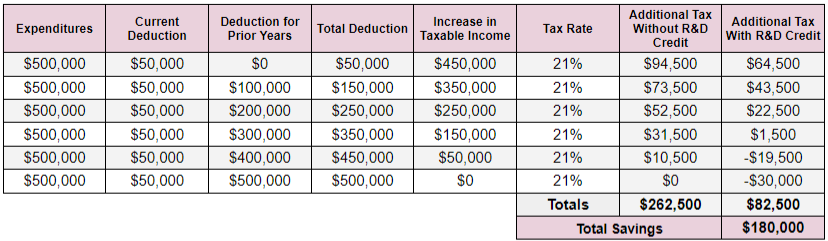
Table-1

Are you developing new technology for an existing application? Did you know your development work could be eligible for the R&D Tax Credit and you can receive up to 14% back on your expenses? Even if your development isn’t successful your work may still qualify for R&D credits (i.e. you don’t need to have a patent to qualify). To find out more, please contact a Swanson Reed R&D Specialist today or check out our free online eligibility test.

Who We Are:

Swanson Reed is one of the U.S.’ largest Specialist R&D tax advisory firms. We manage all facets of the R&D tax credit program, from claim preparation and audit compliance to claim disputes.

Swanson Reed regularly hosts free webinars and provides free IRS CE and CPE credits for CPAs. For more information please visit us at www.swansonreed.com/webinars or contact your usual Swanson Reed representative.

IRS Guidance on Amending Returns for R&D Tax Credit

bigstock Businesswoman presenting to co BW o

The IRS issued a Chief Counsel memo in fall 2021 outlining specific information now required when amending a tax return to include the R&D tax credit. This supplemental information will be used to aid the IRS in expediting their review process of amended returns.

This new requirement for supplemental information impacts any taxpayer planning to amend their tax return for an R&D tax credit after January 10, 2022. If the IRS finds the information provided deficient, the credit claim could be denied.

Previously, amended returns were treated similarly to timely filed returns, wherein taxpayers would only need to provide supplemental documentation upon request. 

The supplemental documentation is to be included in the amended tax return to be reviewed by an IRS agent upon submission. If the claim were to be found deficient, the return would be denied. The taxpayer would then have 45 days to perfect the claim and resubmit it to the IRS.

What is a Valid Tax Credit Claim?

In order to be a valid claim, as defined by the IRS, Taxpayers must:

  • Identify all the business components to which the Internal Revenue Code (IRC) Section 41 research credit claim relates for that year.
  • Identify all research activities performed for each business component.
  • Name the individuals who performed each research activity.
  • Describe the information each individual sought to discover.
  • Provide the total qualified employee wage expenses, total qualified supply expenses, and total qualified contract research expenses for the claim year. This may be done using Form 6765, Credit for Increasing Research Activities.

Additional Details and FAQs

  • Transition Period
      • The IRS extended the transition period to January 10, 2024. During the transition period, taxpayers who file an amended tax return for an R&D credit claim will be allowed 45 days to perfect their claim if the IRS finds the initial filing deficient.
      • After this transition period closes, credit claims that are denied can’t be fixed or appealed.
      • Taxpayers will not receive any refunds for the credits they attempted to amend.
  • What is “Perfecting a Claim for Refund?”
      • Perfecting a claim means taxpayers have the opportunity to provide missing information to process the R&D credit claim.
      • The IRS will notify taxpayers of a deficient claim and provide a maximum of 45 days to perfect the claim. The letter sent to the taxpayer will include the date by which the taxpayer must provide the updated claim.
  • Does supplementary documentation need to be submitted if a claim isn’t being amended for a refund?
      • No. If an R&D credit is submitted on an amended tax return that doesn’t result in a refund to the taxpayer, the supplementary documentation for the claim doesn’t need to be submitted with the amended tax return.
  • What’s the preferred method to provide missing information to the IRS?
      • The IRS noted that the best way to provide missing information for a deficient claim is by fax to a designated number. You can also send information by mail.
      • As of publication date, the IRS planned to have amended tax returns with R&D credit claims reviewed and processed within six months of receiving the amended tax return.
  • Pass through entities
      • If a claim for refund that includes the Research Credit is based on a Research Credit from a BBA partnership, the BBA partnership does not file an amended return.  Instead, the BBA partnership must file an administrative adjustment request (AAR) and attach the five items of information to that AAR.  As part of the AAR process, the BBA partnership will also submit Forms 8985 and 8986 to the IRS and send Forms 8986 to its partners.  The BBA partnership is not required to provide the five items of information again on the Forms 8985 and Forms 8986.  The BBA partners do not need to attach the five items of information to their original returns to which their Forms 8986 are attached. 
      • If a claim for refund that includes the Research Credit is based on a Research Credit from a non-BBA pass-through entity (such as a TEFRA partnership, S corporation, or other non-TEFRA/non-BBA partnership), the non-BBA pass-through entity may include the five items of information with its amended return. Partners or shareholders are required to include the five items of information with their amended tax return claiming the Research Credit.  Partners or shareholders should receive the five items of information from the partnership or S corporation in which they are a partner or shareholder, for example, in the form of an amended Schedule K-1 (and any statements attached thereto).
  • What if you e-file an amended return?
      • Taxpayers who e-file their amended return claiming a refund involving the R&D tax credit are still required to provide the five items of information with their e-filed amended tax return.
  • Statistical Sampling
    • Revenue Procedure 2011-42 provides guidance to taxpayers on using statistical sampling.  
    • If taxpayers utilize a statistical sample to compute their Research Credit, the documentation for all units in the sample must contain the first four items of information and must be provided with the claim for refund.  
    • Taxpayers utilizing a statistical sample to compute their Research Credit are still required to provide the total qualified employee wage expenses, total qualified supply expenses, and total qualified contract research expenses, as computed pursuant to Rev. Proc. 2011-42, for the claim year with the claim for refund.

Additional questions have been answered in an FAQ released by the IRS.

Are you developing new technology for an existing application? Did you know your development work could be eligible for the R&D Tax Credit and you can receive up to 14% back on your expenses? Even if your development isn’t successful your work may still qualify for R&D credits (i.e. you don’t need to have a patent to qualify). To find out more, please contact a Swanson Reed R&D Specialist today or check out our free online eligibility test.

Who We Are:

Swanson Reed is one of the U.S.’ largest Specialist R&D tax advisory firms. We manage all facets of the R&D tax credit program, from claim preparation and audit compliance to claim disputes.

Swanson Reed regularly hosts free webinars and provides free IRS CE and CPE credits for CPAs. For more information please visit us at www.swansonreed.com/webinars or contact your usual Swanson Reed representative.