R&D Spending Trends Among the Global Innovation 1000

Workers Copy e1457330028575

R&D Spending Allocation Trends

Strategy & Business conducted a study, Global Innovation 1000, of the top public companies spending the most on R&D to strengthen their brand from 2010 to 2015. The study found that while overall R&D spending is increasing, the total research and development allocation is shifting towards increased research and development of software offerings.

Why Shift Towards Software?

As software capabilities are rapidly developing there are increasing opportunities to develop product offerings to include additional features catering the demand for advanced services and technology. Popular examples of these developments include embedded software such as sensors and new features or network software connecting systems and communication between products, programs and people.blog
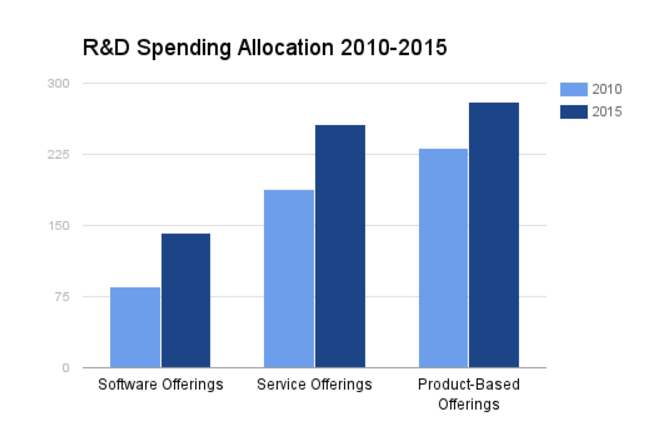
In analyzing the shift, a 34% rise in overall research and development spending was recorded at US$680 with a 65% increase in software R&D, a 36% rise in service R&D and a 21% rise in product-based R&D spending despite the fall of product-based in allocation share. This data is displayed in the chart. *Data from Strategy&Business Global Innovation 1000  

Growth in software research and development is expected to continue engaging 77% of surveyed companies by 2020 from 30% in 2015. The study also concluded that companies investing larger percentages of R&D into software are growing at a higher rate than competitors investing less. Strategy & Business goes on to suggest that investment in software offerings appears to maintain company growth fairly independently of macroeconomic fluctuations assuring growth in successful R&D.

As supported by the research and development tax incentive, R&D spending as a whole is expected to continually increase. If  you would like to discuss the R&D Tax Incentive further, please do not hesitate to contact one of Swanson Reed’s offices today.

Is R&D A Valuable Measurement of Innovation?

Preparation Pointers from Swanson Reed

The Relationship Between R&D and Innovation

It is well known that when performed effectively research and development (R&D) can increase the value of a company. However, Forbes writes that this is commonly misconstrued as it has been claimed that research and development spending directly translates to a measure of innovation. While R&D and innovation do correlate, they are not a perfect formula.

Tendayi said, “having a great R&D process and achieving market success with technologies we invent are two different things.” He goes on to suggest that R&D spending may be an effective measure of best practice within a particular industry.

In gauging the correlation between R&D and innovation rankings, the 2016 report of the Top 10 Innovative Companies provides the perfect example. Five of the ten ranking innovative businesses were also ranked in the top twenty for R&D spending in 2016, while the remaining five spent between $4.5 to $0.7 billion US dollars. Effectively, this demonstrates the necessity for research and development within innovation, as all 10 of the raking companies invest largely in R&D, however, it also demonstrates that spending was not the solo contributor to innovative success.

What is the Perfect Formula?

A successful company is capable of marrying innovation with market understanding. As Forbes explains, effective innovation solves for both technical and market risk factors. This is often left behind in lab based companies where business models are overlooked.

According to Forbes entrepreneurial expert, the formula for success continues to fund research and development programs that meet industry standards while implementing a strong invention to market management process making the improvements and inventions accessible on the market.

If  you would like to discuss the R&D Tax Incentive further, please do not hesitate to contact one of Swanson Reed’s offices today.

Trump’s Proposed Tax Reforms

shutterstock 92766073

After a dramatic election season the proposed tax reforms of US President Elect, Donald Trump, are currently a topic of great interest for businesses. While pre-election reform plans may not necessarily become legislation, Trump will be supported by Republican chambers of commerce, making passing legislation more likely in absence of strong opposition.

How Might This Affect R&D?

In an attempt to decrease corruption due to the influence of special interests, Trump plans to eliminate special interest outlays and most business tax credits such as the domestic production activities deduction and the work opportunity credit which currently supports veterans among other groups. These points are controversial as many of the expenditures he proposes to eliminate relate more to public policy concerns than they do to special interests.

However, one positive position maintained through Trumps reforms is the continuation of the Research and Development (R&D) tax credit. This influences greater innovation and improvement of existing systems or processes within industry. As Trump promotes the repatriation of labor and production, an increase in R&D support could be a possibility. Some predict that Trump may use the incentive as a maner of influencing larger percentages of manufacturing, not just research, within the U.S.

If  you would like to discuss the R&D Tax Incentive further, please do not hesitate to contact one of Swanson Reed’s offices today.

The Secret Ingredient to Craft Beer Growth

bigstock Whiskey And Natural Ice 80724569

The market for craft beer has been growing steadily since the late 1990’s. As of 2015 craft brews dominated 12% of the beer market by consumption and 21% by spending. In comparison with other high end beverage markets, craft beers potentially have plenty of room for growth as specialty coffee and spirits typically control 40% of market share.

While the US now has over 4,600 craft breweries, some industry experts have noticed a tendency for brewers to focus on production, leaving brand improvement activities to the side. The 0.2% drop in total U.S. beer market in 2015 spoke to the consumer desire for fuller flavor. This drop occurred as spirits and wine absorbed the market share of wavering beer drinkers. As consumers move away from cheaper, less flavorful beverages craft brewers are able to charge for quality. We see this as a hopportunity!

Experts recommend for craft brewers to perfect brews and production while simultaneously developing brand strength through R&D to remain competitive in a growing market. Many companies immediately consider their operations ineligible of claiming R&D, however, activities such as production line redesign and brew recipe innovation can be considered eligible. 

In the first few years of development many SMEs (small to medium enterprises) are in crucial need of cash flow in order to solidify their position in the market.  During this time receiving returns on R&D through the Research and Development tax incentive support the growth of an entrepreneur.

If  you would like to discuss the R&D Tax Incentive further, please do not hesitate to contact one of Swanson Reed’s offices today.

Worldwide Innovation Leaders Come Together Over AI

banner wassertechnologie o

Tech leaders Google, Facebook, Microsoft, Amazon and IBM have joined forces to form the Partnership on Artificial Intelligence to Benefit People and Society (Partnership on AI) announced in September.

Just as the name suggests the organization will carry out research and development on artificial intelligence with the fundamental purpose of identifying potential AI challenges for people and society. The partnership hopes that their discoveries will effectively self-regulate the industry independent of government intervention.

Why Be Apprehensive of AI?

Artificial intelligence has enabled major improvements in areas such as manufacturing and transportation, as well as education and healthcare. Despite these developments many people are increasingly uncomfortable with the idea of increasing intelligence in machines designed to think and problem solve independently.

Among experts in the industry, the concern is that these intelligent machines will continue to learn from their environment, eventually outsmarting humans. Two of these people are Elon Musk and Stephen Hawking – both who have warned of the destruction of the human race. Nick Bostrom, a professor at Oxford, believes these machines will supersede humans within decades.

Goals of the Partnership on AI

LeCun, Facebook’s AI research director, has said, “We aim to push new boundaries every day, not only within Facebook, but across the entire research community. To do so in partnership with these companies who share our vision will help propel the entire field forward in a thoughtful responsible way.”

Designated areas of research highlighted in Business Insider include;

  • Ethics, fairness and inclusivity;
  • Transparency , privacy and interoperability;
  • Collaboration between people and AI; and
  • Trustworthiness, reliability and robustness of technology.

The interview also included an eight point plan to benefit and empower as many people as possible, actively engage stakeholders and the public, open research to dialog, address challenges and maximize benefits, allow information to be interpretable and accessible, and to create a beneficial culture of openness.

The partnership has agreed to include academics, non-profits and other organizations such as Open AI, AAAI and AI2 in their research and findings.

Research and Development Tax Incentive

While we know many of our readers are most likely not performing research and development with Elon Musk or developing dogs with artificial intelligence, you may still be eligible to receive benefits from the R&D tax incentive.

Many companies deem themselves ineligible before reading the requirements.

If  you would like to discuss the R&D Tax Incentive further, please do not hesitate to contact one of Swanson Reed’s offices today.

How R&D Spending Correlates to Innovation

bigstock Innovate Innovation Technology 121664084 e1464053317686

From 2015 to 2016 North America increased R&D spending by 8% rising close to $300 Billion as Europe, Japan and the Rest of the World fell by 9%, 8% and 3% respectively and China rose by 19%. Many of  2016’s Most Innovative Companies invested over $8 billion in R&D (research and development) this year as calculated by Strategy & Business.

Apple and Alphabet, formerly known as Google, have maintained first and second in innovation since 2010 increasing R&D spending from $1.3 and $2.8 billion in 2010 to $8.1 and $12.3 billion in 2016.


2016 Top 10 Innovative Companies – Strategy & Business

Company Geography 2016 Innovation Rank 2016 R&D Spending Rank 2016 R&D Spend ($Bn)
Apple United States 1 11 8.1
Alphabet United States 2 4 12.3
3M United States 3 1.8
Tesla Motors United States 4 0.7
Amazon United States 5 3 12.5
Samsung South Korea 6 2 12.7
Facebook United States 7 4.8
Microsoft United States 8 6 12
General Electric United States 9 4.2
IBM United States 10 5.2

* Unfilled Spending Rank signifies company ranked lower than 20th

* R&D spend data is based on most recent full year figures reported prior to July 1st – Strategy&


As displayed by the recorded spending not all Top 10 Innovative Companies of 2016 were ranked in the Top 20 for R&D Spending in 2016, however, each company did perform R&D.

Innovation is supported within the cultures of these leading companies in part by the support of the United States. The research and development tax incentive seeks to foster innovation and growth making R&D possible for SMEs as well as large corporations.

Read about eligibility to find out if you qualify for the R&D Tax Incentive.

If  you would like to discuss the R&D Tax Incentive further, please do not hesitate to contact one of Swanson Reed’s offices today.

U.S. R&D Employment

laboratory 1149152 1920

Research conducted by the National Science Foundation discovered that in 2013, 1.5 million workers inside the U.S. were employed for R&D (research and development) purposes meaning they provided direct support or worked directly on R&D. Those 1.5 million constituted 1% of the U.S. workforce.

The research also found that smaller companies were more likely to support a greater percentage of R&D staff than larger companies. This is due to the innovation, startup and small business atmosphere that is fundamental to the structure and success of these small companies. Larger companies employ roughly 6.5% R&D members where small businesses employ almost double at about 11.7%.

The largest R&D employment industries in 2013 were:

  • Semiconductor and other electronic components (32.4%);
  • Software publishers (25.4%); and
  • Pharmaceuticals and medicines (18.8%).

Within these industries alone the R&D workforce was calculated as two-thirds of the 1.5 million U.S. research and development employment population.

Despite the large scale research and development performed within the U.S., many companies are still foregoing the opportunity to receive the tax break provided through the R&D Tax Incentive, which was created to support innovation and development. In many cases companies do not claim due to a lack of knowledge regarding eligibility.

If  you would like to discuss the R&D Tax Incentive further, please do not hesitate to contact one of Swanson Reed’s offices today.

Should the United States Enact a Patent Box?

Innovation Success Globe

Should the United States Enact a Patent Box?

Swanson Reed has recently written an article for the Tax Advisor outlining the facts surrounding the U.S enacting a Patent Box.

Many countries have enacted patent box systems as they attract innovation by reducing the tax rate on income from intellectual property assets, whilst maintaining economic advantage and enable countries to compete with low-tax jurisdictions.

What exactly is a patent box?

A patent box is a preferential tax system that allows companies to elect a reduced rate of corporate tax on income derived from qualifying IP assets. The economic theory behind this is based primarily on two factors: market failure and increasing global tax competition. Patent boxes reduce the cost of this spillover by increasing the potential profit of innovating, and thus they increase the incentive to develop new products.

As such, a patent box complements R&D tax credit systems by creating tax incentives to spur the commercialization of research outcomes. As stated in a 2013 Organization for Economic Co-operation and Development (OECD) report, “International cooperation should extend . . . to . . . statutory policies for supporting R&D through tax credits and patent boxes.”

Should the U.S enact a Patent Box?

Despite seeing more companies move assets to these other tax jurisdictions, the United States has not yet enacted a patent box system. However, a patent box has been considered in the United States previously when the Treasury first formally considered the concept in 2007 following reports that American multinational corporations had greater incentive to exploit a patent overseas.

The Manufacturing Innovation in America Act of 2012 (and another attempt in 2013) was introduced to amend the Code to allow a taxpayer to elect to deduct the lesser of 71% of the patent box profit or taxable income for the tax year. However, the legislation failed to gain traction.

Moreover, in July 2015 Sens. Rob Portman, R-Ohio, and Chuck Schumer, D-N.Y., drafted legislation to provide a tax concession on intellectual property. They proposed an “innovation box”, which would cover cover patents, inventions, formulas, processes, designs, patterns, know-how, motion picture films or videotapes, and computer software. Furthermore, the proposal would also allow companies to bring overseas IP back into the United States, tax free.

A 2010 study found that the introduction of patent boxes in the Benelux countries (Belgium, Netherlands, Luxembourg) led to significant shifts in patent holdings toward those countries and away from other countries, and in the United Kingdom, patent registrations by German companies went up 27%. Furthermore, the patent box has appeared to be very successful in attracting economic activity in the United Kingdom.

The United States is considering following in its European cousins’ footsteps by introducing a patent box regime to make its tax system more competitive, incentivize domestic innovation and R&D, and create jobs. The idea of a U.S. patent box is not new, however, unlike when previous attempts were made, the current economic climate, and indications from the 2016 U.S. budget, are adding traction to the movement toward comprehensive tax reform.

Should the United States patent box be designed carefully and effectively, it could serve as a powerful complementary tool to existing R&D credits that curbs tax avoidance, boosts the commercialization of research outcomes, and bolsters domestic innovation.

Read the full article here for more information

If you have questions regarding this article please Contact Us

4 Items for Your R&D Eligibility Checklist

bigstock Focused On His Work 96991916 e1457332938677

Foregone Opportunities

The Research and Development (R&D) Tax Incentive was originally established in 1981 as a manner of encouraging businesses to seek innovation by creating new products and technologies or improving upon their existing products and processes.

Each year billions of dollars are claimed, offsetting the liabilities of investing in such research. However, many companies are foregoing the billions remaining in the budget due to a lack of knowledge regarding the tax incentive eligibility.

The majority of these companies are small and mid-sized businesses who may realistically need funds from their tax returns to maintain functionality.

Four Items for your R&D Checklist

Refer to the items below when considering your R&D eligibility.

1. Innovation

If you are revamping your product line, innovating your production capabilities, inventing new market technology or developing internal software you may be eligible for the R&D tax return.

Innovation is key as the information your R&D activities produce must be novel.

2. Uncertainty & Risk

Before initiating the R&D project there must be a question to which, at your current knowledge of the technology, you have no answer or no clear answer. You may have a hypothesis.

The uncertainty and risk involved in the research and development further proves the first point, that your development is indeed producing new knowledge.

3. Qualifying Research Activities (QRAs)

QRAs are the documented evidence of your research and development tasks.This can include anything from the plan writing involved in developing a novel product specific production line to the clinical testing involved in inventing an entirely new technology to detect disease.

Documenting these activities is necessary to substantiate the last item on our checklist.

4. Qualifying Research Expenses (QREs)

QREs go hand in hand with QRAs; these are the documented expenses tied to your research and development activities. Expenses are the labor directly associated with the development or management of development and supplies used during development.

Supporting Innovation

While your company may not be inventing the cure for aging, you may now have determined that the small anti-stick technology you developed for your caramel apple production line qualifies for the R&D Tax return.

If  you would like to discuss your eligibility for the R&D Tax Incentive further, please do not hesitate to contact one of Swanson Reed’s offices today.

The Wait is Over – Internal Use Software Regulations Finalized

Capitol Washington DC e1457327245880

The United States Treasury proposed new regulations regarding Internal Use Software (IUS) for purposes of the research and development (R&D) credit under Section 41 of the Internal Revenue Code on January 20, 2015. These proposed regulations were finalized on October 4, 2016, bringing the suspense to an end. The finalized regulations are very similar to those proposed which was not the only positive outcome. The definition of IUS for purposes of the Research Credit was clarified and the non-IUS definition extended, aiding taxpayers in determining eligibility requirements. The IRS also provided clarity on how dual-function software is treated and what type of internal software can still qualify for the Research Credit. The regulations were not introduced retroactively and taxpayers are not able to amend prior returns.


Overview of Clarifications of IUS

The finalized regulations provide a clear definition of IUS as software developed for general administrative functions facilitating or supporting the conduct of the taxpayer’s business. Generally these functions are administrative or general tasks required for the function of the business, and are not designed for client use.

They are defined in three categories:

  • Financial Management
  • Human Resources Management
  • Support Services

Software characteristics not qualified for the Research Credit:

  • Software offered for commercial sale, lease or licence, or otherwise marketed to third parties;
  • Software to enable a taxpayer to interact with third parties; or
  • To allow third parties to initiate functions or review data on the taxpayer’s system.

Any software developed primarily for any purpose described above is not considered to be IUS within the new regulatory definition.


The Consistency Rule

The finalized regulations require taxpayers who have previously claimed the research credit to adjust and recalculate their base calculations in order to claim research expenses under the newly defined, favorable regulations in current and future years’ returns. Taxpayers must perform two calculations;

  • One applying the new regulations for tax years after January 20, 2015; and
  • One for any returns amended for prior years by choosing between TD 8930 or Regulation 1.41 – 4(c)(6)


Dual Function Software

Dual function software is presumed to be software that has been designed primarily for a taxpayer’s internal use. However where a taxpayer can identify a subset of elements of the software that only enable to the taxpayer to interact with third parties or allows third parties to initiate functions or review data, that presumption does not apply. The portion of expenditure allocated to this subset only needs to qualify for the Research Credit under the less stringent four-part test.

Where this third party subset has been identified and their remains dual function software or a subset of elements of dual function software a safe harbor rule is applicable. This allows for a taxpayer to include 25 percent of the potentially qualified research expenditures associated with the dual function subset through meeting the four-part qualifying test, while the remaining 75 percent would have to meet the higher threshold of the innovation test below.

Safe harbor is applicable where such third party interactions are reasonably anticipated to constitute at least 10% of dual function software use. When changing focus from dual to IUS or the opposite, qualifying expenses are determined on a prospective basis according to the time of change in taxpayer intent.


Three Part Test for IUS

Qualification for IUS requires three core tests can be established:

  • Innovation Test – Measurable and objective, and should reduce the potential for controversy. Innovative software must result in cost reduction, measurable improvement such as speed or reliability.
  • Significant Economic Risk – reasonability test requiring detailed documentation and circumstantial consideration. Taxpayer must show commitment of substantial resources, uncertainty due to technical risk and degree of uncertainty.
  • Commercially Available Test – Analysis of whether similar software may be purchased, leased or licensed and used for the intended purpose without modification, satisfying the innovation and significant economic risk requirements.

In determining the eligibility of your research, speaking with a qualified and experienced professional will be highly beneficial. Many opportunities to claim the research and development incentive are surpassed due to the common mistake of assuming ineligibility.

Whether you are interested in eligibility, adjusting your base calculation or preparing a claim as per the released IUS Regulations, if  you would like to discuss the R&D Tax Incentive further, please do not hesitate to contact one of Swanson Reed’s offices today.