The Sky’s the Limit for Biopharma R&D

If you’re fascinated in the prospect of launching your R&D efforts beyond the bounds of Earth, then the Centre for the Advancement of Science in Space (CASIS) may be the one giant leap you need to make it happen.

Indeed, the final frontier of biopharma R&D is here as life sciences can now be taken to the cosmos. CASIS, the enterprise behind the concept, has the objective of encouraging companies and innovators to take their research to outer space. Apart from appealing to the budding Luke Skywalker’s among us, one may question why a biopharma company would go to the effort of sending their research all the way to the International Space Station (ISS)?

milky-way-984050_640Certainly, sending research on a mission to outer space is no humble task; however, the fact is that space research offers astronomical benefits for biopharma and life science firms. When it comes to actual drug innovation in space, biopharma companies can use the freefall atmosphere as a facilitator for an accelerated model of disease onset and progression. In specific, one of the chief elements that make investment most valuable for pharma and the life sciences is the capability to experience the microgravity environment. Weightlessness offers an accelerated foundation to observe changes to muscle mass and bone density, as well as the effect of drug candidates on their targets.

Hence, this can be extremely helpful when measuring bone loss and muscle atrophy in research. Dr Mike Roberts, the senior research scientist as CASIS, notes, “we’ve learned that some of those effects of that microgravity environment mimic diseases that affect us here on Earth … That loss of bone mineral density is similar to what we see as we age on Earth, the outcome of osteoporosis, our bones becoming more brittle …  It’s an actual opportunity to use that environment as an accelerated model of osteoporosis.” The same is true for muscular atrophy.

However, smaller companies may be disheartened by the hefty price tag of sending research to ‘infinity and beyond’. In relation to this, CASIS stresses that the service is not limited to the wealthiest entities in life sciences, rather CASIS is determined to help get deserving projects to space. Therefore, smaller companies who have relevant R&D that would benefit from the interstellar environment may be internally funded by CASIS.

Aside from internal funding by CASIS, companies engaging in this type of research may be eligible for the government research and development (R&D) tax credits. However, it is important to note that whether you are conducting research in outer space or keeping your feet grounded on earth, scientific research and development are critical ingredients for nurturing biopharma companies. If you’ve been involved in research and development within the biopharma industry, or any other industry, contact us today to find out if you’re eligible for tax savings.

Everything’s Bigger in Texas, Even Energy

In the dark of night, the clang of pans and plates going into the dishwasher is accompanied by the vibrating growl of a vacuum cleaner in the Lone Star State. To clarify, residents in Texas are waiting until the clock strikes 9pm to run their electrical appliances and unplugging before the sun rises at 6am. These odd hours of operation have surfaced due to wind farms in Texas generating so much energy that several utilities are giving power away for free during this time frame.

windmills-984137_640Texas, often most renowned for its lucrative oil and gas industry, is actually the largest wind power producer in the country. In fact, Texas’ wind power accounts for roughly 10 percent of the state’s generation and Texas runs its own electricity grid that does not connect to those that serve other states. Whilst offering free energy might seem like a rife for wasting energy from the hours of 9pm till 6am, the concept actually saves the utility company money in the long term. To enumerate, shifting usage away from peak hours equates to lower wholesale prices, reduces the need of having to construct additional power plants, and condenses the burden that an oversupply of wind energy places on the power grid.

As has been noted above, Texas runs its own electricity grid and the abundance of nightly wind power generated here must be consumed here. Wind blows most strongly at night and is inexpensive because of its profusion in Texas and relatively low maintenance cost. Once wind turbines are moving and have been built, upkeep does not cost much money and there is no need for fuel. Furthermore, wind operators have another advantage over other generators due to generous tax breaks, in specific, a federal production tax credit of 2.3 cents per kilowatt-hour that applies to every kilowatt of power produced.

Undeniably, Texas is one of the largest deregulated electricity economies in the country, making it better suited for innovation and easier for companies to create new incentives for customers. As Scott Burns, senior director for innovation at Reliant Energy stated “You can be green and make green.” Indeed, Texas is a unique power market that has the ability to take great strides in innovation for customers. If your company is operating in the Energy field and you have conducted research and development (R&D) activities to create innovative solutions or incentives, you may be eligible for the government’s R&D Tax Credit scheme. This does not necessarily involve experimenting in a white coat or conducting rocket science, rather, activities you may already be conducting may be eligible. Contact our qualified R&D Tax Specialists today to find out if you are suitable to apply for the tax savings.  We will happily conduct a feasibility study, at no cost, to find out if you could benefit from the credit. Make the most of this opportunity to invest in your research and development and watch your business continue to grow and evolve in an increasingly competitive market.

How Big Data Can Assist R&D in the Life Science Sector

test-214186_640Big data, most renowned for transforming customer-facing functions such as sales and marketing, is now extending to other businesses. In research and development (R&D), for example, big data is being adopted across a range of industries. Increasingly, companies are capitalizing on the big data movement to create competitive advantage and drive strategy to innovate, compete, and capture value. Life sciences, in particular, are at the forefront of utilizing big data and are using real-world data to inform and transform patient care.

Indeed, big data has become a cutting-edge topic in R&D and life science businesses as its potential to accelerate successful drug development becomes more widely recognized. Big data is essentially the collection of large pools of data that can be analyzed to distinguish patterns and make better decisions. Ultimately, it is predicted to become the foundation of competition and growth for firms, improving productivity and generating substantial value for the world economy by decreasing waste and increasing the quality of products and services.

In relation to R&D, companies who can employ big data will increase the productivity and efficiency of research and clinical trials in order to better exhibit clinical benefit and health consequences to researchers, internal stakeholders, physicians and consumers. Big data analytics are informing research and development to produce new technologies that create personalized patient care and treatment options.

Hence, the potential for big data to drive forward the era of personalized and precision medicines make it’s an essential part of a life science organization and their research and development plan. By optimizing innovation and improving the efficiency of R&D and clinical trials, big data can offer vast benefits to firms, in particular, life science businesses. Furthermore, if you have conducted R&D, your company may be eligible for the government’s scheme. In the United States, companies are granted R&D tax credits, which are tax incentives for performing qualified research (not necessarily successful) in the U.S., resulting in a credit to a tax return. If you want to learn more about R&D tax credits, contact a Swanson Reed specialist today for further information.

Does the United States Still have Its Innovative Edge?

eagle-323385_640Citing a dwindling economic growth to high unemployment rates and stagnant wages, pessimists argue that the United States finest days are in the past. However, are they correct in this assumption?



A new report from the Council on Foreign Relations, Keeping the Edge, claims otherwise. The report analyzes where the United States ranks in key dimensions of economic competitiveness. The findings reveal that on innovation, which upsurges living standards in advanced economies, no other country is close.

For instance, total US research and development (R&D) spending is higher as a share of the economy than since the 1960’s and, in absolute terms, no other country invests as much in R&D as the United States. In specific, at 2.8 percent of gross domestic product, the United States does spend heavily on R&D, however, major Asian economies – including Japan, Taiwan, and Korea – have ramped up R&D spending. In fact, according to the report, by 2020 China is projected to exceed the United States as the world’s largest R&D spender.

Moreover, the report highlights that of the top twenty universities in the world that generate the greatest consequences on scientific research, sixteen are in the United States. However, the report does find a red flag in the United States economic overview. Funding for public universities has struggled under exceptional financial pressure. If they are deprived of incentives or resources to perform high-risk but hypothetically high-impact research, scientists and academics are not as likely to produce transformative research. In light of this, the report concludes that where the United States deficiencies exist, is also where the government can have the largest part in guaranteeing the United States remains prevailing and innovative for decades to come by ensuring policies are put in place.

Nonetheless, the report reveals positive results in relation to the United State. In particular, the findings highlight that when it comes to scientific breakthroughs and commercial innovations, the United States is leading the way due to a heavy spend in research and development compared to other countries. If you have conducted research and development within your company you may be eligible for R&D Tax Credits. Contact us today to find out if you’re eligible.

Innovative Texas R&D: Could Temporary Tattoo’s Monitor Your Health?

Undoubtedly, at one point or another, we’ve all probably donned a temporary flag tattoo on our arm for the 4th of July or dabbled in being a pirate as a child by proudly displaying a skull emblem on our wrist. However, could temporary tattoos now be more than decorative body art and actually monitor our health?

Hospital patients, the elderly, and those with heart problems may soon be wearing temporary tattoos instead of heart monitors or pulse oximeters. In reality, patients won’t be wearing a skull or iron-man tattoo design, but rather a disposable patch that can track patient’s vital signs in a reasonably inexpensive way.

pulse-trace-163708_640The research, conducted by engineers at the University of Texas, has created a way of swiftly printing low-priced, wearable biosensors. Utilizing principles of 3D printing, the sensors can be printed on temporary tattoo-like material, which sticks on the skin for a week. The team’s aim is to incorporate multiple sensors onto a credit-card-size patch, which could wirelessly transfer vital signs to a doctor’s computer or smartphone. The patches could also track skin hydration, respiration rate and eye activity, and eventually measure oxygen saturation and blood pressure. This technology innovation could ultimately extend to a array of patients – from pregnant women to athletes.

In addition, the printing of the sensor only takes 20 minutes, creates little waste and doesn’t entail a special lab. Professor Nanshu Lu, who is leading the project, revealed she wants to get the cost down to as low as $1 per patch. Undeniably, Texas research and development such as this is fueling innovation in the economy and having profound effects on the way we face medical problems. Aside from Texas, total U.S. research and development (R&D) spending is currently higher than at any other time since the early 1960s (when the space program was initiated). Indeed, it would appear that companies are increasingly aware of how R&D can boost innovation and improve business processes. However, R&D isn’t confined to the medical field or has to equate to rocket science, if you are improving or modifying products or manufacturing processes, for example making a product greener or cheaper, you may be eligible for tax credits too.

In light of this, what effect could your research and developments have on the economy, your specific industry or even just your company? If you are conducting research activities you may be eligible for the government R&D tax incentive – contact us today to see if you qualify.

Is Big Oil Ready for Big Data?

pump-jack-848300_640Globally, the oil and gas sector continues to experience price volatility, however, is this current environment fueling opportunities for innovation? A new report, Innovating in a New Environment, launched by Lloyd’s Register Energy, couples expert knowledge with third party insights to provide data-driven findings on the role of innovation in the current and future oil and gas industry. Key findings in the report find the “digital oil field” brings an increased need for technology innovation and strong capabilities in data, statistics and mathematics joined with the traditional science and engineering skills.

While the environment may be creating circumstances for innovation, 76% of the study’s respondents reveal that the oil price has led them to slow down or terminate most innovation activities. In relation to this, the report highlights that stopping an innovative project today may assist the bottom line in the short term, however, it could weaken a company’s ability to discover and exploit new reserves of oil and gas tomorrow. Indeed, whether prices are high or low, the fact remains that there is a declining supply of ‘easy oil’.

Therefore, digital technologies could propose the greatest efficiency benefits to be achieved in a low oil price world with dwindling ‘easy oil’ levels. Digital technology can often be expedited upstream more hastily than other technologies and they have the benefit of being scalable at a comparatively low cost. Despite this, the oil and gas industry is no foreigner to data collection implements. For instance, sensors that generate data on deposits have been used in remote environments for well over a decade. Curtin University’s Dr. Evans believes data collection and analytics will overshadow other technologies in the industry and will be directed by a focus on cost-efficiency.  Ultimately, he reveals, “our ability to become lean and mean will come down to our ability to master data analytics.”

In the long term, oil and gas firms must continue to participate in innovation or are in jeopardy of losing competitive edge. As suggested by the report, oil and gas firms should look at new collaboration models to learn how other industries have completed more with less resources, utilized new technologies and employed ‘big data’.

Overall, a continual phase of low oil prices may disintegrate conservative attitudes towards innovation in the oil and gas industry. As the Innovating in a New Environment report revealed, focusing more on research and development, advanced data collection and data analytics, is becoming increasingly important in the current low oil price market. In this respect, lower oil prices may be a blessing in disguise for technology innovation in the  oil and gas industry, thereby transforming the industry’s approach in an enhanced manner that will assist its needs for short and long term challenges. Consequently, the R&D Tax Incentive can have a positive effect on assisting the oil and gas industry who are partaking in innovative activities.  If you believe your company is undertaking qualifying research and development activities, contact one of our specialists today to find out if you could benefit from R&D credits.

Where does the U.S. Rank in the Globalization of R&D?

Research and Development (R&D) spending is on the upsurge and the globalization of R&D has become common practice, latest evidence reveals. According to the 2015 Global Innovation 1000 study from Strategy&, R&D spending has rose 5.1 percent worldwide in 2015, the strongest increase in the last three years. The study, which looked at the 1,000 companies around the world that spent the most on R&D during the last fiscal year, reveals that R&D spending has shifted away from Europe in favor of Asia.

Consequently, what effect does this have on the United States? The study revealed Asia was the top destination for corporate R&D spending this year, however, the U.S. remains strong and ranks second in the report. Moreover, the U.S. retained the title as the number one location for innovation with total in-country R&D spending equating to $145 billion this year, up 34 percent since 2007. In addition, a trio of American-based companies, Apple, Google and Telsa, were ranked as the three most innovative in the world for 2015.

new-york-945240_640However, the U.S also exported R&D to lower-cost countries, particularly in Asia, which raised concerns from some about what effect this would have on the economy. The Strategy& report reveals that India and China were the destination of choice for U.S. exports, signifying a significant change from 2007 when the U.K. and France were the among the top destinations for U.S. exports. Although the U.S. has seen an increase in in R&D exports, the consequence was offset by the rise in imports. The largest advances came from imports from European companies, who have intensely invested in the U.S. and provided 63 percent of the U.S. R&D total in 2015.

In light of this, the study notes that European companies came to the U.S. due to the proximity to their markets and operations, for connections to technology and talent, and to take advantage of the U.S. culture of innovation. Despite being high-cost compared to Asia, the United States indeed offers an agile workforce and a flexible business environment, which are conductive to R&D functions.

As shown above, R&D spending is accelerating as exemplified by the largest year-over-year increase in figures within the last three years. As globalization increasingly becomes standard, companies around the world are reaping the benefits of conducting R&D. If you’ve engaged in R&D, you may be eligible for an incentive by the government called R&D Tax Credits – contact our team of R&D Tax Specialists to find out if you qualify.

Halloween Special: How Research is Busting Halloween Myths

night-995189_640Hollywood has taught us if we wish to conquer a vampire, one generally utilizes a cross, stake, or a string of garlic. However, there is one powerful anti-vampire weapon that few think to use: maths and research. Granted, Buffy or a crossbow might be slightly more enthralling, but a large number of academic research studies have enforced mathematical modelling to the theory of human-vampire co-existence.

Although mad scientists are a force of their own to be reckoned with in horror films, researchers in reality are examining popular myths to illuminate inconsistencies with the help of physics. One study in particular, Cinema Fiction vs. Physics Reality: Ghosts, Vampires, and Zombies by researcher’s Costas Efthimiou and Sohang Gandhi, presented a view of humanity’s future in the face of blood-thirsty vampires.

Firstly, Efthimiou begins with the assumption that a vampire feeds only once a month – a highly conservative assumption given any Hollywood vampire film. Each time the vampire feeds, the vampire population rises by one and the human population declines by one. Efthimiou hypothesizes that the first vampire appeared on Jan. 1, 1600, when the human population was 536,870,911. Hence there would have been two vampires and 536,870,910 humans on Feb. 1, four vampires and 536,870,908 humans on March 1, and so forth. This simple geometric progression reveals that with the vampire population accumulating geometrically and the human population diminishing geometrically, by the 30th month the human race would have been wiped out.

Consequently, Efthimiou notes humans cannot endure under these circumstances in the long run, even if our population was doubling each month. It would be impossible for human birth rates to outpace this, so our very existence refutes the presence of vampires. The typical zombie prototype, aka turning their victims into their own species, is comparable to vampires, thus the same mathematical logic applies. In contrast, a Norwegian study believes vampires are real and researched if vampires were repelled by garlic. As no vampires were obtainable for the study, leeches were used as a substitute. The results? Leeches much favor a hand seasoned with garlic to one without. Consequently, to ensure the imminent survival of the human race, the research article suggests tight constraints be placed on the use of garlic.

As we can see from the above analysis, research can assist with discovering inconsistencies in knowledge or evidence. From investigating vampires eating habits to researching a new product for your company, research can bridge gaps between theory and knowledge. Moreover, the US government promotes companies engaging in research and development activities by granting them tax credits and incentives.

So this Halloween we ask the question, are you missing a treat by ignoring Research and Development Tax Credits? Contact one of our Research and Development Tax specialists today to find out if you’re eligible.

From Cloning Cats to Treating Hyperkalemia: Texas’ Biotech Industry is Booming

10956870_647702642002706_617687347_nDomestic cats of the future could have more than nine lives, bringing a new meaning to the playful term, ‘’copycat’’. Although the act of cloning a domesticated animal is not a brand-new concept, in fact, the first cat was cloned in 2001 by scientists at the Texas A&M University. However, crazy cat ladies and gentlemen of the Internet may have a reason to rejoice, as new technology is venturing into the business of cloning household cats and dogs for high income customers. The firm behind the idea is ViaGen, a Texas-based biotech company specializing in animal cloning technology, gene banking, and what it calls ‘“pet preservation’.”

In other words, this translates into a customer being able to reserve their favorite pet’s genetic makeup as a way to recreate a copy in the future. But this technology comes with a hefty price tag – to clone a cat it costs $25,000 and a dog will set you back $50,000. However, that price is not including fees for consulting, visitation, or for the storage of your pet’s genetic material. Nonetheless, in the meantime our original fluffy friends will have to do as when the “’product”’ will be available to the general public is uncertain.

Aside from cat cloning, other Texas biotech firms are thriving and making impressive strides in innovation. For example, Texas-Based firm ZS Pharma doubled their stock price and boosted the company’s value above $1 billion in the span of a year. Investors are wagering that the FDA will approve the company’s debut drug, ZS-9, developed to combat hyperkalemia and control hazardous potassium levels.

Both the ZS Pharma and ViaGen cases illustrate the promise of a growing biotech industry in Texas. New technologies are expediting a biotech boom nationwide and a recent report by EY revealed that U.S. biotech companies raised a record $54.3 billion in capital last year and produced close to $15 billion in profits.

As we mentioned in our article yesterday, Texas is known more as the home to oil titans and the oil and gas industry is huge. However, low oil prices have dented venture capital activity in the energy sector. Despite this, there are still opportunities in the energy sector for savvy investors, for those attracted to private equity or for those who have the capacity to conduct research and development to create innovative solutions.

In contrast, biotech investments in Texas are on the upsurge and the industry is growing. A recent MoneyTree report reveals approximately $225.3 million has been invested in biotech in Texas in 2015 so far. In comparison to the energy sector, which has received just $67.9 million investment this year, the biotech industry is indeed going strong. In fact, there are more than 200 life science firms in North Texas alone, and around 1,200 regional firms engaged in the industry overall.

Certainly, Texas is making impressive developments in technology and the biotech industry is accelerating. Despite the industry traditionally being concentrated in San Francisco or Boston, the Lone Star State is making a name for itself as a region that cultivates innovation. Nonetheless, it is important to note that scientific research and development are critical ingredients for nurturing biotech companies. If you’’ve been involved in research and development within the biotech industry, or any other industry, contact us today to find out if you’’re eligible for the Research and Development (R&D) Tax Credits.

How R&D Can Transform the Oil & Gas Industry

From operating our vehicles to warming our homes, oil and gas is one the most commonly used and important commodities in the world. In 2014, oil provided approximately 38% of the world’s energy needs and is directly responsible for about 2.5% of world GDP. Indeed, oil and gas is a leading component of the world’s energy mix, a trend that will no doubt endure for many years to come.

However, in an increasingly technologically-driven world, the oil and gas industry is changing in two fundamental ways. Firstly, with majority of the world’s ‘easy oil’ already exhausted, the importance of utilizing sophisticated technologies to find and produce tomorrow’s hydrocarbons is becoming increasingly imperative. Secondly, high profile disasters such as Shell’s Brent Spar Incident in 1995 or the recent Deepwater Horizon accident (Perrons, 2014), has resulted in a significant shift in the expectations of the oil and gas industry in regards to safety, environmental stewardship and human welfare. Thus, in the face of these challenges, technology and innovation will play a pivotal role in the success or failure of the future of oil and gas firms.

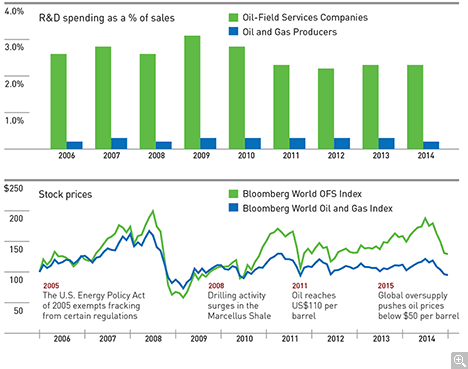
Generating the question, how can oil and gas companies succeed in an industry where supply is limited and expectations are high? One way is through investing in research and development (R&D) to drive innovation and create new and improved technologies. Certainly, one would expect that the economic rewards in an industry that is perceptibly more technology-driven would go to the firms that create most of the innovations – and, indeed, that seems to be happening.  Several international oil companies (IOCs) and national oil companies (NOCs) have increased their spending on R&D dramatically over the past years. In particular, oil-field service companies have greatly increased their investment in innovation which has correlated with higher stock prices, as seen below.

15201_ex1s
Source: Doshi, 2015.

Without a doubt, investing in R&D to create new and improved technologies is vital in enabling the industry to meet global energy demand. Moreover, with traditional forms of energy becoming harder to find, investing in new technologies will be critical in meeting the needs of an increasingly urbanised population and to combat environmental challenges in the decades ahead.

In addition, several companies may already be partaking in R&D activities and may not be aware of how the federal and state governments seek to support them by encouraging innovation through the Research and Development Tax Credit. Oil and gas companies are eligible for this incentive, which presently values at almost 10 billion dollars, for work activities that are often already being conducted. Many of these activities may not occur in traditional laboratories or are not usually thought of as ‘research’. Nonetheless, these undertakings entail time and money that may be defined as qualified research expenditures resulting in substantial tax benefits. Both large and small companies in the oil and gas industry are able to get the incentive – contact Swanson Reed’s R&D tax specialists today to see if you’re eligible.


References:
Perrons, Robert K. (2014) How innovation and R&D happen in the upstream oil & gas industry : insights from a global survey. Journal of Petroleum Science and Engineering124, pp. 301-312.
“Surviving the Worst: It’s Time for Oil Services to Address Shortcomings and Find Strategic Solutions,” by Viren Doshi, John Corrigan, Shawn Maxson, and Adrian del Maestro, Strategy& white paper, Feb. 2015, strategyand.pwc.com/OFS; Bloomberg; University of Michigan Center for Local, State, and Urban Policy.