Documentation Required for Filing the R&D Tax Credit

Collaboration Copy 1 e1455854558709

The R&D tax credit, worth approximately $7 billion annually in recent years, saw 17,700 corporations claim $6.6 billion in R&D Tax Credits on their tax returns in 2005 alone. Indeed, the many economic benefits of the R&D tax credit are well documented – however, just how well do individual companies need to keep their documents? Ultimately, clear and concise documentation of a company’s R&D is vital in ensuring eligibility for the R&D tax credit. Appropriate documentation may require changes to the company’s recordkeeping processes because the burden of proof regarding all R&D expenses claimed is on the taxpayer. Therefore, the company must maintain documentation to illustrate nexus between qualifying research expenses and qualifying research activities.

In our latest video tutorial, we provide a snapshot of the documentation that is required for filing the R&D Tax Credit.

Watch on YouTube: https://www.youtube.com/watch?v=6APM2KfeK9s

Documentation required for filing the R&D tax credit – SwansonReed


Learn the documentation that is required for filing R&D Tax Credit.
Visit: http://www.swansonreed.com to learn more.

Want more quick video tutorials like this?


Check out our series so far:


Swanson Reed is a specialist R&D tax firm and has helped many clients across a diverse range of industries. Contact us for more information on how we can advance your company’s market value and boost its bottom line through the Research and Development Tax Credit.

Can the R&D Tax Credit Counteract Deindustrialization?

factory

During the past 25 years, employment in manufacturing as a share of total employment has fallen dramatically in the United States and other advanced economies – a phenomenon widely referred to as “deindustrialization.” In fact, since 2000 alone, over 5 million manufacturing jobs have been lost. Indeed, the well-reported growth in employment in the service sector and the relative decline in employment in manufacturing industries implies to some a decrease in our industrial capacity. But precisely how can deindustrialization be defined? Does the shift to a service economy imply the erosion of an industrial base? Or is deindustrialization the result of national policies that did not anticipate the full extent and impact of the phenomenon of innovation and globalisation?

At its most basic level, deindustrialization is generally defined as the relative decline of the manufacturing sector. However, the challenge of industrialization in the 21st century differs in several ways from the experiences of developed countries when they initially industrialized in the 19th century, as well as developing countries that rapidly industrialized in the twentieth century.  One important difference is that many countries have in fact experienced deindustrialization in recent times. The challenge of industrialization in the 21st century is thus, in reality for many countries, actually a challenge of ‘reindustrialization’.

In response to this, a recent study from the Massachusetts Institute of Technology (MIT) suggests that efforts be made to maintain, and rebuild, the country’s manufacturing base. The researchers also call for efforts to be made to develop the country’s capacity for innovation, which they see as being closely interconnected with manufacturing. Likewise, the concept of creative destruction – the process of industrial mutation that incessantly revolutionizes the economic structure from within, incessantly destroying the old one, incessantly creating a new one – in developing countries highlights the role of economic policies.  A policy targeted at leveraging the innovative potential of the economy has shown to favor the rise of developing economies. In contrast, in the deficiency of economic policy – when the distribution of resources is surrendered to the market – or when economic policy is unsuitable, substitution activities have not been enough to compensate for the lost jobs and revenues.

In specific, policies targeted at increasing national research and development (R&D) activities are now a crucial component of national tactics to surge productivity, long run economic growth and international competitiveness in majority of OECD countries. The rationalization behind this objective depends on on two contentions. First, investment in R&D is a vital driver of long run productivity development. Second, deprived of government support firms will have an inclination to under invest in R&D comparative to the social optimum. To inspire higher rates of R&D, governments employ a assortment of policy instruments. Incentives delivered through the tax system are one of the most prevalent policy instruments which have swiftly gained widespread support.

Ultimately, the notion that R&D makes a big contribution to industrial innovation and competitiveness is prevalent among economists and politicians. The R&D Tax Credit offered in the United States, in particular, can provide companies with a legislative platform to allow them to offset the cost of innovation. Undeniably, innovation is a key driver in helping companies within the manufacturing sector deliver on strategic goals by setting the right products to market with speed and establishing significant competitive differentiation. However, the R&D tax credit isn’t limited to just the manufacturing sector – in fact, the credit is purposely broad to reward companies for increasing spending on R&D within the U.S. Fundamentally, the R&D credit is available to businesses that create new, improved, or technologically advanced products, processes, principles, methodologies, or materials.

Thus, as noted above, deindustrialization is not necessarily a symptom of the failure of a country’s manufacturing sector or, for that matter, of the economy. On the contrary, deindustrialization is simply the natural outcome of economic development. However, economic policies can play a large role in how a country responds to the notion of deindustrialization, or ‘reindustrialization’. In specific, the R&D tax credit offers an opportunity for firms to leverage the role of innovation and is a vital competitive factor for companies as it lowers the effective tax rate and can refuel R&D efforts through increased cash flow. Ultimately, the R&D tax incentive is an economic policy that is aimed at increasing the innovative potential of the economy. As divulged earlier, the existence of such policies can offset the threats deindustrialization and favour the emergence of growth in an economy.


If you would like to discuss the R&D Tax Credit further, please do not hesitate to contact one of Swanson Reed’s offices today.

Timing Issues for Texas R&D Tax Credit Claims

Calendar 600

It’s upon us: that time of year when we have to schlep through mountains of financial paperwork and rack our brains to remember major life events, minor purchases, and everything in between. Yes, tax season is officially here.

Indeed, as we edge closer to spring, we also get progressively closer  to tax day – April 15. Just like spring cleaning your home, now can be a good time to get your financials in order.

However, with tax day drawing near, it’s important to know what dates apply to your State in order to prevent overlooking deadlines. Therefore, in our latest short video tutorial, we divulge the timing issues for the Texas R&D Tax Credit claim process to prevent any delays or missed cutoffs.

Watch the on YouTube here: https://www.youtube.com/watch?v=QkdYQhlBeuQ

Or alternatively, watch below:


Swanson Reed is a specialist R&D tax firm and has helped many clients across a diverse range of industries. Contact us for more information on how we can advance your company’s market value and boost its bottom line through the Research and Development Tax Credit.

Texas’ Sweeping Startup Ecosystem

TX and USA flags

When the phrase “start-ups in Texas” is mentioned, the city of Austin is typically the first place that may come to mind. Indeed, Austin does have a thriving start-up culture, one that frequently ranks highly on voguish start up hubs list. However, merely 200 miles northeast exists one of the United States’ largest business networks, base to 18 Fortune 500 company headquarters and where 25 billionaires call home.

Dallas – whilst the mention of the city may conjure images of Dallas Cowboys, Cheerleaders, or even the popular film, Dallas Buyers Club – is the city set to have a new reputation as a prosperous start-up hub?

Indeed, from the peppering of “sir” and “ma’am” in sentences to chicken-fried steak as a menu option, it is hard to resist the sweet Texan drawl and dining options. But Dallas has other benefits, in particular, a burgeoning business scene. This is due to a favorable tax environment and a collective Texan “can-do” attitude. Moreover, the region alone vaunts a list of entrepreneurs who found their affluence in oil and gas, semiconductors and real estate.

In 2015 in particular, the Dallas entrepreneurial ecosystem has been bustling with activity. For instance, according to PitchBook data, Angel investors invested $213.5 million into 35 start-ups in the first nine months of this year.  That’s approximately three times last year’s total angel investments of $73.4 million in 42 deals. Thus, similar to Austin, a new generation of innovators, young start-ups and the digital savvy are putting North Texas on the world map as an innovation mecca, rivalling the likes of other cities such as Miami and New York.

However, it is important to note that Dallas is creating its own unique start-up ecosystem that is different from other cities. To begin with, the sheer size of Dallas, encompassing 9,200 square miles, indicates business is going to be conducted a little differently compared to the consumer-facing start-ups that inhabit tech hubs such as Silicon Valley.

In relation to this entrepreneur Craig Lewis, the founder of Dallas-based Visage Payroll, describes the evolution of Dallas. Lewis states, “It went from the cheerleading stage, where everybody said Dallas could be a start-up community, to you’re starting to see valuable companies form and people are getting legitimate pieces of funding; maybe not massive rounds but strong rounds. What’s more interesting is a lot of us are building strong businesses, substantive businesses in comparison to the fly-by-nights you see in other ecosystems.”

Thus, rather than paralleling Dallas with Silicon Valley or any other innovation mecca, entrepreneur Lewis labels it best, “We don’t have to do it like other start-up communities. We just need to be Dallas. There’s just one Dallas. Let’s just be the best Dallas we can be.” Furthermore, statistics such as the fact that Dallas is in the top 20 region for number of patents issued , has the 6th largest concentration of high tech workers in the U.S., and is the 5th largest metro in self-employment in the U.S.,  reinforce the idea that Dallas is indeed a suitable environment for start-ups.

Certainly, as this article reveals, the city of Dallas – aside from serving up niche food options and a friendly Texan attitude –  also propositions a business-friendly state. With a thriving start-up network that is growing, the innovation ecosystem in the state of Texas is flourishing. Moreover, the R&D tax credit can help put cash back into start-ups and several states, including Texas, offer businesses their own version of the R&D tax credit.  Individuals should take advantage of any R&D tax credits available at the state and federal levels as they can claim the credits concurrently. Contact us today to talk to a specialized R&D Tax professional who will be able to answer any questions you may have.

Examples of Qualifying and Non-Qualifying R&D Activities

2

As the cut-off for lodgement of R&D tax claims approaches, companies should now be turning their focus to the preparation and registration of their R&D tax credit claim for 2015. Nonetheless, the fact remains that there is still quite a bit of confusion around what can and cannot be claimed.

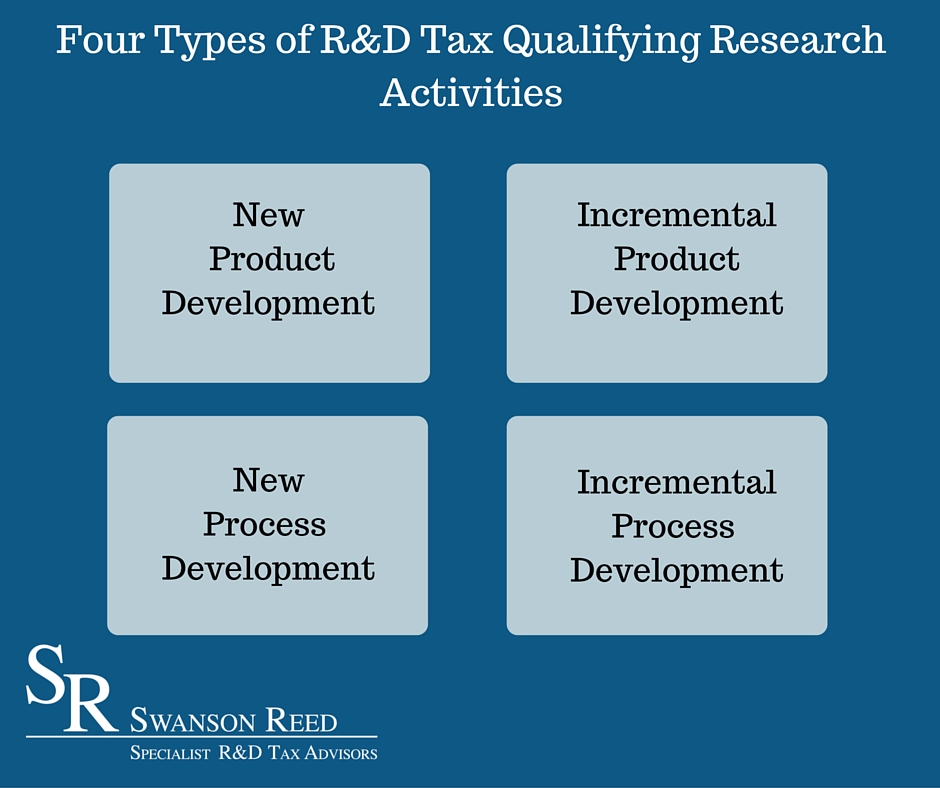
To begin with, qualifying R&D activities generally fall into one of four general categories (see infographic below).


In relation to the above, it is important to note that ‘new’ or ‘incremental’ is determined as related to an individual company, rather than the industry or the world.

Additional examples of qualifying activities include:

  • Design and development of new products – particularly products that are safer, more effective or have increased functionality, better performance or longer shelf life;
  • research of new applications for existing products;
  • testing for compliance with domestic or foreign regulatory requirements;
  • design, development and implementation of new reagents, testing methods or protocols;
  • product experimentation and modification to increase yield or decrease reaction times;
  • improvement of manufacturing or production technologies, processes, techniques or procedures to increase yield, reduce waste and byproducts, improve safety, improve energy efficiency or comply with regulatory requirements;
  • design and development of scaled-up manufacturing processes;
  • development of prototype pilot batches of new product candidates for testing and validation;
  • implementation of automated processes or robotics to increase production efficiency;
  • Software development or information technology initiatives related to product or process improvements; and
  • research to receive International Organization for Standardization certifications, fertilizer safety or other similar certifications.

When claiming for the R&D tax credit, the following activities are unlikely to have a link to R&D activities and thus considered non-qualifying activities. Typically, these activities would relate to general company operating expenditure that the company would undertake regardless of R&D activities.

  • routine testing or inspection activities for quality control;
  • development related purely to aesthetic properties of a product or packaging;
  • testing and qualification of production lines;
  • production line modifications which don’t involve technical uncertainty, i.e. trouble shooting involving detecting faults in production equipment or processes;
  • market research for advertising or promotions;
  • routine data collections;
  • research conducted outside the U.S., Puerto Rico or any possession of the U.S.;
  • research that is funded by a third party other than the taxpayer; and
  • any other activities that don’t meet all of the four tests previously outlined.

Undeniably, the rules and regulations surrounding the R&D tax credit may be bewildering for some. Hence, a company may wish to seek external assistance to help identity their R&D eligible activities. Many accountants are not acquainted with the ins-and-outs of the R&D Tax, thus you may wish to consider a consultant that specialises in the area. Swanson Reed specialises in the R&D Tax Credit – contact us today to discuss your eligibility and learn more about how the R&D Tax Incentive may benefit your business.

Capitalizing on ‘IoT’ in Manufacturing: How Important is Documentation?

bigstock Internet Of Things 88710083

Undeniably, majority of us are already familiar with a number of smart devices. Powerful, sensor-equipped smart phones, for instance, have brought an unprecedented level of connectivity to our daily lives. Likewise, the Internet of Things (IoT) promises to extend sensor technology to all sorts of objects, even those that are not usually associated with the term “smart”. From a pacemaker to a coffee machine, everything will be linked together through the Internet.

Thus, the burgeoning of this fully connected world represents a unique opportunity for innovation. Throughout the nation, businesses of all types and sizes are engaged in making the IoT a reality. In effect, according to IDC, the worldwide IoT market will grow from $655.8 billion in 2014 to $1.7 trillion in 2020. Furthermore, insights from the MPI Group‘s Internet of Things Study, reveal that 76% of manufacturers will increase their use of smart devices or embedded intelligence in manufacturing processes in the next two years.

However, are companies capitalizing on all the opportunities that IoT represents? Irrefutably, the very nature of IoT is intrinsically linked to innovation.  On the one hand, new products, novel business models, improved processes, and innovative interactions are bound to emerge. On the other hand, ground-breaking technological advances will be necessary before the IoT begins to realize its full potential. Either way, companies engaged in any type of IoT-related innovation may qualify for significant federal research and development (R&D) tax credits.

Nonetheless, despite approximately two-thirds of manufacturers believing that the IoT will increase their profitability, majority are actually lagging in maximising their IoT opportunities. Specifically, MPI Group’s insights highlight that manufacturing companies are overlooking substantial R&D tax credit savings.  In fact, the study reveals only 17 percent of manufacturers said they were planning to claim tax credits and incentives for their IoT investments, meaning most manufacturers (83 percent) are missing a critical opportunity. For those manufacturers not planning to claim credits and incentives for IoT investments, concern about the associated costs is identified by only 11 percent of respondents. Whereas nearly half (45 percent) of manufacturers say the reason for not claiming the credits is based on a lack of documentation.

Ultimately, manufacturers can address the cost and risk of research and development by leveraging the aforementioned federal, state and local tax incentives. Indeed, planning ahead by creating an infrastructure that identifies qualifying research activities and collects contemporaneous documentation is ideal in reducing future tax liabilities and synthesizing an R&D tax credit that will be sustainable on audit examination. However, although documentation is useful to support these credits, courts have ruled previously that oral testimony can be used to support them as well.  For taxpayers without detailed records, reasonable estimates based on the longstanding rule in “Cohan rule” may be allowed. Though, it is still preferential to always keep contemporaneous documentation in support of research activities.

In conclusion, the R&D tax credit is available to businesses that uncover new, improved or technologically advanced products, processes, principles, methodologies or materials. As noted above, the nature of IoT is inherently interrelated to innovation and many companies engaged in any type of IoT-based innovation may qualify for significant tax savings. While claiming the credit requires time, resources and expertise, it can also provide significant monetary and operational benefits to businesses. Nonetheless, the credit continues to be underused by qualified companies primarily because of a misunderstanding of qualification and documentation requirements for federal and state credits. Therefore, in this instance, it is best to contact that help of specialist R&D Tax Advisor to assist with your claim.

Swanson Reed’s R&D tax professionals are available to discuss the R&D tax credit – contact us today if you would like to know if your company now qualifies.

What are the State Credit Calculations Required for the R&D Tax Credit?

Blue office Building San Francisco rentable storage

In our latest short video tutorial, we provide an overview of the state credit calculations required for the R&D tax credit claim process.

Watch the video below, or alternatively watch the tutorial on youtube at: https://www.youtube.com/watch?v=yGfITa5tjQE


Swanson Reed is a specialist R&D tax firm and has helped many clients across a diverse range of industries. Contact us for more information on how we can advance your company’s market value and boost its bottom line through the Research and Development Tax Credit.

St Patrick’s Day Exclusive: The R&D Tax Credit for Beverage Innovation

bigstock Whiskey And Natural Ice 80724569

Each year on March 17th, the Irish and the Irish at heart across the globe observe St Patrick’s Day. What began as a religious feast day for the patron saint of Ireland has metamorphosed into an international festival celebrating Irish culture with parades, dancing, live music, beverages and food. Undeniably, for the creators and purveyors of whiskey, Guinness and green apparel, the day is indeed worth celebrating.

Nonetheless, festivity or not, the whiskey beverage industry may already be revelling due to a spike in popularity in recent years. In 2015 alone, U.S whiskey sales increased by 20% to $664 million, according to the Distilled Spirits Council of the United States. The steady rise of whiskey drinkers, aside from the Don Draper aspirants, is most likely due to more options being available in the market.

Essentially, the variant of alternatives available for the beverage comes down to an investment in research and development (R&D) to expand the products scope. Fortunately, federal and state governments offer R&D tax credits to beverage companies of all sizes to help offset the expenses of R&D.

To clarify, the R&D tax credit allows companies that perform eligible research to receive tax breaks on certain costs, as long as it was performed in the United States. However, the credits are often mistakenly assumed to apply only to the creation of a new product or package, but there are actually a number of ways in which beverage companies can qualify for research tax credits—including for activities that already regularly occur at the company. Consider the following examples:

Product:

  • Improving the taste, texture, or nutritional content of beverage formulations
  • Incorporating new or sustainable ingredients in a formula
  • Producing sample batches in a test kitchen or a pilot run

Processes:

  • Developing techniques that will reduce costs and/or improve product consistency
  • Redesigning processes to comply with new federal or state regulations

Packaging:

  • Creating new packaging to improve shelf life, durability, and/or product integrity
  • Reducing materials or using more environmentally friendly materials in packaging
  • Introducing new or alternative materials to improve packaging

Sustainability efforts:

  • Creating new methods for minimizing contamination, scrap, waste, and spoilage
  • Increasing energy efficiency of water, fuel, and utilities through the introduction of new technologies
  • Developing processes to convert waste to energy

Thus, from developing and testing the beverage formulation to improving the distilling process, the options for innovation in this field are ostensibly broad. However, it is an often overlooked fact that the expenditure incurred to bring these innovations to market is potentially available for a tax credit. On the whole, the R&D tax credit is a valuable tool for growing and improving products – whether that is for expanding the horizons of whiskey or growing innovation within your own businesses. Prompting the question, could an R&D tax benefit be the luck you need this St Patrick’s Day?

It is imperative, nonetheless, that businesses recognize what kinds of costs are eligible in order to maximize the credit so that appropriate records can be sustained throughout the year. Swanson Reed’s R&D tax professionals are available to discuss the R&D tax credit – contact us today if you would like to know if your company now qualifies.

Texas’ Growth in Small Business Fortifies Economic Diversity

bigstock Texas Star 84460247

Believed to be the engine of job creation in the United States, small businesses are fundamentally the basic building blocks of our economy. Their value and the role they play in our economy is often underestimated as, they are in fact, small. But the truth is there’s nothing minor about the impact they have on our financial state.

Take Texas, for example, where the plunging price of a barrel of oil has forced layoffs across the state. Despite the downturn of one of the State’s key industries, small businesses are still hiring workers at positive pace. In fact, Texas ranks fourth in the nation in jobs added by companies that employ fewer than 50 people. Dallas, in particular, observed the highest growth rate among major metropolitan areas – adding small business jobs at a 1.6 percent annual rate.

Essentially, these small employers are helping soften the blow of layoffs in the oil and gas industry brought on by low commodity prices. Considering that over 50% of the working population (120 million individuals) works in a small business, their survival and growth in hardship is indicative of Texas’ diverse and strong economy.

In addition, thriving small businesses also serve as a bulwark against the global economy as they rely less on overseas customers and focus more on local innovation. Furthermore, as a consequence of the downturn of the oil and gas industry in Texas, the need for innovation is burgeoning. Research and Development (R&D), plays a critical role in the economic growth of a country and essentially spurs the innovation necessary for a strong U.S. economy. Most notably, there is one policy that has allowed for the expedition of innovation and R&D in the United States and that is the R&D tax credit.

However, historically, many startup companies and small businesses were unable to benefit from the research credit due to operating losses or alternative minimum tax limitations.  However, in addition to making the research credit permanent, the Protecting Americans from Tax Hikes (PATH) Act added two new provisions that are effective January 1, 2016. These two provisions are designed to increase the number of startups and small to mid-sized businesses that can benefit from the credit. In our last post, we went into details of both of these two modifications to the credit.

It is imperative, nonetheless, that businesses recognize what kinds of costs are eligible in order to maximize the credit so that appropriate records can be sustained throughout the year. Swanson Reed’s R&D tax professionals are available to discuss the R&D tax credit and the changes in the new PATH Act – contact us today if you would like to know if your company now qualifies.

The Digitalization of the Workplace: Is Internal-Use Software Eligible for the R&D Tax Credit?

bigstock Cloud Computing Concepts 83855360 e1464053255289

In the era of the digital age, there are few areas of our lives which are not impacted by the use of technology. The business world, in particular, is moving faster and becoming more global, more mobile, and more digitized.  Ultimately, as technology advances, the digitalisation of the corporate workplace is inevitable.

As a result of this digitalization, many companies have internal-use software (IUS) systems in place. To clarify, IUS includes software that has been acquired, internally developed, or modified exclusively to meet the entity’s internal need. Nonetheless the question remains, can companies capitalize on the costs incurred in developing this type of internal software?

Traditionally, it was a grey area for companies seeking to qualify for the Research and Development (R&D) tax credit on the grounds of IUS. The hurdle to qualify was harder, with companies needing to pass the high threshold of the innovation test – a three-prong test where the taxpayer must prove that the software is innovative, the software development involves significant economic risk, and the software is not commercially available. Moreover, IUS had conventionally been sketchily defined by the IRS as anything that is not a third-party-facing or a commercially available product.

However, the recent change in regulations from the Department of Treasury clarifies and relaxes the IRS’ position over IUS – which is now defined as software that is developed by the taxpayer for use in general and administrative functions that facilitate or support the conduct of the taxpayer’s trade or business.

Moreover, the Treasury and the IRS have clarified that any software designed to interact with third-party customers may now forego the high threshold of innovation test, even if that software was not designed with the goal of selling, leasing, licensing or otherwise marketing it to unrelated third parties.

For years, taxpayers shied away from claiming a research tax credit for internal use software due to definitional uncertainty and the expense of defending software claims in an IRS examination.  Overall, the new regulations provide favorable guidance with a broader and more realistic definition of software eligible for the credit. Through enhanced clarity, companies can now have greater confidence when investing in software innovation.

Swanson Reed is a specialist R&D tax firm and has helped many clients across a diverse range of industries. Contact us for more information on how we can advance your company’s market value and boost its bottom line through the Research and Development Tax Credit.