The Joy of Spare Change: How Startups Can Benefit From the Overlooked R&D Tax Credit

piggy-bank-970340_960_720From finding a $20 note in your back pocket to discovering a gold mine of spare change lurking in the cushions of your sofa, undeniably, the act of finding money is exhilarating. Your mind wanders as you begin to envision the endless possibilities available to you and your new found money. However, in the back your mind, a lingering voice pries, “are there other saving opportunities I may be missing out on?’

As a startup you may be disregarding savings much more lucrative than an extra $20 in your bank account.  It goes by the name of the Research and Development (R&D) tax credit and this tax scheme can lead to serious savings on firm’s investments.

Historically, many startup companies and small businesses were unable to benefit from the research credit due to operating losses or alternative minimum tax limitations.  However, in addition to making the research credit permanent, the Protecting Americans from Tax Hikes (PATH) Act added two new provisions that are effective January 1, 2016. These two provisions are designed to increase the number of startups and small to mid-sized businesses that can benefit from the credit. In our last post, we went into details of both of these two modifications to the credit.

Nonetheless, there still remains uncertainty around who actually qualifies for the tax credits. Essentially, if you’re spending money on personnel and outside professionals to research a new product or platform, you’ll likely qualify for the credit.

From our experience as specialist R&D Tax agents, the most difficult aspect for companies is when it comes to accumulating all the research and development costs at the end of the year. Whilst most companies document spending, often companies don’t file costs for particular types of tasks. Thus, when the end of the year arrives, it can be problematic to gather and judge the actual research costs incurred.

As a result, the best action a company can take is ensuring an accounting platform is prepared to capture these costs as they transpire. In addition, in order to maximise the accumulation, a general knowledge of what type of costs are involved when claiming can go a long way. For instance, does an administrative assistant helping a computer programmer compile data qualify? The answer to that and similar questions depends on the business. Ultimately, the uncertainty surrounding the scheme highlights the benefits of talking to a specialist tax advisor. A specialist tax advisor can guarantee that you are taking the proper steps to ensure you don’t leave money on the table.

The only question you should be asking yourself now is, are you ready to discover your company’s hidden savings?

Contact Swanson Reed for more information on how we can advance your company’s market value and boost its bottom line through the Research and Development Tax Credit.

Understanding Small Business R&D Tax Credits

business-861323_960_720If your company is engaged in R&D of any variety, you may be missing out on generous tax savings. In fact, a common misbelief surrounding the R&D tax credit is that only large corporations qualify and that it’s too complex to apply for. Indeed, when it comes to claiming the R&D tax credit, far too often business sow the seeds of self-censorship.


However, new alterations to the valuable credit are making it easier than ever for startups and small businesses to benefit. To elaborate, thirty-five years after its original formation as a temporary provision of the tax code, the federal R&D tax credit was finally made permanent by The Protecting Americans from Tax Hikes Act of 2015 (“PATH” Act) in December 2015. Within the PATH Act, two new provisions were outlined which makes it more accessible for smaller businesses. As a result, we’ve broken down the key elements of the changes below.

How do the new alterations benefit startups?

The first new R&D tax provision will have an enormous effect on startups. Formerly, early-stage companies that were not producing adequate income to have a federal income tax liability could only carry forward the credit for use in future years. Beginning this year, eligible startups with less than $5 million in gross receipts can apply up to $250,000 of their R&D tax credit against their payroll taxes.

So now even if you don’t have a federal tax liability, the credit can generate instantaneous value for your business. Read more about the Payroll Tax Benefit with examples here.

How do the variations benefit small and medium-sized businesses?

The second provision is a positive update for shareholders of qualifying pass-through entities, such as S corporations, that have an Alternative Minimum Tax (AMT) liability. This modification allows eligible businesses with $50 million and less in gross receipts (based on a three-year average) to apply the R&D tax credit against the AMT liability. Ultimately,  this eradicates a huge obstruction that had prohibited many small businesses from obtaining the credit in the past. Read more about the AMT liability here.

Despite these positive changes to the R&D tax credit, claiming the credit remains one of the most challenging provisions of the tax code. Thus, it is recommended that businesses should consider engaging a tax professional with R&D tax credit expertise to help them qualify for and claim this beneficial credit. Swanson Reed has a broad range of experience assisting a vast range of industries. Contact us today to learn more about the R&D Tax Credit and what your tax savings could be!

Texas Boasts a Thriving Tech Sector

robot-507811_960_720The Lone Star State is traditionally identified for being big in size, but did you know it’s also a major technology hub? In fact, Texas ranks only second to California in number of technology jobs in America. Aside from popular firms like Google, Apple, Dropbox and Oracle — which all recently constructed or extended major campuses in Austin — nearly two dozen California tech companies also repositioned to Texas or opened outposts there since 2014.

Historically, between 1997 and 2000 during the pinnacle of the dot-com boom, the Bay Area was a net importer of Texans. To be specific, about 1,500 more households moved into the Bay Area from Texas than vice versa – supplying a supplementary $191 million (2015 dollars) in taxable income into the region.

However,  in the early 2000s the trend started to adjust, and Texas has been a net importer of Bay Area households ever since. From 2009 and 2012, as the recession was winding down and the second tech boom was accelerating, the region lost about 1,430 households to Texas, and nearly $390 million in taxable income.

Despite the fact that IRS data isn’t available beyond 2012, census statistics show that 24,600 more people moved from California to Texas in 2014 than the other way around. Notwithstanding a recent dip in energy-sector jobs, the state has three of the country’s five fastest-growing cities in 2014. Moreover, Austin — a landing hub for many Bay Area tech firms seeking to expand — grew more than any other big city in the United States, according to census data.

Ultimately, the move to Texas by companies from the Bay Area is supported by an infrastructure that nurtures education, research, and entrepreneurship. In addition, Texas companies, universities, and research institutions are national and global leaders in research and development in many industries, including electronics, medical, biotechnology, aerospace, advanced materials, and energy. The state also boasts a competitive State R&D Tax Credit, which can be used concurrently with the federal R&D Tax Credit.

Hence, for these technology companies that are involved with developing and researching innovative, new technologies, the credit scheme in Texas can add a layer of extra appeal.  Fundamentally, investing in R&D is a way of spurring economic growth and taking advantage of the opportunities technology has made available.

If you want to learn more about R&D tax credits at both state and federal levels, contact a Swanson Reed specialist today for further information.

A Basic Overview of the R&D Tax Credit Forms

bigstock savings finances economy and 82701587 e1457318413316

By now, you probably have a stack of tax forms from employers, banks, stockbrokers, lenders and more on your desk – or more likely, the kitchen counter.  Indeed,  you may not want to admit it, but tax time starts well before the filing deadline. Whilst the deadline isn’t til later in the year, important tax forms start arriving like clockwork in the mail in January.

Hence in light of this, we’ve produced a short video tutorial to provide a rudimentary overview of the R&D tax credit forms and share some helpful tips on how to fill them out.

Watch on YouTube: https://www.youtube.com/watch?v=V8sO5E4VFVQ


Swanson Reed is a specialist R&D tax firm and has helped many clients across a diverse range of industries. Contact us for more information on how we can advance your company’s market value and boost its bottom line through the Research and Development Tax Credit.


Obama’s Final Budget Seeks to Expand the R&D Tax Credit

barack-obama-1174489_960_720President Barack Obama checked off another “last” of his White House tenure on February 9th 2016, submitting his final budget proposal to Congress amid the growing buzz from the campaign trail. The budget proposes several investments to accelerate the pace of American innovation. In particular, it included several new ideas for expanding the research and development (R&D) tax credit.

Indeed, the new proposals came as somewhat of a surprise to many given the fact that only just last year the R&D Tax Credit observed changes. In December, Congress passed and President Obama signed into law the PATH act that not only made the R&D tax credit permanent but also contained several important improvements to the R&D tax credit – especially for small businesses and start-up companies. Nonetheless, the proposals put forward in the budget could have a positive influence on boosting and rewarding research and development if passed.

An overview of the Treasury Department’s new proposals for the R&D tax credit is as follows:

  1. Eradicate the traditional process for calculating the R&D tax credit;
  2. Rise the rate of the alternative simplified credit (ASC) from 14 to 18 percent;
  3. Reduced ASC rate of 6 percent for businesses without qualified research expenses in the prior three years would be abolished;
  4. R&D tax credit would be allowed to offset AMT liability for all taxpayers (at the moment it is capped at $50 million dollars average gross receipts over the prior three years);
  5. Contract research expenses would include 75 percent of payments to qualified non-profit organizations (e.g. educational institutions) for qualified research;
  6. The special rule for owners of a pass-through entity would be repealed; and
  7. The rule concerning amortization of 174 expenditures by passive owners would be repealed.

Overall, eliminating the reduced ASC rate for businesses without qualified research expenses will result in a significant increase in the credit for companies in their first three years of operation. Undeniably, the overall increase of the ASC rate to 18 percent is optimistic news for all companies engaged in innovative activities.

Ultimately, for the United States to be an attractive location for research and development this entails having a robust R&D tax credit. The provisions mentioned above would certainly expand the credit which would no doubt be welcomed by many businesses. However, compared to other R&D tax credits offered around the globe, the United States’ model remains one the most competitive.  The R&D tax credit fuels innovation which translates into new product development, job creation and increased productivity—three key factors necessary for growth in a global environment

Contact Swanson Reed for more information on how we can advance your company’s market value and boost its bottom line through the Research and Development Tax Credit.

How does the United State’s R&D Performance Compare to the Rest of the World?

Test Tubes Supersmall

new-york-945240_640Experts agree that research and development (R&D) is the backbone of a globally competitive, knowledge-driven economy. R&D investment helps develop new products and services that drive growth, create jobs, and improve the national welfare. For decades the U.S. government and private sector have spent more than any other nation on R&D. But that advantage is eroding as other nations increase public and private R&D investments at faster rate. In light of this, how does the United States R&D performance compare to the rest of the world?

The Organisation for Economic Cooperation and Development (OECD) provides an overview of several economies R&D performance.  As detailed by OECD, global R&D performance remains highly concentrated in three geographic regions: North America, Asia, and Europe. North America (United States, Canada, Mexico) accounted for 32% ($462 billion) of worldwide R&D performance in 2011; the combination of East/Southeast and South Asia (including China, Taiwan, Japan, India, South Korea) accounted for 34% ($492 billion); and Europe, including (but not limited to) European Union countries accounted for 24% ($345 billion). The remainder, around 10%, reflects the R&D of countries in the regions of Central and South America, Central Asia, the Middle East, Australia/Oceania, and Africa.

Despite more rapid growth overseas, the United States is still a scientific powerhouse. In fact, U.S. researchers are responsible for more publications in top scientific journals than any other nation, and account for nearly half of the top 1 percent of the most cited (PDF) scientific papers. In addition, forty of the world’s top fifty research universities are in the United States. Historically, the R&D/GDP ratio in the United States has ranged from 1.4% in 1953 to well above 2.8% in 1963–67 to an all time high of 2.9% in 2009. Overall, the ratio has generally been rising since 2004.

Hence, as noted above the United States performance in R&D continues to experience sturdy growth. Moreover, tax incentives like the Research and Development tax credit are one tool to encourage investment. In our blog yesterday, we provided an overview of how the United States tax credit compared to others on offer around the globe. Check out our infographic in our previous blog to get a more complete picture of international government support for business R&D.

Swanson Reed is a specialist R&D Tax firm with a broad range of experience assisting a vast range of industries. Contact us today to learn more about the R&D Tax Credit. 

A Global Evaluation of R&D Tax Credits

Around the globe, governments are increasing indirect support for business R&D, predominantly by the way of tax credits. For example, by 2011 almost 80 per cent of OECD countries had some form of R&D tax credits in place. In an increasingly global world, R&D investment by a government is believed to be a chief element in boosting skills, jobs and economic growth. As a result,  governments across the world have begun to recognize the attraction of tax benefits to spur more knowledge intensive industries and technologies.

Hence, how does the United States R&D tax credit scheme compare to others on offer around the globe?

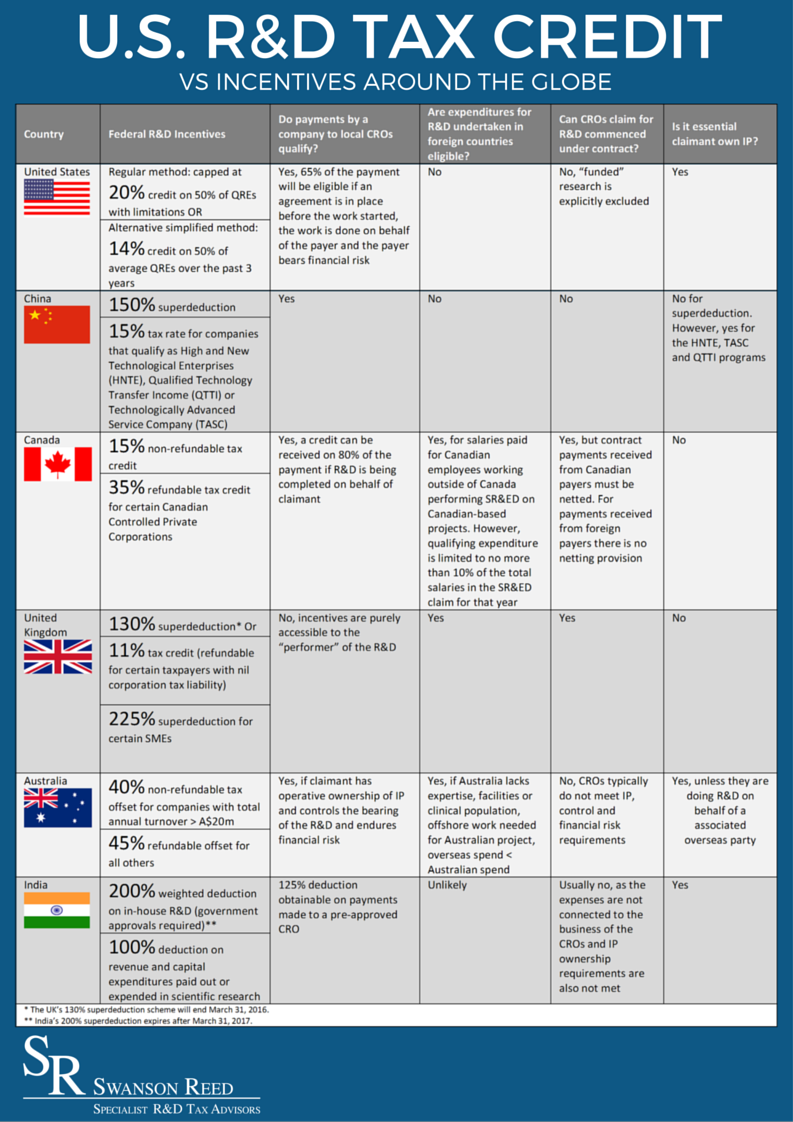
To answer this question we’ve compiled the table below to provide a more complete picture of global government support for business R&D.

U.S.-RD-Tax-Credit-VS-Incentives-Around-the-Globe-new

Overall, the United States does have a globally competitive R&D program. In fact, according to the OECD, the United States provided the largest volumes of tax support in absolute terms, followed by China and France. With R&D tax credits being worth US$8.3 billion in the United States. Ultimately, the R&D tax credit program offered in the US can expedite innovation through the development of products, processes and systems. Swanson Reed is a specialist R&D tax firm and has helped many clients across a diverse range of industries. Our specialists can identify and readily scope out the correct value of your claim. If you should be claiming, our R&D Tax specialists will help you write the technical justification, advise you on what does and doesn’t qualify, clarify what costs should be included and support any questions you may have. If you would like any more information on the R&D Tax Credit, please contact us today to find out more.


Timing Issues for the Federal R&D Tax Credit

bigstock Calendar Due Date And Calculat 81485162 e1457325978170

As the saying goes, life is about timing. Likewise, and not exempted from this adage, is the timing involved with applying for the R&D Tax Credit.

In our most recent video tutorial, learn the difference between calendar years and fiscal years (what drives tax reporting), filing dates, and timing issues for different types of corporations.

This is further discussed in our video below, or alternatively you can watch on YouTube at: https://www.youtube.com/watch?v=UnNe5aUSick 


Swanson Reed is a specialist R&D tax firm and has helped many clients across a diverse range of industries. Contact us for more information on how we can advance your company’s market value and boost its bottom line through the Research and Development Tax Credit.

How Research & Development has Shaped Valentine’s Day

valentines-day-1182252_960_720On February 14th around the globe, confectioners would have us believe that the way to the heart is through the stomach – in particular, with heart-foiled chocolate. However, how has research and development (R&D) helped shape this day into what it is at present?

As it turns out, chocolate actually has quite a rich history as a ‘love’ food. Passion for chocolate is rooted deep in Mesoamerican history and cacao beans consumption can be traced back to ancient Mayan in 500 A.D.. In fact, cacao beans were as valuable a commodity as gold, and were even used to pay taxes levied by Aztec rulers. Moreover, it was a highly-prized luxury item among Mayan and Aztec upper class elites. Montezuma, a one-time emperor of Mexico, allegedly always swigged a liquid chocolate drink called xocoatl before entering his harem to fuel his romantic trysts – touting it to be a natural aphrodisiac.

chocolates-491165_960_720Nonetheless, chocolate wasn’t always the delicacy we know and love today. Rather, Montezuma’s variety was hot, bitter and liquid. It was centuries before research & development assisted in learning how to make it into a solid treat. Daniel Peter, a Swede, was the first to add dried milk and produce the milk chocolate variety. However, it was Richard Cadbury, scion of a British chocolate manufacturing family, who “invented” the first Valentine’s Day candy box during the Victorian era in the late 1800s. Moving forward, the commercialization of Valentine’s Day flourished in America at the turn of the century.

From fair-sourced cocoa beans and sugar-free chocolate to understanding the health benefits of flavanols in cocoa – undeniably, chocolate has transformed over the ages thanks to R&D. Currently, there is even a start-up company in Spain that’s utilizing 3D printing for chocolate. On Valentine’s Day, customers can send a chocolate with their own portrait printed on it for their loved one to devour. Who said romance was dead?

Certainly, chocolate is universally loved and the global demand for it remains constant. Hence, it is to no surprise that research and development of new applications for this old flavor persist. On the whole, research and development (R&D) is a valuable tool for growing and improving products. Whether that be for expanding the horizons of chocolate, or growing innovation within your own businesses.

In addition, if you are conducting eligible R&D activities, you may be able to claim generous tax savings back on your investment. The government encourages businesses within the U.S. to do this by allowing business owners to offset research and development with R&D Tax Credits.  Although as noted above, you don’t need to be inventing new varieties of chocolate for Valentine’s Day – the IRS has a purposely broad range of industries which qualify for the credit. Moreover, businesses can take advantage of both state and federal credits and can claim the credits concurrently.  Contact us today to see if you are eligible to claim the R&D Tax Credit.

Which Industries Qualify for the R&D Tax Credit?

One of the major barriers for companies claiming the Research & Development (R&D) Tax Credit is self-censorship. However, it can often come as a surprise when businesses learn just how many different industries are in fact eligible for R&D credits. Ultimately, these federal and state tax credits offer a viable opportunity to transform R&D expenses (developing new or improved products, processes or software) to valuable R&D tax credits.

Undeniably, a common misbelief surrounding the R&D tax credit is that only large corporations qualify and that it’s too complex to apply for. Although with recent changes to the R&D Tax credit, start-ups and small and medium-sized companies now have an unparalleled chance to profit from this lucrative credit.

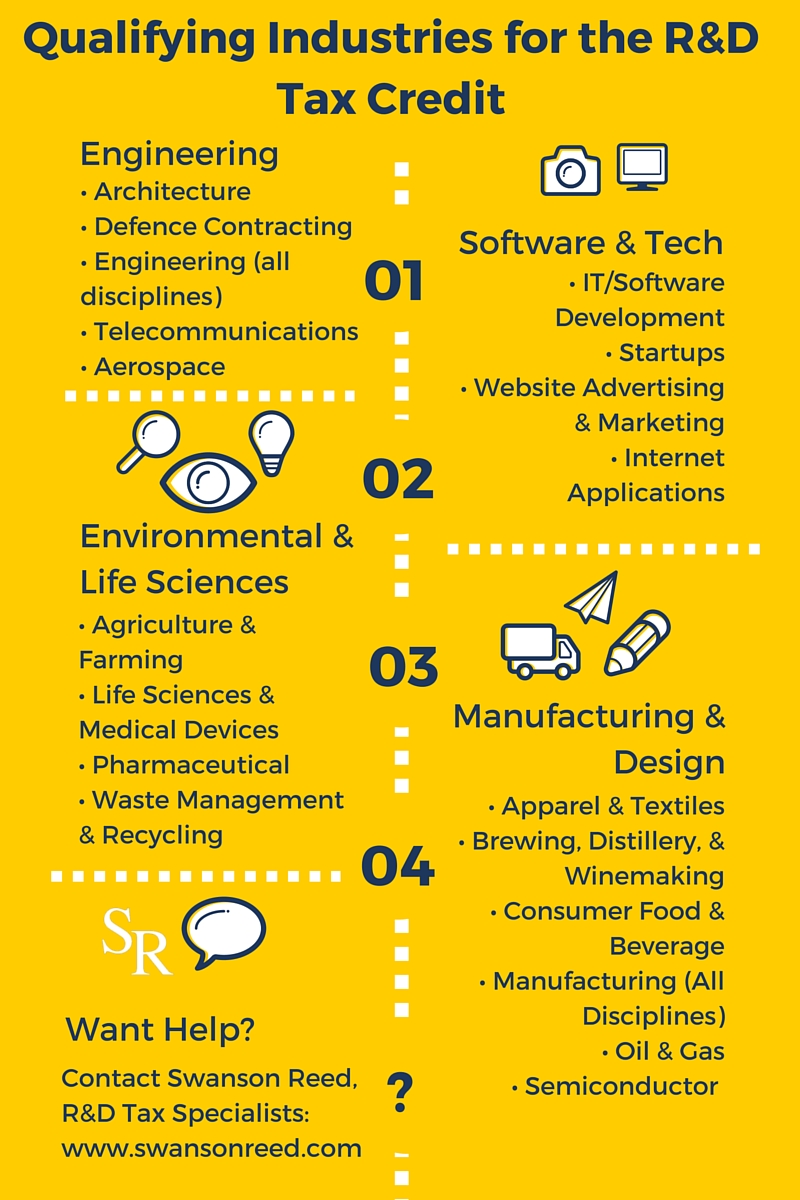
In light of this, we’ve put together an infographic which indicates which industries qualify for the R&D Tax Credit below. Alternatively, you can download the PDF to print or save here: Qualifying Industries for the R&D Tax Credit.

Qualifying Industries for the R&D Tax Credit (2)

Swanson Reed has a broad range of experience assisting a vast range of industries. Contact us today to learn more about the R&D Tax Credit and what your tax savings could be!