Electric Scooter Transportation On The Rise

street 238458 1920

By the end of 2017 the electric scooter market is expected to be valued at more than $8B with the market then jumping 3.9% to $12B by the end of 2027. Research and development (R&D) is being conducted in order to find the best hybrid scooter, and the most efficient way to charge the scooters, taking it from hours to minutes.

Charging stations producing a direct current need to be readily available, allowing scooters to be charged in less than an hour. Engineers are currently trying to find a way to provide direct current as opposed to alternating current being sourced from overhead grid lines. The nature of this project is eligible for R&D due to the experimentation relying on the engineering of these charging stations, and the increased performance of this transportation.

The sales of electric scooters made up 2% of the total number sold worldwide in 2015. In order for this to change these charging stations need to be readily available. With the help of R&D Tax Credits this can happen.

If you would like to check your eligibility for R&D, contact a Swanson Reed R&D Tax Advisor today.

R&D Tax Credit Opportunities within the 3D Printing Industry

prostetic 1273183 1920

3D printing is expected to grow more than 31% every year, surpassing $1.4 billion in revenue in the U.S. alone. Startup businesses have the opportunity to apply for research and development (R&D) tax credits if they are producing new or improved products or services, including the materials and software associated with 3D printing.

The most difficult task for a startup is deciding which business model to use, including their manufacturing model. Startups are tending to favour 3D printed products, as they are more responsive than traditional manufacturing methods – being readily customizable, with a fast turnaround time and low production costs. The large investment in 3D printing has resulted in huge progress over the recent years. However, it is widely recognized that there is still considerable progress to be made. The significant research and experimentation being undertaken in this industry means it is a prime candidate for R&D tax funding.

All businesses have the opportunity to apply for the R&D Tax Credit, which is backed by both the Federal and State governments. Now is the time for 3D printing businesses to take advantage of the possible 14% R&D Tax Credit. If your company is experimenting with new technology or products, contact a Swanson Reed R&D Tax Advisor today to see if you are eligible to claim.

Increase in R&D Activities Prove to Aid in Automotive Lithium Ion Battery Market

charger 2377021 1920

The automotive lithium ion battery market is showing steady growth, thanks in part to an increase in research and development (R&D) funds provided by the R&D Tax Credit.

Many countries are trying to lower their dependency on gas and diesel for transportation, and focus more on sustainable fuels. This has been driving companies to look to alternative sources of energy. However, until recently there has been little advance in battery technology due to high production costs and a limited availability of the rare materials required. But with the rise in popularity of electric cars, the global lithium ion battery market is expected to increase rapidly; and R&D credits are fueling their development.

Along with R&D tax credits, there are a number of other incentives that the government is providing for this sector. The Internal Revenue Service (IRS) are giving tax credits of $2,500-$7,000 per electric vehicle purchased in the United States. with some states also providing rebates (e.g. $2,500 in California, $1,000 in Delaware and $5,000 in Colorado) towards the purchase of an electric vehicle.

These government incentives and the growing consumer desire to use clean fuels will continue to drive the demand for electric vehicles; and subsequently the demand for improved lithium ion batteries. R&D credits will prove invaluable in helping companies overcome the high cost of developing and improving new battery technologies.

Although the electric car market is still in its infancy, the projected future looks very promising, thanks in part to R&D Tax Credits. If you would like to find out how your company could benefit from R&D Tax Credits, contact a Swanson Reed R&D Tax Advisor today for an assessment.

R&D Tax Credit Boosts Growing Material Handling Industry

industrial 1636403 1920

The demand for material handling and logistics industry has had a continued upward trend in today’s global world. The need for global supply chains and distribution of goods through advanced technology has employed over 700,000 in the material handling market, according to recent figures, and consumption greater than $156 billion in the U.S. In 2013, business logistics accounted for 8% of the U.S.’s GDP. This growth could accelerate with the Research and Development (R&D) Tax Credit. With recent legislative changes, the credit can now be claimed by more businesses and includes more eligible supply costs; a change that may increase a business’ claim by up to ten times.

What qualifies as “research and development” for credit eligibility? There are a number of qualifying activities, including developing material handling systems, designing robotic systems, manufacturing motor systems, or developing overhead material handling solutions, to name a few. The R&D Tax Credit is permanent and many states also have a similar credit which can be added to the federal claim.

Previously, small and medium businesses were often ineligible to claim the R&D tax credit due to the alternative minimum tax (AMT). At the start of the 2016 tax year, the AMT barrier was removed allowing all businesses to benefit from the incentive. Other regulatory and legislative changes have expanded the credit further, allowing companies to be rewarded for innovative solutions such as solving a technical problem on a factory floor or improving a distribution process.

Design improvements through automated systems and innovative technologies can pay off for companies who take advantage of the R&D tax credit. A material handling company which improved designs to an existing industrial system received $596,000 through federal and state R&D credits. These incentives help encourage companies to invest in automated solutions and advance the material handling industry.

If you think your company’s innovative solutions or designs could qualify for the R&D Tax Credit, contact a Swanson Reed Tax Advisor for a free assessment.


Income Boosts From Innovation Are Not Just For Laboratories

money


In an age of rapid change and modernization, hot words such as innovation, research and development, and growth are popularly thrown around. However, what many are still to realize, is the relation of innovation and companies that have nothing to do with lab coats.


Business Innovation quoted Martin Parkinson saying, “We tend to think of innovation as being done by start-ups or people in white coats, but it’s much more than that. By and large our greatest gains have come from building a culture that adapts and diffuses the ideas of others.”


Innovation is for everyone. In fact, Business Insider claims that, “innovation is good for income.” Innovation can be the adaption of a product manufacturing line to include newly redesigned technology or functionality. Innovation can be the development of new software technology that allows vehicles to autopilot completely, differentiating that company from the market. Innovation can be the research and creation of a new screening technology for cancer within the body.


Through the process of research and development (R&D), innovations can increase income when successfully applied. The world’s most successful and innovative companies are known for their large R&D programs turning innovation into business and revenue.


Business Insider reports that the majority of innovation stems from previously existing ideas that are then adapted and altered. For companies that are not yet profitable or for startups investing in R&D, the research and development tax incentive is a valuable tool.
If  you would like to discuss the R&D Tax Incentive further, please do not hesitate to contact one of Swanson Reed’s offices today.

R&D Within the Smartphone Industry

bigstock Focused On His Work BW e1456197707778

Reuters reported Apple’s commitment to invest roughly $44 million in a research and development center in Indonesia. The investment will allow Apple to begin selling the iPhone 7 as the government has stipulated 30 percent of handsets sold within the country must be made of local content which includes hardware, software or investment commitment.


Apple’s local content certification received in November allows the company to begin selling the iPhone 7 as of January 2017.  The agreement allows Apple to sell products of $488 (6 million rupiah) value and above.


As said by Suryawirawan, director general of metal, machines, transport equipment and electronics at the industry ministry, ” they can distribute devices priced 6 million rupiah ($448) and above. That means all iPhones can be distributed.”


With Samsung controlling 26 percent of the smartphone sales in Indonesia, and China’s OPPO holding 19 percent market share, Apple will have tough competition for one of the biggest social media markets worldwide.


The company has been trying to enter the market for some time, however, as Q3 of 2016 showed Apple’s first decline in revenue in over 15 years, this is a very important moment. As the iPhone comprises two thirds of the of the company’s total revenue the success of this market would have a large impact on revenue.

If  you would like to discuss the R&D Tax Incentive further, please do not hesitate to contact one of Swanson Reed’s offices today.

Tax Incentive Changes in Nebraska Legislation

bigstock savings finances economy and 82701587 e1457318413316

The Nebraska Advantage Act

A recent report on the business tax incentive programs in Nebraska suggest that in the past eight years, the program has not been as effective as desired in attracting new business to the state. According to the recorded growth, only nine new companies were established in Nebraska over an eight year time period.

Each of these new jobs created within the state cost the local governments and state between $24,500 to $320,000 with the Nebraska Advantage Act. However, this among other incentives, encouraged 69 business to add positions between 2006 and 2014.

This variation of results has spurred a discussion of overlapping incentives and receiving incentives from multiple states.  

Quality Over Quantity 

The report stated that of the 78 business studied, 75% had benefited from additional programs. These programs included customized job training, state-supported internships and research and development tax credits (R&D).

Renee Fry was quoted saying, “We hope that lawmakers will conduct a broader examination of exemptions and incentives to see if their benefits justify their cost, as it is vital to ensure state tax dollars are used as efficiently as possible.”

While the research and development tax incentive does not seem to be at risk as the report mainly focuses on the Nebraska Advantage Act, the incentive program is named as one of the overlapping incentives.

If  you would like to discuss the R&D Tax Incentive further, please do not hesitate to contact one of Swanson Reed’s offices today.

Illinois Manufacturing Industry and R&D Update

illinois

The manufacturing industry is the highest claimant of the R&D Tax Credit, claiming more than 60% of Illinois State R&D Credits. The month of October saw a net gain of 1,600 jobs, the majority of impact has been on the manufacturing industry. 

Unfortunately, the Illinois Department of Employment Security (IDES) has reported the net loss of 10,000 jobs during 2016. 

During October, 429 of the 812 layoffs of the month were manufacturing positions. Director of the Illinois Chamber of Commerce, Sean McCarthy, stated that several manufacturers had moved into Wisconsin to take advantage of competitive prices causing the high rate of job loss which averaged 200 jobs per week in 2016.

Why Are Manufacturers Crossing Borders?

Reportedly high rates of workers’ insurance and workers’ compensation make neighboring states increasingly attractive for manufacturing companies as Illinois has had a tough and long recovery from the Great Recession.

The addition of manufacturing technology has also improved to replace workers. This is a trend that has been increasing and is only expected to increase greatly.

During 2015 the loss of research and development (R&D) tax credits caused a massive shift in manufacturing. The four years prior to to the cuts, the manufacturing industry claimed 60% of Illinois state R&D credits. The generation of new processes and products, supported

directly by research and development, were lost as well.

The Importance of R&D

The Research and Development Tax Incentive is popularly supported as it directly influences the creation and adoption of new ideas, products and processes into local and global markets. The incentive provides SME’s the capability to develop products before receiving revenue and continues to support larger successful companies, in turn stimulating the economy.

If  you would like to discuss the R&D Tax Incentive further, please do not hesitate to contact one of Swanson Reed’s offices today.

R&D Spending Trends Among the Global Innovation 1000

Workers Copy e1457330028575

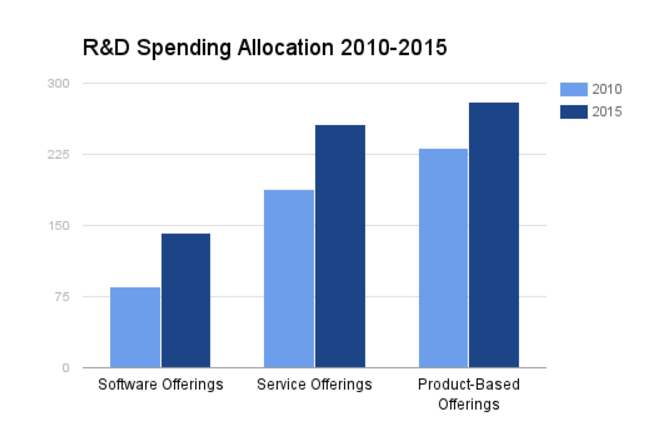
R&D Spending Allocation Trends

Strategy & Business conducted a study, Global Innovation 1000, of the top public companies spending the most on R&D to strengthen their brand from 2010 to 2015. The study found that while overall R&D spending is increasing, the total research and development allocation is shifting towards increased research and development of software offerings.

Why Shift Towards Software?

As software capabilities are rapidly developing there are increasing opportunities to develop product offerings to include additional features catering the demand for advanced services and technology. Popular examples of these developments include embedded software such as sensors and new features or network software connecting systems and communication between products, programs and people.blog

In analyzing the shift, a 34% rise in overall research and development spending was recorded at US$680 with a 65% increase in software R&D, a 36% rise in service R&D and a 21% rise in product-based R&D spending despite the fall of product-based in allocation share. This data is displayed in the chart. *Data from Strategy&Business Global Innovation 1000  

Growth in software research and development is expected to continue engaging 77% of surveyed companies by 2020 from 30% in 2015. The study also concluded that companies investing larger percentages of R&D into software are growing at a higher rate than competitors investing less. Strategy & Business goes on to suggest that investment in software offerings appears to maintain company growth fairly independently of macroeconomic fluctuations assuring growth in successful R&D.

As supported by the research and development tax incentive, R&D spending as a whole is expected to continually increase. If  you would like to discuss the R&D Tax Incentive further, please do not hesitate to contact one of Swanson Reed’s offices today.

Is R&D A Valuable Measurement of Innovation?

Preparation Pointers from Swanson Reed

The Relationship Between R&D and Innovation

It is well known that when performed effectively research and development (R&D) can increase the value of a company. However, Forbes writes that this is commonly misconstrued as it has been claimed that research and development spending directly translates to a measure of innovation. While R&D and innovation do correlate, they are not a perfect formula.

Tendayi said, “having a great R&D process and achieving market success with technologies we invent are two different things.” He goes on to suggest that R&D spending may be an effective measure of best practice within a particular industry.

In gauging the correlation between R&D and innovation rankings, the 2016 report of the Top 10 Innovative Companies provides the perfect example. Five of the ten ranking innovative businesses were also ranked in the top twenty for R&D spending in 2016, while the remaining five spent between $4.5 to $0.7 billion US dollars. Effectively, this demonstrates the necessity for research and development within innovation, as all 10 of the raking companies invest largely in R&D, however, it also demonstrates that spending was not the solo contributor to innovative success.

What is the Perfect Formula?

A successful company is capable of marrying innovation with market understanding. As Forbes explains, effective innovation solves for both technical and market risk factors. This is often left behind in lab based companies where business models are overlooked.

According to Forbes entrepreneurial expert, the formula for success continues to fund research and development programs that meet industry standards while implementing a strong invention to market management process making the improvements and inventions accessible on the market.

If  you would like to discuss the R&D Tax Incentive further, please do not hesitate to contact one of Swanson Reed’s offices today.