GE opens oil and gas R&D center in Oklahoma

1475771430341

Two test wells drilled deep underground and a well simulation towering five stories above, highlight the advanced research capabilities of GE’s Oil and Gas Technology Center.

GE have opened their oil and gas technology center in Oklahoma City, which is expected to become the central hub for the company’s scientists and engineers to collaborate with the oil and gas industry on digital and hardware solutions and advancements. The center consists of five stories and 125,000 sq ft of lab and office space, suitable for 230 employees.

The facility is designed to advance technology throughout the oil and natural gas industry, and is the company’s 10th worldwide research center, however, the first to specialize in one area.

GE’s CEO, Lorenzo Simonelli, says the research focus at the center will span across all areas of oil and gas such as; production solutions and well construction systems, oilfield facilities and systems, and reservoir performers. Simonelli believes a strong commitment to R&D will help the oil and gas customers find new efficiencies to work through tough market conditions and lead to transformational opportunities for the industry to thrive long term.

“This is a unique center from a global perspective and the plan is to be at the forefront and take the industry forward through applied technology,” Simonelli said. “Unconventional oil and gas drilling is taking place in other parts of the world. There is an opportunity to bring them in here to study and learn with others in the industry. This is going to provide the ability for commercialization of new technology and a new approach at a faster pace.”

The new technology center will accelerate innovation, the center will enable the full power of digital solutions and technology from across GE’s industrial businesses to advance the oil and gas industry.

While the oil and natural gas industry has used improved technology over the past decade to unlock vast amounts of oil and natural gas, the industry remains inefficient, said Mike Ming, general manager of the research facility. The new technology outcomes from this center will solve this issue by utilizing reserves in cost-effective and environmentally friendly ways and subsequently attracting companies from across the nation and around the world.

An innovative creation which has already been developed at the technology center is ‘Raven’ the prototype drone, engineered to detect emissions precisely and cost-effectively. ‘Raven’ has already been successfully piloted and was able to detect emissions from oilfield equipment at well sites in Arkansas. ‘Raven’ is one of many exciting developments to be produced from Oklahoma’s new research center.

To find out whether your company could qualify for the Federal Research Credit, Contact a Swanson Reed specialist.

Gateway to Growth: R&D in the Oil & Gas Industry

xxxxx

oil-field-76302_960_720From operating our vehicles to warming our homes, oil and gas is one the most commonly used and important commodities in the world. In 2014, oil provided approximately 38% of the world’s energy needs and is directly responsible for about 2.5% of world GDP. Indeed, oil and gas is a leading component of the world’s energy mix, a trend that will no doubt endure for many years to come.

However, in an increasingly technologically-driven world, the oil and gas industry is changing in two fundamental ways. Firstly, with majority of the world’s ‘easy oil’ already exhausted, the importance of utilizing sophisticated technologies to find and produce tomorrow’s hydrocarbons is becoming increasingly imperative. Secondly, high profile disasters such as Shell’s Brent Spar Incident in 1995 or the recent Deepwater Horizon accident (Perrons, 2014), has resulted in a significant shift in the expectations of the oil and gas industry in regards to safety, environmental stewardship and human welfare. Thus, in the face of these challenges, technology and innovation will play a pivotal role in the success or failure of the future of oil and gas firms.

Generating the question, how can oil and gas companies succeed in an industry where supply is limited and expectations are high? Ultimately, the oil and gas economy in the United States is at a critical juncture and innovation is what is going to push the economy forward.

Without a doubt, investing in R&D to create new and improved technologies is vital in enabling the industry to meet global energy demand. Moreover, with traditional forms of energy becoming harder to find, investing in new technologies will be vital in meeting the needs of an increasingly urbanised population and to combat environmental challenges in the decades ahead.

In addition, several companies may already be partaking in R&D activities and may not be aware of how the federal and state governments seek to support them through the Research and Development Tax Credit. Oil and gas companies are eligible for this credit, which presently values at almost 10 billion dollars, for work activities that are often already being conducted.

Below are some examples of qualifying research activities in the oil and gas industry:

  • Offshore structure design
  • Helidecks
  • Development and testing in a variety of areas including shutdown services, plug and abandonment solutions and turnaround
  • Plant design regarding safety, chemicals, pollution control and pressurization
  • Wastewater solutions
  • Designing and improving drilling

If you would like more information, Swanson Reed is hosting a free webinar on May 10th to discuss the benefits of the R&D tax credit for those in the oil and gas industry. Our specialists will be covering the basics of the credit, exploring an oil and gas case study and detailing the qualifying activities in the oil and gas industry. Could the R&D Tax Credit help your business?

If you’re interested in finding out more, register for our free webinar on EventBrite:
https://www.eventbrite.com/e/free-webinar-how-the-rd-tax-credit-can-benefit-the-oil-and-gas-industry-tickets-24977534478

Contact Swanson Reed’s R&D tax specialists today if you would like to know more about the R&D tax credit.

Texas’ Growth in Small Business Fortifies Economic Diversity

bigstock Texas Star 84460247

Believed to be the engine of job creation in the United States, small businesses are fundamentally the basic building blocks of our economy. Their value and the role they play in our economy is often underestimated as, they are in fact, small. But the truth is there’s nothing minor about the impact they have on our financial state.

Take Texas, for example, where the plunging price of a barrel of oil has forced layoffs across the state. Despite the downturn of one of the State’s key industries, small businesses are still hiring workers at positive pace. In fact, Texas ranks fourth in the nation in jobs added by companies that employ fewer than 50 people. Dallas, in particular, observed the highest growth rate among major metropolitan areas – adding small business jobs at a 1.6 percent annual rate.

Essentially, these small employers are helping soften the blow of layoffs in the oil and gas industry brought on by low commodity prices. Considering that over 50% of the working population (120 million individuals) works in a small business, their survival and growth in hardship is indicative of Texas’ diverse and strong economy.

In addition, thriving small businesses also serve as a bulwark against the global economy as they rely less on overseas customers and focus more on local innovation. Furthermore, as a consequence of the downturn of the oil and gas industry in Texas, the need for innovation is burgeoning. Research and Development (R&D), plays a critical role in the economic growth of a country and essentially spurs the innovation necessary for a strong U.S. economy. Most notably, there is one policy that has allowed for the expedition of innovation and R&D in the United States and that is the R&D tax credit.

However, historically, many startup companies and small businesses were unable to benefit from the research credit due to operating losses or alternative minimum tax limitations.  However, in addition to making the research credit permanent, the Protecting Americans from Tax Hikes (PATH) Act added two new provisions that are effective January 1, 2016. These two provisions are designed to increase the number of startups and small to mid-sized businesses that can benefit from the credit. In our last post, we went into details of both of these two modifications to the credit.

It is imperative, nonetheless, that businesses recognize what kinds of costs are eligible in order to maximize the credit so that appropriate records can be sustained throughout the year. Swanson Reed’s R&D tax professionals are available to discuss the R&D tax credit and the changes in the new PATH Act – contact us today if you would like to know if your company now qualifies.

Case Study for Oil and Gas R&D

pump jack 848300 640

pump-jack-848300_640

This case study shows the application of key legislative requirements for qualifying R&D activities as they apply to relevant activities in the oil and gas industry. 

Business Scenario

Burrow Geoscience Solutions (BGS) is an innovative geoscience company offering a diverse range of products and services to the global oil and gas industry. In particular, BGS has developed a new range of software that assists clients in the exploration process by utilizing seismic data processing, imaging and interpretation.

Since BGS’s inception in 2003, the firm has matured with research and development (R&D) underlining the core of the company’s business activities.  BGS’s projects began with the main objective to develop a processing and imaging toolkit for small-scaling processing. The team soon realised that the interpretation software tools existing on the market were inconvenient and out-dated; this ultimately led to BGS’s creation of a unique suite of cutting-edge software.

BGS constantly conducted R&D over the years to create new and improved products to perform to the best of its ability. In the past few years, BGS has augmented to include illumination studies, petrophysics, seismic data processing, depth imaging, geostatistical depth conversion, quantitative interpretation and multi-client studies. Currently, BGS’s services span the entire exploration and production lifecycle.

In order to qualify for the Research and Development Tax Credit, BGS needed to determine the eligibility of its proposed R&D activities. The “qualified research” must meet four main criteria, known and developed by Congress as the Four-Part Test.  BGS’s qualified R&D activities included the following.

BGS’s Eligible R&D Activities

Design and development of a series of prototypes to achieve the technical objectives (design of an interpretation software).

BGS’s hypothesis for this activity questioned whether a software could be designed and developed to assist in the exploration process.

The experiments BGS conducted in the design phase predominantly entailed computer modelling, conceptual engineering drawings and mathematical calculations. These experiments could only be proven effective or ineffective in the prototype development and testing phase. Following the experiments in that phase, during which the product was built and tested in various applications, the design was modified and re-tested until the desired outcome was achieved.

Trials and analysis of data to achieve results that can be reproduced to a satisfactory standard (development and testing of software).

The main objective for this activity stated that with improved knowledge of the intrinsic factors related to the extraction of oil and gas, it was possible to identify mechanisms for improving for the seismic data processing, imaging and interpretation.

Details of this experiment included development of the enhancers based on information gained through the model and testing of the enhancers to ensure efficiency, accuracy and safety.

Background research to evaluate current knowledge gaps and determine feasibility (background research of the development of BGS’s products).

Prior to 2003, the interpretation software tools existing on the market were cumbersome and obsolete. Thus, besides the lack of comparable solutions available, the outcomes of activities in this research could not have been known or determined in advance due to a number of specific technical challenges.

BGS’s eligible R&D activities during this phase of experimentation included:

  • Literature search and review, including maintaining up-to-date knowledge on relevant certification and standards.
  • Consultation with industry professionals and potential customers to determine the level of interest and commercial feasibility of the product.
  • Preliminary equipment and resources review with respect to capacity, performance and suitability for the project.
  • Consultation with key component/part/assembly suppliers to determine the factors they considered important in the design and to gain an understanding of how the design needed to be structured accordingly.

The background research conducted by BGS was directly related to the main objective of designing interpretation software, therefore qualifying as R&D.

Ongoing analysis of customer or user feedback to improve the prototype design (feedback R&D of the interpretation software).

BGS’s eligible R&D activity for this phase of its project included:

  • Ongoing analysis and testing to improve the efficiency and safety of the project.
  • Ongoing development and modification to interpret the experimental results and draw conclusions that served as starting points for the development of new hypotheses.
  • Commercial analysis and functionality review.

These activities were necessary to evaluate the performance capabilities of the new design in the field and to improve any flaws in the design, therefore qualifying as R&D.

Commentary

Qualified Research Defined

Qualified research consists of research for the intent of developing new or improved business components. A business component is defined as any product, process, technique, invention, formula, or computer software that the taxpayer intends to hold for sale, lease, license, or actual use in the taxpayer’s trade or business.

The Four-Part Test

Activities that are eligible for the R&D Credit are described in the “Four-Part Test” which must be met for the activity to qualify as R&D.

1.    Permitted Purpose: The purpose of the activity or project must be to create new (or improve existing) functionality, performance, reliability, or quality of a business component.

2.    Elimination of Uncertainty: The taxpayer must intend to discover information that would eliminate uncertainty concerning the development or improvement of the business component. Uncertainty exists if the information available to the taxpayer does not establish the capability of development or improvement, method of development or improvement, or the appropriateness of the business component’s design.

3.    Process of Experimentation: The taxpayer must undergo a systematic process designed to evaluate one or more alternatives to achieve a result where the capability or the method of achieving that result, or the appropriate design of that result, is uncertain at the beginning of the taxpayer’s research activities.

4.    Technological in Nature: The process of experimentation used to discover information must fundamentally rely on principles of hard science such as physical or biological sciences, chemistry, engineering or computer science.

What records and specific documentation did BGS keep?

Similar to any tax credit or deductionBGS had to save business records that outlined what it did in its R&D activities, including experimental activities and documents to prove that the work took place in a systematic manner. BGS saved the following documentation:

  • Project records/ lab notes
  • Innovation Log
  • Conceptual sketches
  • Design drawings
  • Literature review
  • Background research
  • Records of changes and bug fixes
  • Testing protocols
  • Results of records of analysis from testing/trial runs
  • Records of resource allocation/usage logs
  • Staff time sheets
  • Tax invoices
  • Receipts
  • Patent application number

By having these records on file, BGS confirmed that it was “compliance ready” — meaning if it was audited by the IRS, it could present documentation to show the progression of its R&D work, ultimately proving its R&D eligibility.

 Contact us today if you’ve been involved with oil and gas technology R&D and would like to achieve generous tax benefits.

The Silver Lining of Texas’ Low Oil Prices

oil-106913_960_720The oil industry, with its history of booms and busts, has been reported to be in its deepest downturn since the 1990s, if not earlier. The cause is the plunging price of a barrel of oil, which has fallen more than 70 percent since June 2014. But why exactly has the price of a barrel of oil plummeted so much?

Fundamentally, it comes down to supply and demand. United States domestic production has nearly doubled over the last several years, pushing out oil imports that need to find another home. Saudi, Nigerian and Algerian oil that once was sold in the United States is suddenly competing for Asian markets, and the producers are forced to drop prices. Canadian and Iraqi oil production and exports are rising year after year. Even the Russians, with all their economic problems, manage to keep pumping. On the demand side, the economies of Europe and developing countries are weak and vehicles are becoming more energy-efficient. Thus as a result, demand for fuel is lagging a bit.

Certainly, the plunge in oil prices is a boon for some, and a calamity for others. However, for oil producers is there a silver lining? Ultimately, those that can maintain the cost reductions and productivity improvements when prices eventually rise may be stronger than before the crash. In Texas, the price per a barrel of oil has been hovering around the $30 mark.  As Tom Erikson,  head of the University of North Dakota’s Energy and Environmental Research Center, puts it, “at $30 oil, you need to innovate, or else you’re just losing money.”

Indeed, further innovative developments in the oil and gas industry are required in order to remain competitive in today’s markets. As a result, substantial research and development (R&D) is needed, which can be costly.  Fortunately, the R&D tax credit is available for eligible companies, offering a lucrative investment that allows for forward thinking and the next steps in innovation within the oil and gas industry.

Initially, the R&D tax credit was primarily used for technological and biomedical research when it was introduced by congress over thirty years ago. Since its first introduction the tax credit has evolved, now it encompasses multiple industries including the oil and gas industry.

There are certain activities that determine whether companies and organizations in this industry are eligible for the credit. Here is a short list to give you an idea of what activities are included:

  • Offshore structure design
  • Helidecks
  • Development and testing in a variety of areas including shutdown services, plug and abandonment solutions and turnaround
  • Plant design regarding safety, chemicals, pollution control and pressurization
  • Wastewater solutions
  • Designing and improving drilling
  • Combustion testing
  • Improvements in drilling processes and design
  • Testing and development including:
    • Plug and abandonment solutions
    • Shutdown services
    • Turnaround

Overall, R&D is the lifeblood of technological advancement and could greatly assist companies in the oil industry grow in a seemingly difficult time. In 2006, the IRS broke out numbers to show that $388 million in R&D credit was claimed on individual tax returns, including pass-through income from smaller companies organized as S corps or partnerships. Ultimately, businesses of all sizes can benefit from utilizing the R&D tax credit to grow their organization, maintain a competitive edge in the industry, and add new jobs. If you want to discuss how you can take advantage of the R&D tax credit, Contact Swanson Reed  to talk to one of our specialist R&D Tax Advisors. For more information about qualifying activities, read our oil and gas case study. 

Is Big Oil Ready for Big Data?

pump-jack-848300_640Globally, the oil and gas sector continues to experience price volatility, however, is this current environment fueling opportunities for innovation? A new report, Innovating in a New Environment, launched by Lloyd’s Register Energy, couples expert knowledge with third party insights to provide data-driven findings on the role of innovation in the current and future oil and gas industry. Key findings in the report find the “digital oil field” brings an increased need for technology innovation and strong capabilities in data, statistics and mathematics joined with the traditional science and engineering skills.

While the environment may be creating circumstances for innovation, 76% of the study’s respondents reveal that the oil price has led them to slow down or terminate most innovation activities. In relation to this, the report highlights that stopping an innovative project today may assist the bottom line in the short term, however, it could weaken a company’s ability to discover and exploit new reserves of oil and gas tomorrow. Indeed, whether prices are high or low, the fact remains that there is a declining supply of ‘easy oil’.

Therefore, digital technologies could propose the greatest efficiency benefits to be achieved in a low oil price world with dwindling ‘easy oil’ levels. Digital technology can often be expedited upstream more hastily than other technologies and they have the benefit of being scalable at a comparatively low cost. Despite this, the oil and gas industry is no foreigner to data collection implements. For instance, sensors that generate data on deposits have been used in remote environments for well over a decade. Curtin University’s Dr. Evans believes data collection and analytics will overshadow other technologies in the industry and will be directed by a focus on cost-efficiency.  Ultimately, he reveals, “our ability to become lean and mean will come down to our ability to master data analytics.”

In the long term, oil and gas firms must continue to participate in innovation or are in jeopardy of losing competitive edge. As suggested by the report, oil and gas firms should look at new collaboration models to learn how other industries have completed more with less resources, utilized new technologies and employed ‘big data’.

Overall, a continual phase of low oil prices may disintegrate conservative attitudes towards innovation in the oil and gas industry. As the Innovating in a New Environment report revealed, focusing more on research and development, advanced data collection and data analytics, is becoming increasingly important in the current low oil price market. In this respect, lower oil prices may be a blessing in disguise for technology innovation in the  oil and gas industry, thereby transforming the industry’s approach in an enhanced manner that will assist its needs for short and long term challenges. Consequently, the R&D Tax Incentive can have a positive effect on assisting the oil and gas industry who are partaking in innovative activities.  If you believe your company is undertaking qualifying research and development activities, contact one of our specialists today to find out if you could benefit from R&D credits.

How R&D Can Transform the Oil & Gas Industry

From operating our vehicles to warming our homes, oil and gas is one the most commonly used and important commodities in the world. In 2014, oil provided approximately 38% of the world’s energy needs and is directly responsible for about 2.5% of world GDP. Indeed, oil and gas is a leading component of the world’s energy mix, a trend that will no doubt endure for many years to come.

However, in an increasingly technologically-driven world, the oil and gas industry is changing in two fundamental ways. Firstly, with majority of the world’s ‘easy oil’ already exhausted, the importance of utilizing sophisticated technologies to find and produce tomorrow’s hydrocarbons is becoming increasingly imperative. Secondly, high profile disasters such as Shell’s Brent Spar Incident in 1995 or the recent Deepwater Horizon accident (Perrons, 2014), has resulted in a significant shift in the expectations of the oil and gas industry in regards to safety, environmental stewardship and human welfare. Thus, in the face of these challenges, technology and innovation will play a pivotal role in the success or failure of the future of oil and gas firms.

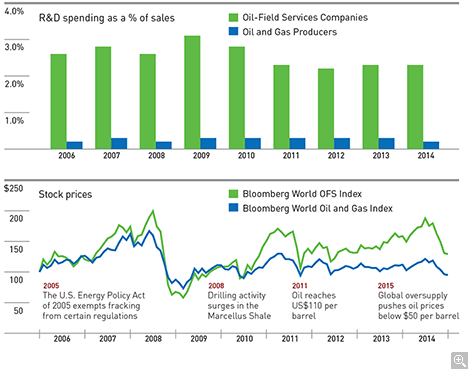
Generating the question, how can oil and gas companies succeed in an industry where supply is limited and expectations are high? One way is through investing in research and development (R&D) to drive innovation and create new and improved technologies. Certainly, one would expect that the economic rewards in an industry that is perceptibly more technology-driven would go to the firms that create most of the innovations – and, indeed, that seems to be happening.  Several international oil companies (IOCs) and national oil companies (NOCs) have increased their spending on R&D dramatically over the past years. In particular, oil-field service companies have greatly increased their investment in innovation which has correlated with higher stock prices, as seen below.

15201_ex1s
Source: Doshi, 2015.

Without a doubt, investing in R&D to create new and improved technologies is vital in enabling the industry to meet global energy demand. Moreover, with traditional forms of energy becoming harder to find, investing in new technologies will be critical in meeting the needs of an increasingly urbanised population and to combat environmental challenges in the decades ahead.

In addition, several companies may already be partaking in R&D activities and may not be aware of how the federal and state governments seek to support them by encouraging innovation through the Research and Development Tax Credit. Oil and gas companies are eligible for this incentive, which presently values at almost 10 billion dollars, for work activities that are often already being conducted. Many of these activities may not occur in traditional laboratories or are not usually thought of as ‘research’. Nonetheless, these undertakings entail time and money that may be defined as qualified research expenditures resulting in substantial tax benefits. Both large and small companies in the oil and gas industry are able to get the incentive – contact Swanson Reed’s R&D tax specialists today to see if you’re eligible.

 

References:
Perrons, Robert K. (2014) How innovation and R&D happen in the upstream oil & gas industry : insights from a global survey. Journal of Petroleum Science and Engineering124, pp. 301-312.
“Surviving the Worst: It’s Time for Oil Services to Address Shortcomings and Find Strategic Solutions,” by Viren Doshi, John Corrigan, Shawn Maxson, and Adrian del Maestro, Strategy& white paper, Feb. 2015, strategyand.pwc.com/OFS; Bloomberg; University of Michigan Center for Local, State, and Urban Policy.

Low Oil Prices Are Causing Companies To Create New Innovative Technologies

The fallen oil prices have triggered new creativity in oil companies when finding ways to get the most bang for their buck. Unlike the past when oil companies were focused on drilling LOTS of oil FAST, the main concern these days seems to be drilling oil efficiently – producing the most amount of oil for the least amount of money – and oil companies are banking on advanced technology to help them do so.

Companies have started using high-tech equipment such as lasers and data analytics prior to drilling to check if a new oil well will give them the most oil for their money. Some are testing out new technologies that will produce more oil from both old and new wells. Refracking – using new advanced fracking technologies to get more out of wells that have been fracked in the past – is becoming a common practice, along with using advanced software and sensors to determine the best place to use certain materials to produce the most amount of oil.

The big players in the oil and gas industry are investing more money in R&D this year. Eric Gebhardt, Chief Technology Officer and Vice President of Engineering for General Electric’s oil and gas division, says that his divisions plans on increasing its R&D spending this year in search for new technologies.

“You have to keep your focus on finding new and innovative solutions,” said Bruce Tocher, manager for shale oil and gas research at Statoil, a Norwegian energy company, according to The Wall Street Journal. “You need those solutions more than ever.”

Contact a Swanson Reed specialist for more information on claiming the R&D tax credit for qualified activities in the oil and gas industry.
Source: www.wsj.com


A royalty free image from the oil and gas industry of two oil workers in an oil field at duck.

R&D Tax Credit : Oil and Gas Industry

Initially, the R&D tax credit was primarily used for technological and biomedical research when it was introduced by congress over thirty years ago. Since its first introduction the tax credit has evolved, now it encompasses multiple industries including the oil and gas industry.

The R&D tax credit can be used to revolutionize the oil and gas industry. Both of these commodities are widely used throughout the world. They are used in our homes, our vehicles and in businesses. In order to continue developing the gas and oil industry innovation is required, which is where the R&D tax is proving to be essential in Texas and the rest of the United States.

Innovation Requires Time, Money and Resources

Further developments in the oil and gas industry are required in order to remain competitive in today’s markets. However, substantial research and development is needed, which can be costly. Thankfully the R&D tax credit is available for eligible companies, offering a lucrative investment that allows for forward thinking and the next steps in innovation within the oil and gas industry.

Technology for the gas and oil industry is one of the most complex, therefore it’s only fitting that the tax credit is now available to ensure the research and development is able to continue to grow. This is an industry that is vital to the American economy as oil and gas are used everyday around the world.

Qualifying for the R&D Tax Credit

There are certain activities that determine whether companies and organizations in this industry are eligible for the credit. Here is a short list to give you an idea of what activities are included:

  • Offshore structure design
  • Helidecks
  • Development and testing in a variety of areas including shutdown services, plug and abandonment solutions and turnaround
  • Plant design regarding safety, chemicals, pollution control and pressurization
  • Wastewater solutions
  • Designing and improving drilling
  • Combustion testing
  • Improvements in drilling processes and design
  • Testing and development including:
    • Plug and abandonment solutions
    • Shutdown services
    • Turnaround

The tax credit is there for you to use, the government wants you to use it so now is the time to take advantage and make it work for your business. Many businesses are missing out on this essential tax credit because they feel they don’t qualify, or that they simply don’t have the time or the resources to handle the application. We’re here to help. We will happily conduct a feasibility study, at no cost, to find out if you could benefit from the credit. Make the most of this opportunity to invest in your research and development and watch your business continue to grow and evolve.

Contact us for further information.

iStock_000004341760Small