New York Announces an Initiative of $650M for Life Sciences

Test Tubes small

The Empire State Boosts Life Science

With the aim of becoming a top tier biocluster state, New York has announced an initiative to increase the state’s ability to commercialize research by investing $650 million into life sciences. The incentive hopes to have a success rate similar to those of California, whose company growth has accelerated that of job growth and Massachusetts, which invested $1 billion in a highly successful life sciences program 10 years prior.

As announced by Governor Andrew Cuomo the initiative will include $250 million in tax incentives for life science companies (new and existing), $200 million for capital grants towards wet labs and innovation space, $100 million towards early stage life science development and $100 million towards operating support from private partnerships.

The term life sciences has been defined by New York State as including, “biopharma, biomedical technologies, life systems technologies, as well as organizations and institutions that devote most of their efforts to research, development, technology transfer, and commercialization.”

In recent years, despite the presence of major academic research centers and Wall Street, New York has lacked commercialized research, early-stage company incentives, and biocluster development reported by Genetic Engineering & Biotechnology News.

Good News For R&D

The incentive will support the job market by investing $10 million annually in the Excelsior Job program. Refundable tax credit will be available at a 15% rate to life science businesses and at a 20% rate for small life science businesses.

The state also plans to attract life science talent to the state through internship programs, research recruitment programs, a mentor program to bring together entrepreneurs and innovators, and a program to support teaching hospitals with over $8.5 million in support annually.

If  you would like to discuss the R&D Tax Incentive further, please do not hesitate to contact one of Swanson Reed’s offices today.

Future R&D Spending within OECD Countries

Blue office Building San Francisco rentable storage

Predicted Spending 

At a time when aging populations and the environmental challenges of climate change are in need of innovative solutions the decline in public-backed science and technology research is a concern. Data from the Organisation for Economic Co-operation and Development (OECD) shows the first fall of R&D spending in government and higher education in 2014 since the organisations conception in 1981.

The OECD Science, Technology and Innovation Outlook Report showed increased R&D spending from 2000 in Korea, Japan and Germany while the UK, US, Australia, FInland, Italy, France and Spain have decreased spending. Owing to the financial recession, overall government spending in OECD countries has been in decline since 2009.

With the combination of competing policies such as pensions, health and social care and the annual loss of tax revenue, conservatively estimated between $100 billion to $240 billion, the OECD says the warning signs are there. The organisation expects to see a greater decrease in government-backed science.

Increasing the R&D Tax Incentive

As budgets are increasingly tight, governments are increasing the use of policies that do not require short term public spending, partial public procurement and tax incentives for R&D and innovation.

Also, the increase in philanthropists, charities and foundations funding research has helped to balance the government drop off. These funds are estimated to support about 30% of annual research in leading US universities.

Specialization

The OECD has noted that specialization might be a key element within the recent climate. As the US devotes 24% of R&D spending to health, Canada, England and Luxembourg focus about one fifth of their budgets, and countries such as Mexico, Japan and Korea focus on energy.

If  you would like to discuss the R&D Tax Incentive further, please do not hesitate to contact one of Swanson Reed’s offices today.

Tax Incentive Changes in Nebraska Legislation

bigstock savings finances economy and 82701587 e1457318413316

The Nebraska Advantage Act

A recent report on the business tax incentive programs in Nebraska suggest that in the past eight years, the program has not been as effective as desired in attracting new business to the state. According to the recorded growth, only nine new companies were established in Nebraska over an eight year time period.

Each of these new jobs created within the state cost the local governments and state between $24,500 to $320,000 with the Nebraska Advantage Act. However, this among other incentives, encouraged 69 business to add positions between 2006 and 2014.

This variation of results has spurred a discussion of overlapping incentives and receiving incentives from multiple states.  

Quality Over Quantity 

The report stated that of the 78 business studied, 75% had benefited from additional programs. These programs included customized job training, state-supported internships and research and development tax credits (R&D).

Renee Fry was quoted saying, “We hope that lawmakers will conduct a broader examination of exemptions and incentives to see if their benefits justify their cost, as it is vital to ensure state tax dollars are used as efficiently as possible.”

While the research and development tax incentive does not seem to be at risk as the report mainly focuses on the Nebraska Advantage Act, the incentive program is named as one of the overlapping incentives.

If  you would like to discuss the R&D Tax Incentive further, please do not hesitate to contact one of Swanson Reed’s offices today.

Illinois Manufacturing Industry and R&D Update

illinois

The manufacturing industry is the highest claimant of the R&D Tax Credit, claiming more than 60% of Illinois State R&D Credits. The month of October saw a net gain of 1,600 jobs, the majority of impact has been on the manufacturing industry. 

Unfortunately, the Illinois Department of Employment Security (IDES) has reported the net loss of 10,000 jobs during 2016. 

During October, 429 of the 812 layoffs of the month were manufacturing positions. Director of the Illinois Chamber of Commerce, Sean McCarthy, stated that several manufacturers had moved into Wisconsin to take advantage of competitive prices causing the high rate of job loss which averaged 200 jobs per week in 2016.

Why Are Manufacturers Crossing Borders?

Reportedly high rates of workers’ insurance and workers’ compensation make neighboring states increasingly attractive for manufacturing companies as Illinois has had a tough and long recovery from the Great Recession.

The addition of manufacturing technology has also improved to replace workers. This is a trend that has been increasing and is only expected to increase greatly.

During 2015 the loss of research and development (R&D) tax credits caused a massive shift in manufacturing. The four years prior to to the cuts, the manufacturing industry claimed 60% of Illinois state R&D credits. The generation of new processes and products, supported

directly by research and development, were lost as well.

The Importance of R&D

The Research and Development Tax Incentive is popularly supported as it directly influences the creation and adoption of new ideas, products and processes into local and global markets. The incentive provides SME’s the capability to develop products before receiving revenue and continues to support larger successful companies, in turn stimulating the economy.

If  you would like to discuss the R&D Tax Incentive further, please do not hesitate to contact one of Swanson Reed’s offices today.

R&D Growth In Higher Education

Team and whiteboard Copy

A report focused on federal R&D funding for higher education, published by the National Center for Science and Engineering Statistics (NCSES), shows that 2016 is the fourth consecutive year in which federal R&D funding has decreased since its peak in 2011.

As of 2015 universities reported a 2.2% increase from the previous year at $68.8 billion in R&D spending. The data was collected from 906 degree-granting institutions that has spent a minimum of $150,000 the year prior.

Since 2011, where federal funding supported 62.5% of higher education R&D costs, R&D funding has declined by 13%. A decline in funding of 1.7% was recorded between 2014 and 2015. Of the $68.8 billion spent during 2015, federal funding covered only $37.9 billion dropping the percentage of funding to 55.2%.

While federal funding has decreased, research has continued to grow by 2.2% from the previous year with additional funding from other sources at 6.4%. Medical science was reported to have supported the highest growth rate spending $21.3 billion while biological and engineering sciences floated around $11 billion.

If  you would like to discuss the R&D Tax Incentive further, please do not hesitate to contact one of Swanson Reed’s offices today.

US-Israel Cybersecurity R&D Cooperation

software

This week a large majority of the US Congress voted in favor of two bills which will benefit US-Israel cybersecurity research and development. The bills were introduced by John Ratcliffe, from Texas, and Jim Langevin, from Rhode Island, following discussion which commenced in May regarding cybersecurity threats recorded in the US and Israel.

The United States-Israel Cybersecurity Cooperation Enhancement Act of 2016

This bill moves to increase detection and combat of cyber threats through a grant program supporting R&D projects for US-Israel joint ventures, non-profits, and academic or government entities in both countries. These grants will be provided to non-classified projects and the program is expected to run for seven years.

The United States-Israel Advanced Research Partnership Act

This act will expand an existing bi-national R&D program which is run by the US Department of Homeland Security and Israel’s Ministry of Public Security. Not only will the bill expand the program to include cybersecurity research, the bill aims to increase the success rate of products moving from the initial stages of development to successful commercialization.

Cyber Giants

As web security is the greatest security challenge of current generations, the US and Israel have recognized the importance of uniting as primary cybersecurity technology exporters to promote cooperation and unity against a dangerous front.

If  you are performing research and development and would like to discuss the R&D Tax Incentive further, please do not hesitate to contact one of Swanson Reed’s offices today.
R&D Spending Trends Among the Global Innovation 1000

Workers Copy e1457330028575

R&D Spending Allocation Trends

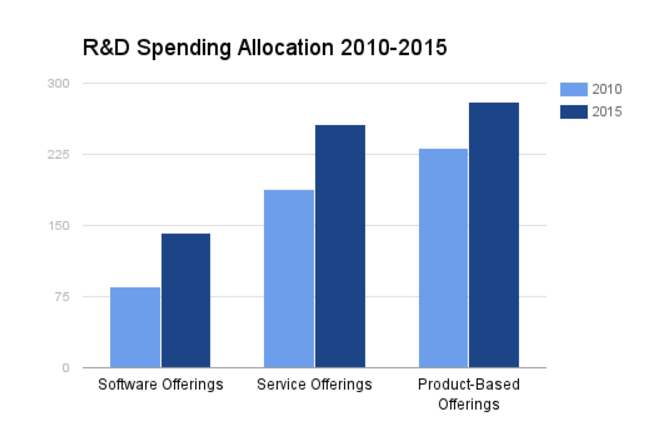
Strategy & Business conducted a study, Global Innovation 1000, of the top public companies spending the most on R&D to strengthen their brand from 2010 to 2015. The study found that while overall R&D spending is increasing, the total research and development allocation is shifting towards increased research and development of software offerings.

Why Shift Towards Software?

As software capabilities are rapidly developing there are increasing opportunities to develop product offerings to include additional features catering the demand for advanced services and technology. Popular examples of these developments include embedded software such as sensors and new features or network software connecting systems and communication between products, programs and people.blog

In analyzing the shift, a 34% rise in overall research and development spending was recorded at US$680 with a 65% increase in software R&D, a 36% rise in service R&D and a 21% rise in product-based R&D spending despite the fall of product-based in allocation share. This data is displayed in the chart. *Data from Strategy&Business Global Innovation 1000  

Growth in software research and development is expected to continue engaging 77% of surveyed companies by 2020 from 30% in 2015. The study also concluded that companies investing larger percentages of R&D into software are growing at a higher rate than competitors investing less. Strategy & Business goes on to suggest that investment in software offerings appears to maintain company growth fairly independently of macroeconomic fluctuations assuring growth in successful R&D.

As supported by the research and development tax incentive, R&D spending as a whole is expected to continually increase. If  you would like to discuss the R&D Tax Incentive further, please do not hesitate to contact one of Swanson Reed’s offices today.

Is R&D A Valuable Measurement of Innovation?

Preparation Pointers from Swanson Reed

The Relationship Between R&D and Innovation

It is well known that when performed effectively research and development (R&D) can increase the value of a company. However, Forbes writes that this is commonly misconstrued as it has been claimed that research and development spending directly translates to a measure of innovation. While R&D and innovation do correlate, they are not a perfect formula.

Tendayi said, “having a great R&D process and achieving market success with technologies we invent are two different things.” He goes on to suggest that R&D spending may be an effective measure of best practice within a particular industry.

In gauging the correlation between R&D and innovation rankings, the 2016 report of the Top 10 Innovative Companies provides the perfect example. Five of the ten ranking innovative businesses were also ranked in the top twenty for R&D spending in 2016, while the remaining five spent between $4.5 to $0.7 billion US dollars. Effectively, this demonstrates the necessity for research and development within innovation, as all 10 of the raking companies invest largely in R&D, however, it also demonstrates that spending was not the solo contributor to innovative success.

What is the Perfect Formula?

A successful company is capable of marrying innovation with market understanding. As Forbes explains, effective innovation solves for both technical and market risk factors. This is often left behind in lab based companies where business models are overlooked.

According to Forbes entrepreneurial expert, the formula for success continues to fund research and development programs that meet industry standards while implementing a strong invention to market management process making the improvements and inventions accessible on the market.

If  you would like to discuss the R&D Tax Incentive further, please do not hesitate to contact one of Swanson Reed’s offices today.

Trump’s Proposed Tax Reforms

shutterstock 92766073

After a dramatic election season the proposed tax reforms of US President Elect, Donald Trump, are currently a topic of great interest for businesses. While pre-election reform plans may not necessarily become legislation, Trump will be supported by Republican chambers of commerce, making passing legislation more likely in absence of strong opposition.

How Might This Affect R&D?

In an attempt to decrease corruption due to the influence of special interests, Trump plans to eliminate special interest outlays and most business tax credits such as the domestic production activities deduction and the work opportunity credit which currently supports veterans among other groups. These points are controversial as many of the expenditures he proposes to eliminate relate more to public policy concerns than they do to special interests.

However, one positive position maintained through Trumps reforms is the continuation of the Research and Development (R&D) tax credit. This influences greater innovation and improvement of existing systems or processes within industry. As Trump promotes the repatriation of labor and production, an increase in R&D support could be a possibility. Some predict that Trump may use the incentive as a maner of influencing larger percentages of manufacturing, not just research, within the U.S.

If  you would like to discuss the R&D Tax Incentive further, please do not hesitate to contact one of Swanson Reed’s offices today.

The Secret Ingredient to Craft Beer Growth

bigstock Whiskey And Natural Ice 80724569

The market for craft beer has been growing steadily since the late 1990’s. As of 2015 craft brews dominated 12% of the beer market by consumption and 21% by spending. In comparison with other high end beverage markets, craft beers potentially have plenty of room for growth as specialty coffee and spirits typically control 40% of market share.

While the US now has over 4,600 craft breweries, some industry experts have noticed a tendency for brewers to focus on production, leaving brand improvement activities to the side. The 0.2% drop in total U.S. beer market in 2015 spoke to the consumer desire for fuller flavor. This drop occurred as spirits and wine absorbed the market share of wavering beer drinkers. As consumers move away from cheaper, less flavorful beverages craft brewers are able to charge for quality. We see this as a hopportunity!

Experts recommend for craft brewers to perfect brews and production while simultaneously developing brand strength through R&D to remain competitive in a growing market. Many companies immediately consider their operations ineligible of claiming R&D, however, activities such as production line redesign and brew recipe innovation can be considered eligible. 

In the first few years of development many SMEs (small to medium enterprises) are in crucial need of cash flow in order to solidify their position in the market.  During this time receiving returns on R&D through the Research and Development tax incentive support the growth of an entrepreneur.

If  you would like to discuss the R&D Tax Incentive further, please do not hesitate to contact one of Swanson Reed’s offices today.