Don’t Forget the R&D Tax Credit this Tax Season

CaptureS

As the days tick down until the end of tax season, some clients need a little push to get their taxes done, or at least to file for a six-month extension.

Not surprisingly, 60 percent of small-business owners say administrative burdens, like paperwork and confusing rules, are the worst part of filing — even more so than the financial cost of taxes, according to a recent survey by the National Small Business Association. Almost half of small-business owners file under extension, the survey found.

Nonetheless, there are many tax options available that may reduce the taxes you and your business owe — possibly by thousands of dollars. In this instance, is it best to pursue the advice of tax specialist to help with your company’s filing and ensuring you don’t miss out on any potential tax savings.

In particular, the R&D Tax Credit is a frequently overlooked tax benefit, with companies often mistakenly believing they don’t qualify. The government lets you deduct the costs of research and experimentation to develop or improve a product, formula, invention, process or technique. The costs of getting your own patent — including attorneys’ fees for the application — can be deducted, but not costs from obtaining another person’s patent.  Bearing in mind the broad application of the credit and recent changes to the eligibility criteria, the R&D tax credit could be a huge game changer for companies.

While the R&D deduction is relatively simple for small businesses to take, doing additional calculations to claim the “innovation” or R&D tax credit can be more complex but rewarding for entrepreneurs. The credit reduces taxes dollar for dollar, and entrepreneurs can generate the biggest credit by ramping up research activities over time.

In addition, there were a host of tax breaks that Congress included in last December’s tax extenders legislation, the PATH Act. The new rules and regulations outlined in the PATH Act have made it easier for all types of businesses to profit from the R&D Tax Credit. Start-ups and other small businesses should take distinctive note of major changes specifically intended for their advantage.  Now, start-ups (businesses with gross receipts of less than $5 million a year) will be able to take the credit, capped at $250,000 against their 2017 payroll taxes.

In addition to the direct start-up provision, starting in 2016, small businesses (businesses with less than $50 million in gross receipts) will now permanently be able to claim the R&D credit against their Alternative Minimum Tax (AMT). The removal of the AMT barrier may see a tenfold upsurge in the number of small businesses that can utilize the R&D Tax Credit. Combined, these two alterations will benefit start-ups and small businesses with approximately $2 billion in added tax savings.

Getting advice from your tax preparer is always a good thing, but the R&D Tax Credit may be outside of their normal practice. If you do claim the credit it will be beneficial to consult with an R&D Tax Credit specialist. They will help determine your eligibility, assist with confusing rules, properly prepare your claim up to IRS standards and provide guidance in the case of an audit.

R&D Tax Filing Date Only a Week Away!

bigstock Tax Form With The Deadline Tim 84295040

The filing dates for R&D Tax Credit and deadline submission dates for claims are fast approaching. Tax filing dates and rules are set by law so it is important to be aware of filing dates. Filing dates determine when tax returns can be amended, which opens the possibility of claiming more R&D credits. Filing a late claim could result in a missed opportunity to receive a substantial credit.

The date deadlines differ depending on the company type. Details of each of these are outlined below:

Corporations (C-Corps and S-Corps)

  • Initial filing date: 2 ½ months after the end of the fiscal year.
  • Extended filing date:  6 months after the initial filing date.
  • EXAMPLE:
    • Fiscal year end = December 31
    • Initial filing = December 31 + 2 ½ months = March 15
    • Extended filing = March 15 + 6 months = September 15

Limited Liability Companies (LLC’s)

LLC’s are initially treated like a sole proprietorship or partnership with an initial filing date of April 15 and an extended filing date of October 15. LLC’s can elect to change their fiscal year and be treated like a corporation for tax purposes. If this is the case, LLC’s will have the same filing dates as Corporations.

Individuals, Sole Proprietorship and Partnerships

Individuals, sole proprietorships and partnerships have the same initial filing date of April 15 and an extended filing date of October 15. Individuals receive “flow-through” benefits from S-Corps and LLC’s.

To simplify this, we’ve provided the table below for quick reference:

Company Type Original Filing Date Extension Filing Date
  • Single-member & multi-member LLC’s, Individuals, Partnerships, Estates and Trusts
April 15, 2016 October 15,2016
  • Corporations (S,C)
March 15, 2016 September 15, 2016

If you would like further information about tax lodgement or filing for an extension, please contact your  nearest Swanson Reed representative or office.

Six Tips to Reduce Your Audit Risk with an R&D Tax Credit Claim

bigstock Research and Development on Fo 121044080

New rules and regulations have made it easier for all types of businesses to profit from the R&D Tax Credit, but there is always a possibility that the credit will provoke an IRS audit. Even hearing the word audit can spur risk aversion in clients, therefore it’s best to be prepared as possible to ease your mind.

To elaborate, an R&D tax credit audit is an examination of compliance with the relevant R&D tax credit legislation, and it consists of a thorough review of the claim from both a scientific/technological and a financial/tax technical perspective.

In light of this, we’ve collated six key tips to assist companies in reducing their audit risk.

1. Recognize what qualifies as research

To start with, you need to confirm whether the activities undertaken are eligible as “qualified research.” IRS has a four-part test for this, the four parts to consider are:

  • Is your research technological in nature?
  • Does the research have a permitted purpose?
  • Are you working toward the elimination of uncertainty about a product?
  • Are you engaged in the process of experimentation?

Ultimately, you must be able to explain scientifically why this is an authentic experiment whose outcomes you were testing in good faith. Firms should especially watch out for “R&D” that is actually just standard practice.

2. Collect and organize your documentation

Documentation is the basis of the R&D Tax Credit, so having your records organized and readily available is essential. Appoint a staff member who has access to the documents to collect the data throughout the R&D project. That way one person will be responsible for having everything in once place in case an audit occurs. Read up on what documents are needed to claim.

3. Get familiar with the Audit Techniques Guides

The Audit Techniques Guides are published by the IRS to train IRS employees, but are available to the public to help provide a better understanding of the audit process. There is a large assortment of guides, each one tailored to a specific audit concern. There are four different ones for the R&D Tax Credit alone that can be found on the Research Credit page of the IRS website. Be aware that some guides are industry specific so make sure to choose the one tailored to your business. Even skimming one will help prepare you for what to expect.

4. Reinforce high deductions with proof

One of the biggest triggers for a tax audit is having high deductions compared to other taxpayers within your same tax bracket. You can account for high deductions by attaching a receipt or other documentation to your tax return. While above average deductions can trigger an audit, being proactive and providing proof will reduce your chances of being audited. Don’t be afraid to deduct expenses that are legally deductible. Instead, make sure you can justify the amount of your deduction. Write checks whenever possible and keep a copy of the cancelled check in your records.

5. Double check your maths

Addition and subtraction errors are common reasons for tax audits. They’re also easy to fix and avoid. Check and double check your numbers to make sure you’ve included the right ones.

6. Consult a specialist 

Getting advice from your tax preparer is always a good thing, but the R&D Tax Credit may be outside of their normal practice. If you do claim the credit it will be beneficial to consult with an R&D Tax Credit specialist. They will help determine your eligibility, properly prepare your claim up to IRS standards and provide guidance in the case of an audit.

Swanson Reed is familiar with the review process and knows what the government expectation is in terms of technical supporting documentation. Therefore, we can manage expectations in order to take the pressure and stress out of the equation. For more details on this service, visit our Audit Advisory page.

Claiming the Texas R&D Tax Credit through the Franchise Tax Credit

bigstock Uk Tax Form With Calculator Ly 113610671 e1457318844977

The State of Texas adopted Texas House Bill 800 (House Bill 800) providing state tax benefits for engaging in qualified research expenditures in the State of Texas beginning January 1, 2014. In specific, taxpayers in Texas can claim the R&D Tax Credit to offset a portion of their franchise tax or use it towards a sales and use tax exemption on the purchase or lease of depreciable tangible personal property used in qualified research in Texas.

Our latest video tutorial covers the process of claiming the Texas R&D Tax credit through the Franchise Tax Credit and highlights the applicable periods for claiming the credit.

Watch below, or alternatively, watch on YouTube at: https://www.youtube.com/watch?v=e9YF1W6wksE

Claiming the Texas R&D Tax Credit through the Franchise Tax Credit – SwansonReed


This video covers the process of claiming the Texas R&D Tax credit through the Franchise Tax Credit.

Want more quick video tutorials like this?


Check out our series so far:


Swanson Reed is a specialist R&D tax firm and has helped many clients across a diverse range of industries. Contact us for more information on how we can advance your company’s market value and boost its bottom line through the Research and Development Tax Credit.

How Imperative is Water Innovation?

highspeed photography 1004250 960 720

highspeed-photography-1004250_960_720Undeniably, water is indispensable to life and the nation’s social, economic, and environmental well-being. For more than a century the United States’ h20 system has been one of the most reliable in the world. Today, it provides sufficient water to support over 315 million people, almost 55 million acres of irrigated farmland, and a $16 trillion economy. Yet the sector faces increasing pressures.

In particular, growth in population and the economy, along with urbanization and land-use changes, are threatening both water quality and the ability to meet demand. Looking to the future, climate change is expected to further stress water-systems in large parts of the country. In fact, according to the United Nations, 1.8 billion people will live in regions that face “absolute water scarcity” by 2025.

Solutions to the country’s growing water challenges lie, in part, with the development and adoption of new innovative technologies. The importance of water-related innovations has been realized by policy makers in recent years and is evident by its increasing inclusion in policy and research agendas and international discourse. As a result, federal and state research & development (R&D) tax credits are available to support the commercialization of advanced water technologies and potentially solve the growing worldwide crisis.

Indeed, innovative technologies will provide a partial solution to problem. The biggest challenge for both researchers and businesses trying to bring innovations to market lay in funding their projects. Making use of both federal and state R&D tax credits can help innovations come to market and address the water shortages the United States faces both now and in the future. Therefore, in order to further boost innovation in this vital sector, Swanson Reed has partnered with AccelerateH20 to assist companies with accessing the benefits of state and federal based tax incentives. Within the water industry, the federal and Texas state R&D Tax Credit laws apply to businesses that are performing eligible R&D activities, including participation in AccelerateH2O organized pilots and demonstration.

If you would like to learn more about water technology R&D tax credits, check out our AccerlateH20 page or  get in touch with us today by contacting one of our offices.

Documentation Required for Filing the R&D Tax Credit

Collaboration Copy 1 e1455854558709

The R&D tax credit, worth approximately $7 billion annually in recent years, saw 17,700 corporations claim $6.6 billion in R&D Tax Credits on their tax returns in 2005 alone. Indeed, the many economic benefits of the R&D tax credit are well documented – however, just how well do individual companies need to keep their documents? Ultimately, clear and concise documentation of a company’s R&D is vital in ensuring eligibility for the R&D tax credit. Appropriate documentation may require changes to the company’s recordkeeping processes because the burden of proof regarding all R&D expenses claimed is on the taxpayer. Therefore, the company must maintain documentation to illustrate nexus between qualifying research expenses and qualifying research activities.

In our latest video tutorial, we provide a snapshot of the documentation that is required for filing the R&D Tax Credit.

Watch on YouTube: https://www.youtube.com/watch?v=6APM2KfeK9s

Documentation required for filing the R&D tax credit – SwansonReed


Learn the documentation that is required for filing R&D Tax Credit.
Visit: http://www.swansonreed.com to learn more.

Want more quick video tutorials like this?


Check out our series so far:


Swanson Reed is a specialist R&D tax firm and has helped many clients across a diverse range of industries. Contact us for more information on how we can advance your company’s market value and boost its bottom line through the Research and Development Tax Credit.

Can the R&D Tax Credit Counteract Deindustrialization?

factory

During the past 25 years, employment in manufacturing as a share of total employment has fallen dramatically in the United States and other advanced economies – a phenomenon widely referred to as “deindustrialization.” In fact, since 2000 alone, over 5 million manufacturing jobs have been lost. Indeed, the well-reported growth in employment in the service sector and the relative decline in employment in manufacturing industries implies to some a decrease in our industrial capacity. But precisely how can deindustrialization be defined? Does the shift to a service economy imply the erosion of an industrial base? Or is deindustrialization the result of national policies that did not anticipate the full extent and impact of the phenomenon of innovation and globalisation?

At its most basic level, deindustrialization is generally defined as the relative decline of the manufacturing sector. However, the challenge of industrialization in the 21st century differs in several ways from the experiences of developed countries when they initially industrialized in the 19th century, as well as developing countries that rapidly industrialized in the twentieth century.  One important difference is that many countries have in fact experienced deindustrialization in recent times. The challenge of industrialization in the 21st century is thus, in reality for many countries, actually a challenge of ‘reindustrialization’.

In response to this, a recent study from the Massachusetts Institute of Technology (MIT) suggests that efforts be made to maintain, and rebuild, the country’s manufacturing base. The researchers also call for efforts to be made to develop the country’s capacity for innovation, which they see as being closely interconnected with manufacturing. Likewise, the concept of creative destruction – the process of industrial mutation that incessantly revolutionizes the economic structure from within, incessantly destroying the old one, incessantly creating a new one – in developing countries highlights the role of economic policies.  A policy targeted at leveraging the innovative potential of the economy has shown to favor the rise of developing economies. In contrast, in the deficiency of economic policy – when the distribution of resources is surrendered to the market – or when economic policy is unsuitable, substitution activities have not been enough to compensate for the lost jobs and revenues.

In specific, policies targeted at increasing national research and development (R&D) activities are now a crucial component of national tactics to surge productivity, long run economic growth and international competitiveness in majority of OECD countries. The rationalization behind this objective depends on on two contentions. First, investment in R&D is a vital driver of long run productivity development. Second, deprived of government support firms will have an inclination to under invest in R&D comparative to the social optimum. To inspire higher rates of R&D, governments employ a assortment of policy instruments. Incentives delivered through the tax system are one of the most prevalent policy instruments which have swiftly gained widespread support.

Ultimately, the notion that R&D makes a big contribution to industrial innovation and competitiveness is prevalent among economists and politicians. The R&D Tax Credit offered in the United States, in particular, can provide companies with a legislative platform to allow them to offset the cost of innovation. Undeniably, innovation is a key driver in helping companies within the manufacturing sector deliver on strategic goals by setting the right products to market with speed and establishing significant competitive differentiation. However, the R&D tax credit isn’t limited to just the manufacturing sector – in fact, the credit is purposely broad to reward companies for increasing spending on R&D within the U.S. Fundamentally, the R&D credit is available to businesses that create new, improved, or technologically advanced products, processes, principles, methodologies, or materials.

Thus, as noted above, deindustrialization is not necessarily a symptom of the failure of a country’s manufacturing sector or, for that matter, of the economy. On the contrary, deindustrialization is simply the natural outcome of economic development. However, economic policies can play a large role in how a country responds to the notion of deindustrialization, or ‘reindustrialization’. In specific, the R&D tax credit offers an opportunity for firms to leverage the role of innovation and is a vital competitive factor for companies as it lowers the effective tax rate and can refuel R&D efforts through increased cash flow. Ultimately, the R&D tax incentive is an economic policy that is aimed at increasing the innovative potential of the economy. As divulged earlier, the existence of such policies can offset the threats deindustrialization and favour the emergence of growth in an economy.


If you would like to discuss the R&D Tax Credit further, please do not hesitate to contact one of Swanson Reed’s offices today.

Timing Issues for Texas R&D Tax Credit Claims

Calendar 600

It’s upon us: that time of year when we have to schlep through mountains of financial paperwork and rack our brains to remember major life events, minor purchases, and everything in between. Yes, tax season is officially here.

Indeed, as we edge closer to spring, we also get progressively closer  to tax day – April 15. Just like spring cleaning your home, now can be a good time to get your financials in order.

However, with tax day drawing near, it’s important to know what dates apply to your State in order to prevent overlooking deadlines. Therefore, in our latest short video tutorial, we divulge the timing issues for the Texas R&D Tax Credit claim process to prevent any delays or missed cutoffs.

Watch the on YouTube here: https://www.youtube.com/watch?v=QkdYQhlBeuQ

Or alternatively, watch below:


Swanson Reed is a specialist R&D tax firm and has helped many clients across a diverse range of industries. Contact us for more information on how we can advance your company’s market value and boost its bottom line through the Research and Development Tax Credit.

Examples of Qualifying and Non-Qualifying R&D Activities

2

As the cut-off for lodgement of R&D tax claims approaches, companies should now be turning their focus to the preparation and registration of their R&D tax credit claim for 2015. Nonetheless, the fact remains that there is still quite a bit of confusion around what can and cannot be claimed.

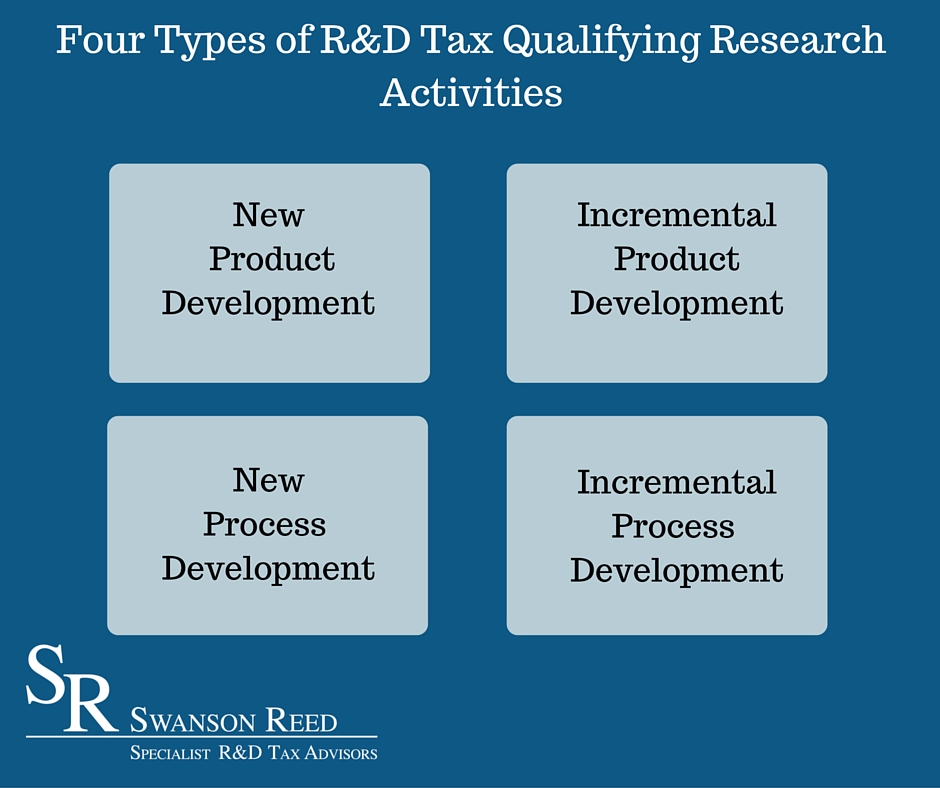
To begin with, qualifying R&D activities generally fall into one of four general categories (see infographic below).


In relation to the above, it is important to note that ‘new’ or ‘incremental’ is determined as related to an individual company, rather than the industry or the world.

Additional examples of qualifying activities include:

  • Design and development of new products – particularly products that are safer, more effective or have increased functionality, better performance or longer shelf life;
  • research of new applications for existing products;
  • testing for compliance with domestic or foreign regulatory requirements;
  • design, development and implementation of new reagents, testing methods or protocols;
  • product experimentation and modification to increase yield or decrease reaction times;
  • improvement of manufacturing or production technologies, processes, techniques or procedures to increase yield, reduce waste and byproducts, improve safety, improve energy efficiency or comply with regulatory requirements;
  • design and development of scaled-up manufacturing processes;
  • development of prototype pilot batches of new product candidates for testing and validation;
  • implementation of automated processes or robotics to increase production efficiency;
  • Software development or information technology initiatives related to product or process improvements; and
  • research to receive International Organization for Standardization certifications, fertilizer safety or other similar certifications.

When claiming for the R&D tax credit, the following activities are unlikely to have a link to R&D activities and thus considered non-qualifying activities. Typically, these activities would relate to general company operating expenditure that the company would undertake regardless of R&D activities.

  • routine testing or inspection activities for quality control;
  • development related purely to aesthetic properties of a product or packaging;
  • testing and qualification of production lines;
  • production line modifications which don’t involve technical uncertainty, i.e. trouble shooting involving detecting faults in production equipment or processes;
  • market research for advertising or promotions;
  • routine data collections;
  • research conducted outside the U.S., Puerto Rico or any possession of the U.S.;
  • research that is funded by a third party other than the taxpayer; and
  • any other activities that don’t meet all of the four tests previously outlined.

Undeniably, the rules and regulations surrounding the R&D tax credit may be bewildering for some. Hence, a company may wish to seek external assistance to help identity their R&D eligible activities. Many accountants are not acquainted with the ins-and-outs of the R&D Tax, thus you may wish to consider a consultant that specialises in the area. Swanson Reed specialises in the R&D Tax Credit – contact us today to discuss your eligibility and learn more about how the R&D Tax Incentive may benefit your business.

Capitalizing on ‘IoT’ in Manufacturing: How Important is Documentation?

bigstock Internet Of Things 88710083

Undeniably, majority of us are already familiar with a number of smart devices. Powerful, sensor-equipped smart phones, for instance, have brought an unprecedented level of connectivity to our daily lives. Likewise, the Internet of Things (IoT) promises to extend sensor technology to all sorts of objects, even those that are not usually associated with the term “smart”. From a pacemaker to a coffee machine, everything will be linked together through the Internet.

Thus, the burgeoning of this fully connected world represents a unique opportunity for innovation. Throughout the nation, businesses of all types and sizes are engaged in making the IoT a reality. In effect, according to IDC, the worldwide IoT market will grow from $655.8 billion in 2014 to $1.7 trillion in 2020. Furthermore, insights from the MPI Group‘s Internet of Things Study, reveal that 76% of manufacturers will increase their use of smart devices or embedded intelligence in manufacturing processes in the next two years.

However, are companies capitalizing on all the opportunities that IoT represents? Irrefutably, the very nature of IoT is intrinsically linked to innovation.  On the one hand, new products, novel business models, improved processes, and innovative interactions are bound to emerge. On the other hand, ground-breaking technological advances will be necessary before the IoT begins to realize its full potential. Either way, companies engaged in any type of IoT-related innovation may qualify for significant federal research and development (R&D) tax credits.

Nonetheless, despite approximately two-thirds of manufacturers believing that the IoT will increase their profitability, majority are actually lagging in maximising their IoT opportunities. Specifically, MPI Group’s insights highlight that manufacturing companies are overlooking substantial R&D tax credit savings.  In fact, the study reveals only 17 percent of manufacturers said they were planning to claim tax credits and incentives for their IoT investments, meaning most manufacturers (83 percent) are missing a critical opportunity. For those manufacturers not planning to claim credits and incentives for IoT investments, concern about the associated costs is identified by only 11 percent of respondents. Whereas nearly half (45 percent) of manufacturers say the reason for not claiming the credits is based on a lack of documentation.

Ultimately, manufacturers can address the cost and risk of research and development by leveraging the aforementioned federal, state and local tax incentives. Indeed, planning ahead by creating an infrastructure that identifies qualifying research activities and collects contemporaneous documentation is ideal in reducing future tax liabilities and synthesizing an R&D tax credit that will be sustainable on audit examination. However, although documentation is useful to support these credits, courts have ruled previously that oral testimony can be used to support them as well.  For taxpayers without detailed records, reasonable estimates based on the longstanding rule in “Cohan rule” may be allowed. Though, it is still preferential to always keep contemporaneous documentation in support of research activities.

In conclusion, the R&D tax credit is available to businesses that uncover new, improved or technologically advanced products, processes, principles, methodologies or materials. As noted above, the nature of IoT is inherently interrelated to innovation and many companies engaged in any type of IoT-based innovation may qualify for significant tax savings. While claiming the credit requires time, resources and expertise, it can also provide significant monetary and operational benefits to businesses. Nonetheless, the credit continues to be underused by qualified companies primarily because of a misunderstanding of qualification and documentation requirements for federal and state credits. Therefore, in this instance, it is best to contact that help of specialist R&D Tax Advisor to assist with your claim.

Swanson Reed’s R&D tax professionals are available to discuss the R&D tax credit – contact us today if you would like to know if your company now qualifies.