
Is Big Oil Ready for Big Data?

pump-jack-848300_640Globally, the oil and gas sector continues to experience price volatility, however, is this current environment fueling opportunities for innovation? A new report, Innovating in a New Environment, launched by Lloyd’s Register Energy, couples expert knowledge with third party insights to provide data-driven findings on the role of innovation in the current and future oil and gas industry. Key findings in the report find the “digital oil field” brings an increased need for technology innovation and strong capabilities in data, statistics and mathematics joined with the traditional science and engineering skills.

While the environment may be creating circumstances for innovation, 76% of the study’s respondents reveal that the oil price has led them to slow down or terminate most innovation activities. In relation to this, the report highlights that stopping an innovative project today may assist the bottom line in the short term, however, it could weaken a company’s ability to discover and exploit new reserves of oil and gas tomorrow. Indeed, whether prices are high or low, the fact remains that there is a declining supply of ‘easy oil’.

Therefore, digital technologies could propose the greatest efficiency benefits to be achieved in a low oil price world with dwindling ‘easy oil’ levels. Digital technology can often be expedited upstream more hastily than other technologies and they have the benefit of being scalable at a comparatively low cost. Despite this, the oil and gas industry is no foreigner to data collection implements. For instance, sensors that generate data on deposits have been used in remote environments for well over a decade. Curtin University’s Dr. Evans believes data collection and analytics will overshadow other technologies in the industry and will be directed by a focus on cost-efficiency.  Ultimately, he reveals, “our ability to become lean and mean will come down to our ability to master data analytics.”

In the long term, oil and gas firms must continue to participate in innovation or are in jeopardy of losing competitive edge. As suggested by the report, oil and gas firms should look at new collaboration models to learn how other industries have completed more with less resources, utilized new technologies and employed ‘big data’.

Overall, a continual phase of low oil prices may disintegrate conservative attitudes towards innovation in the oil and gas industry. As the Innovating in a New Environment report revealed, focusing more on research and development, advanced data collection and data analytics, is becoming increasingly important in the current low oil price market. In this respect, lower oil prices may be a blessing in disguise for technology innovation in the  oil and gas industry, thereby transforming the industry’s approach in an enhanced manner that will assist its needs for short and long term challenges. Consequently, the R&D Tax Incentive can have a positive effect on assisting the oil and gas industry who are partaking in innovative activities.  If you believe your company is undertaking qualifying research and development activities, contact one of our specialists today to find out if you could benefit from R&D credits.
How R&D Can Transform the Oil & Gas Industry

From operating our vehicles to warming our homes, oil and gas is one the most commonly used and important commodities in the world. In 2014, oil provided approximately 38% of the world’s energy needs and is directly responsible for about 2.5% of world GDP. Indeed, oil and gas is a leading component of the world’s energy mix, a trend that will no doubt endure for many years to come.

However, in an increasingly technologically-driven world, the oil and gas industry is changing in two fundamental ways. Firstly, with majority of the world’s ‘easy oil’ already exhausted, the importance of utilizing sophisticated technologies to find and produce tomorrow’s hydrocarbons is becoming increasingly imperative. Secondly, high profile disasters such as Shell’s Brent Spar Incident in 1995 or the recent Deepwater Horizon accident (Perrons, 2014), has resulted in a significant shift in the expectations of the oil and gas industry in regards to safety, environmental stewardship and human welfare. Thus, in the face of these challenges, technology and innovation will play a pivotal role in the success or failure of the future of oil and gas firms.

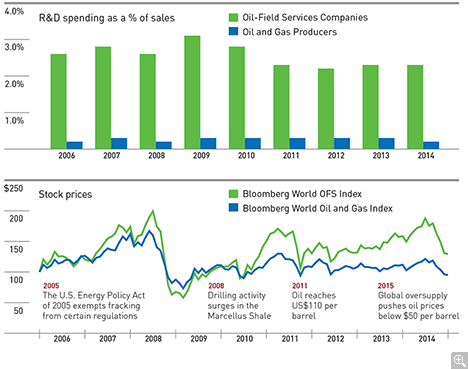
Generating the question, how can oil and gas companies succeed in an industry where supply is limited and expectations are high? One way is through investing in research and development (R&D) to drive innovation and create new and improved technologies. Certainly, one would expect that the economic rewards in an industry that is perceptibly more technology-driven would go to the firms that create most of the innovations – and, indeed, that seems to be happening.  Several international oil companies (IOCs) and national oil companies (NOCs) have increased their spending on R&D dramatically over the past years. In particular, oil-field service companies have greatly increased their investment in innovation which has correlated with higher stock prices, as seen below.

15201_ex1s
Source: Doshi, 2015.

Without a doubt, investing in R&D to create new and improved technologies is vital in enabling the industry to meet global energy demand. Moreover, with traditional forms of energy becoming harder to find, investing in new technologies will be critical in meeting the needs of an increasingly urbanised population and to combat environmental challenges in the decades ahead.

In addition, several companies may already be partaking in R&D activities and may not be aware of how the federal and state governments seek to support them by encouraging innovation through the Research and Development Tax Credit. Oil and gas companies are eligible for this incentive, which presently values at almost 10 billion dollars, for work activities that are often already being conducted. Many of these activities may not occur in traditional laboratories or are not usually thought of as ‘research’. Nonetheless, these undertakings entail time and money that may be defined as qualified research expenditures resulting in substantial tax benefits. Both large and small companies in the oil and gas industry are able to get the incentive – contact Swanson Reed’s R&D tax specialists today to see if you’re eligible.

 

References:
Perrons, Robert K. (2014) How innovation and R&D happen in the upstream oil & gas industry : insights from a global survey. Journal of Petroleum Science and Engineering124, pp. 301-312.
“Surviving the Worst: It’s Time for Oil Services to Address Shortcomings and Find Strategic Solutions,” by Viren Doshi, John Corrigan, Shawn Maxson, and Adrian del Maestro, Strategy& white paper, Feb. 2015, strategyand.pwc.com/OFS; Bloomberg; University of Michigan Center for Local, State, and Urban Policy.

Low Oil Prices Are Causing Companies To Create New Innovative Technologies

The fallen oil prices have triggered new creativity in oil companies when finding ways to get the most bang for their buck. Unlike the past when oil companies were focused on drilling LOTS of oil FAST, the main concern these days seems to be drilling oil efficiently – producing the most amount of oil for the least amount of money – and oil companies are banking on advanced technology to help them do so.

Companies have started using high-tech equipment such as lasers and data analytics prior to drilling to check if a new oil well will give them the most oil for their money. Some are testing out new technologies that will produce more oil from both old and new wells. Refracking – using new advanced fracking technologies to get more out of wells that have been fracked in the past – is becoming a common practice, along with using advanced software and sensors to determine the best place to use certain materials to produce the most amount of oil.

The big players in the oil and gas industry are investing more money in R&D this year. Eric Gebhardt, Chief Technology Officer and Vice President of Engineering for General Electric’s oil and gas division, says that his divisions plans on increasing its R&D spending this year in search for new technologies.

“You have to keep your focus on finding new and innovative solutions,” said Bruce Tocher, manager for shale oil and gas research at Statoil, a Norwegian energy company, according to The Wall Street Journal. “You need those solutions more than ever.”

Contact a Swanson Reed specialist for more information on claiming the R&D tax credit for qualified activities in the oil and gas industry.
Source: www.wsj.com


A royalty free image from the oil and gas industry of two oil workers in an oil field at duck.

Texas, The New Tech Hub

Texas has the potential of giving Silicon Valley a run for its money. Texas employs more workers that provide Internet services (ISP) than any other state and ranks second in the nation for the Computer Systems Design sector of the IT industry. Texas is home to 13,991 technology firms employing over 156,500 workers with an average salary of nearly $70,000. Here is what the tech industry workforce in Texas looks like:

Industry Firms Employment Average Annual Wage
Computers and Peripheral Equipment 115 16,110 134,351
Computer Systems Design and Related Services 14,825 122,403 93,311
Software Publishers 778 17,464 118,116
Data Processing and Related Services 956 28,947 89,401
Internet Publishing, Broadcast and Web Portals 530 3,763 75,053
Specialized Telecommunications and ISP’s 94 1,680 80,097

Discovering New Technology is Required to Remain Competitive

Without investment in research and development there is no way technology firms will be able to stay competitive and survive as a business. R&D is the lifeblood of technological advancement and  is one of the reasons why the R&D tax credit was created — as an incentive for companies to develop new technologies here at home instead of overseas.

If you’re looking to benefit from the credit it is important to look at the guidelines behind eligibility and what is necessary  throughout the R&D process. If you’re unsure about your eligibility we are here to help you. Familiarize yourself with the IRS’ 4-part qualifying test and take our eligibility test to find out if your business qualifies.

Reduce Your Tax Liabilities and Invest in Innovation

The R&D tax credit is an excellent way of reducing tax liabilities and enables  the chance to invest in research and development  for all tax-paying firms, even the youngest and smallest of start-ups. If you’re working on ways to improve products or processes there is a good chance you are eligible for the credit. The R&D activities you undertake need to be of a technological nature. If so there are many business expenses within the R&D processes that you can use in your claim. These include the costs relating to prototypes, inventions and creating pilot products. In 2012, the info tech industry received $1.8 billion in R&D credits from the government, while the professional and tech services industry received $1.1 billion. Find out how you can get a portion of that number.

Swanson Reed regularly hosts free webinars and provides free IRS CE and CPE credits for CPAs. For more information please visit us at www.swansonreed.com/webinars or contact your usual Swanson Reed representative. Click here for more information about our technical expertise.

Source: texaswideopenforbusiness.com

Swanson-Reed-Specialist-RD-Tax-Advisors

Pharmaceutical R&D Productivity Continues to Improve

According to new data from the Thomson Reuters 2015 CMR Pharmaceutical R&D Factbook, the number of innovative medicines released internationally increased from 20 in 2013 to 46 in 2014, the highest it’s been in 17 years.

Nearly one-third of all R&D spending went towards oncology, making it the most funded area for research. Just in the last year, two cancer drugs were introduced that help the body’s immune cells fight tumors.

The industry has also seen an improvement in the amount of success stories, with the number of projects failing in the final stage of research greatly decreasing in the past six years. In the past three years, projects failing in phase III, fell to 56 from the 68 documented in 2009-2011.

Philip Miller, senior director for clinical and regulatory affairs at Thomson Reuters said, “the industry is looking in really good shape.” He said the industry is also benefiting from a move to specialized drugs which usually  advance through clinical development quicker than mass-produced and highly marketable medicines.


Source: reuters.com

Chemist cropped - pharmaceutical

Texas Is Home to a Thriving Biotech Industry

Texas has become a hot spot for scientific and medical research in the United States, with over 30 colleges, institutes and centers working on research and development projects. In 2014, the National Institutes of Health (NIH) database ranked Texas second in the nation for the number of clinical trials being conducted, with more than 16,900 studies in progress.

The numbers don’t lie…

  • Texas has more than 3,600 businesses engaged in biotechnology R&D and manufacturing.
  • From 2008 to 2013, venture capitalists invested $1.3 billion in 161 biotech and medical device deals.
  • The Texas Medical Center in Houston conducts $3.4 billion in R&D every year while housing more than 49,000 students and 106,000 employees.
  • Through the Texas Emerging Technology Fund (TETF), the state of Texas has raised $145 million in bio-medicine and pharmaceutical projects.

Texas Universities  and other health-related institutions invest millions of dollars each year in biotech R&D and intellectual property generation. Texas is home to five of the nation’s top 100 medical schools. The top ten institutions for bio-medical R&D in Texas have invested nearly $2.5 billion in R&D.

Institution Total Medical R&D Invested
(in millions)
The University of Texas M.D. Anderson Cancer Center $582.1
Baylor College of Medicine-Houston $450.6
The University of Texas Southwestern Medical Center at Dallas $388.9
The University of Texas Health Science Center at Houston $226.7
The University of Texas Health Science Center at San Antonio $163.8
The University of Texas Medical Branch at Galveston $139.3
Texas A&M Health Science Center $77.5
Texas Tech University Health Science Center $60.6
University of North Texas Health Science Center $41.9
The University of Texas Health Science Center at Tyler $12.0
Total $2,143.4


The Workforce 

The biotech workforce in Texas is highly competitive. Texas is one of the top three states in the country for biotech doctorates awarded in agricultural sciences/natural resources, health sciences, life sciences and biological/bio-medical sciences.

The depth and strength of the Texas biotech industry can be seen in the workforce numbers.

Industry Industry
Code
Firms Employment Average
Annual Wage ($)
Other Basic Organic Chemical Mfg. 32519 105 7,366 114,254
Agricultural Chemical Mfg. 3253 110 3,096 85,477
Pharmaceutical & Medicine Mfg. 3254 155 9,930 105,582
Electromedical Apparatus Mfg. 334510 57 2,039 92,026
Analytical Laboratory Instruments Mfg. 334516 32 1,534 80,434
Medical Equipment and Supplies Mfg. 3391 727 11,519 50,573
Testing Laboratories 54138 840 14,974 67,261
Biotechnology R&D 541711 353 4,485 105,097
Physical, Engineering & Life Sciences R&D 541712 687 15,657 89,997
Medical and Diagnostic Laboratories 6215 1,242 18,307 54,851


Well played, Texas.

Contact a Swanson Reed specialist for further information.

Source: texaswideopenforbusiness.com

Test-Tubes-small

The Information Technology and Innovation Foundation Asks Congress for More Supportive Manufacturing Policies

Congress’ recent Congressional Research Service (CRS) report states that the manufacturing industry has recovered from the Great Recession and is thriving.

The Information Technology and Innovation Foundation (ITIF) found this information to be misleading and released a report today — titled “A Critique of CRS’s ‘U.S. Manufacturing in International Perspective’” — saying the manufacturing industry is still in trouble and needs policymakers’ support to help it flourish again.

“America’s future economic prosperity depends on a healthy manufacturing sector,” said Robert Atkinson, founder and president of ITIF and co-author of the report. “We need to take an honest look in the mirror. Right now, the state of U.S. manufacturing is not a pretty picture. The CRS reports gets it wrong. The real facts are clear: U.S. manufacturing is in trouble and needs help more than ever.”

The ITIF report analyzes and opposes multiple statements from the CRS report:  

How many manufacturing jobs did we lose?

The CRS reports a 12 percent loss of manufacturing jobs between 2003 and 2013 based on unofficial data.

The ITIF report found that  based on the Bureau of Economic Analysis data, manufacturing employment decreased 30.7 percent between 2003 and 2013.

Is U.S. manufacturing output actually up?

The CRS report compares U.S. manufacturing output to other countries and finds that everything looks as it should with no real concerns.

The ITIF report compares U.S. manufacturing output as a percent of GDP and found that numbers were static at best.

Are there signs of growth?

The CRS report says the future is looking optimistic due to our high manufacturing R&D, high foreign direct investment and a high percentage of domestically manufactured inputs.

The ITIF report found that when controlling for industrial composition, the results are not so favorable for R&D.

The ITIF report continues with suggestions on how Congress could help support the struggling manufacturing industry, including legislation to reduce the corporate tax rate; improve investment incentives, including for R&D; better execute trade rules internationally and support manufacturing innovation and workforce development.

“Clearly, Congress needs to act to get U.S. manufacturing back on track,” said Atkinson. “Policymakers must take seriously the gravity of this situation. It is time to reinvigorate American manufacturing  before it’s too late.”

Read the full ITIF report here.

Source: www.benzinga.com


Construction

House Passes Legislation to Repeal the Medical Device Tax

On June 18, the House of Representatives passed the Protect Medical Innovation Act (H.R. 160), which amends the Internal Revenue Code to repeal the excise tax (2.3 %) on medical device manufacturers and importers.

The excise tax was initially created in 2010 to help pay for the health care overhaul, but had been acting as a deterrent for healthcare companies to create new technologies and was negatively affecting the industry as a whole. It had been referred to as a “tax on innovation” and a “job-killing tax” due to its effect on R&D spending and job creation.

Since the tax came into effect two years ago, Companies have been lobbying to get rid of it and Congress is now receiving praise for the 280-140 House vote for passage of the Protect Medical Innovation Act.

One supporter of the repeal, Biocom the association representing the Southern California life science community, released a statement expressing its gratitude and excitement for the future.

“The medical technology industry of Southern California supports 35,000 jobs and generates over $21 billion in economic activity annually. Over the past decades, our community has invested billions in research and development and brought cutting edge, life-saving technologies to patients in need, at home and abroad. The medical device tax is effectively a tax on innovation, which stifles investment in R&D and job creation, and ultimately jeopardizes patient access to breakthrough devices and therapies.”


Chemist cropped

Innovation Is Key for Manufacturing Companies

Manufacturing companies are focusing on innovation and R&D investment to stay competitive in the market.

According to the 2015 KPMG Global Manufacturing Outlook (GMO) Survey , more than 2/3 of the 386 manufacturing executives surveyed state that long-term innovation strategies, with an intention for increased investment in R&D and new manufacturing technologies, are their top priority.

“Investing more in R&D is certainly helpful, but manufacturers need to also focus on continuously enhancing and adapting their innovation models if they hope to survive,” says Jeff Dobbs, KPMG’s Global Head of Industrial Manufacturing, according to Global Trade Daily.

44% of those surveyed said they will spend more than 20% of their technology budget on systems to enhance the “pace and value of innovation — engineering, manufacturing and supply chain — ” within the next year.

“The focus on new product development, collaborative innovation and speed-to-market all require new strategies and business models. If manufacturers hope to grow by driving new innovations to market, they need to focus on improving the agility and integration of their supply chain models,” said Dobbs.

Many manufacturing companies rely on the R&D Tax Credit to be able to innovate and excel in the industry. Out of the $10.8 billion in research credits that were granted in 2012, $6.6 billion were reported by corporations in the manufacturing business.

By identifying and documenting qualifying research activities and expenditures, manufacturing corporations, along with essentially any other industry, can optimize their R&D tax credits and reduce tax liability.

Click here to find out if your company is eligible for the federal R&D Tax Credit.

Machine Operator

The Value of Government Research Dollars

In an attempt to stop the steady decline of public funding for science, the Academy of Radiology Research has shown Congress just how much the country gains from the government’s research money.

According to the science research institute Battelle, every $100 million invested in research by the National Institutes of Health (N.I.H) produces close to six patents. Every $100 million at the National Science Foundation produces more than 10 patents. That same amount of investment dollars at the National Institute of Biomedical Imaging and Bioengineering, which finances research in radiology, generates nearly 25 patents. In return, these patents created $578.2 million of further R&D down the road.

“N.I.H research has helped lower the burden of disease, and people in both parties recognize its importance,” said Jonathan Lewin, chairman of the department of radiology at Johns Hopkins University and head of the academy of radiology, according to The New York Times. “We decided to look at the economic value of our research to make the argument about this value, too.”

Today, the National Institutes of Health budgets are 20% less than they were 10 years ago.

The government’s investment in research produces a plethora of social benefits; a strong economy, more jobs, improved public health, and high quality universities. There is no doubt that science is a public good.

The Academy of Radiology Research is hoping that their study will assist in prioritizing funding and serve as a wake up call.

Book Keeping - Copy