R&E Amortization and the R&D Tax Credit

bigstock Businesswoman presenting to co BW e1456197552538

Key Takeaway: Companies who perform and incur research and experimental expenses must amortize their R&E costs, regardless of whether or not the R&D Tax Credit is claimed. 

While the Tax Cuts and Jobs Act (TCJA) became effective January 1, 2018, not all provisions came into effect right away. One such provision included changes to the treatment of research and experimental (R&E) expenditures. This provision, outlined in Section 13206 of the TCJA, became effective for tax years beginning after December 31, 2021, and will have a ripple effect in both financial and tax reporting.

The Change

Section 13206 amended Sec. 174, requiring taxpayers to amortize specified R&E expenditures ratably over a 5-year period for domestic expenditures and a 15-year period for specified R&E expenditures attributed to foreign research, using a half-year convention.

In this amendment, the TCJA also changed the term “research or experimental expenditures” under the old Sec. 174(a) to “specified research or experimental expenditures.” The amendment defines specified research or experimental expenditures as “research or experimental expenditures which are paid or incurred by the taxpayer during such taxable year in connection with the taxpayer’s trade or business.”

Software development costs were also specifically mentioned. Software development expenses incurred in tax years starting after December 31, 2021, are no longer deductible under Rev. Proc. 2000-50. Instead, they must be treated as R&E expenditures under Sec. 174 and, as such, amortized.

History

In the past (i.e. for tax years beginning before December 31, 2021), taxpayers were able to treat R&E expenditures in one of four ways:

  1. Currently deduct costs under Sec. 174(a);
  2. Capitalize the costs (if not subject to depreciation or depletion allowances under Sec. 167 or 611) and then amortize them over a period of not less than 60 months under Sec. 174(b), beginning with the month in which they first realize benefits from the expenditures;
  3. If neither (1) nor (2), they could charge them to capital account under Regs. Sec. 1.174-1; or 
  4. Under Sec. 59(e), they could capitalize and amortize ratably certain qualified expenditures over a 10-year period. Under Sec. 59(e)(2), a qualified expenditure is any amount that would have been allowable as a deduction for the tax year in which the expenditure was paid or incurred. Under Sec. 59(e)(2)(B), expenditures under Sec. 174(a) would have qualified for the 10-year amortization treatment.

What This Means for the R&D Tax Credit

First, the TCJA did alter the definition of qualified research under Sec. 41 (d)(1), moving from “expensed under section 174” to “specified research or experimental expenditures under Section 174). This change aligns the definitions of qualified research in Secs. 41 and 174. In other words, specified R&E expenditures for the credit under Sec. 41 must first be included in specified R&E expenditures under Sec. 174. Prior to the TCJA, the Sec. 41 credit only required that R&E expenditures were eligible for Sec. 174 treatment.

It is important to note that the changes made to Sec 174 are not contingent on claiming the R&D tax credit. In fact, it’s the reverse. Any and all R&E (i.e. Sec 174) costs must be subjected to the new provision regardless of whether or not your company claims the R&D tax credit. The credit can only be calculated using those R&D (i.e. Sec 41) expenditures which have been included in Sec 174 treatment.

Second, the TCJA made a conforming amendment to Sec. 280C(c) to preclude taxpayers from receiving a double benefit. Sec. 280C(c)(1) provides that if the amount of the credit under Sec. 41(a)(1) exceeds the amount allowable as a deduction for a tax year for qualified research expenses or basic research expenses, then the amount chargeable to capital account for the tax year for such expenses is reduced by the amount of the excess. In other words, if the amount of the Sec. 41 credit exceeds the amount of deductible qualified R&E expenditures, then the amount of the capitalized R&E expenditures must be reduced by this excess.

280C(c) Example

A taxpayer has a $150,000 research credit and an allowable $100,000 qualified research expense deduction (i.e. the current year deductible portion of the R&D expenses). The taxpayer must reduce the capitalized portion of the R&E expenditures by $50,000. The taxpayer may avoid this result by instead electing to reduce the credit under Sec. 280C(c)(2) on a timely filed tax return. The first few years of this change will present some challenges. However, as time passes, the impact of this rule change should diminish.

What This Means Long Term

Assuming Congress does not delay, postpone, or repeal the amortization of R&E expenditures this year, federal tax liabilities of taxpayers with these expenditures may increase. The current R&E expenditure deduction will be cut by 90% in the first year under a five-year amortization period (15-year for foreign R&E expenditures) and a half-year convention.

Taxpayers with stable R&E expenses will see a return to normal within a few years, wearing the currently deductible R&E expenditures will approach the levels that were deductible before the change.

Value of the R&D Tax Credit with a Stable R&E Spend Example

In this example, a taxpayer incurs $500,000 per year in R&E expenditures (Sec 174). Out of this, $400,000 are determined to be R&D expenditures (Sec 41), resulting in a net R&D tax credit of $30,000 annually. Assuming these values are stable each year, the table below demonstrates how the amortization of the Section 174 Expenses will impact the amount of tax owed.

After the sixth year, the amount of deductible R&E expenditures will be at the levels prior to the rule change. In addition, the R&D tax credit helps to alleviate the tax burden sooner than without the credit. Generally, taxpayers will pay more in taxes in year 1 and 2, but not more overall.
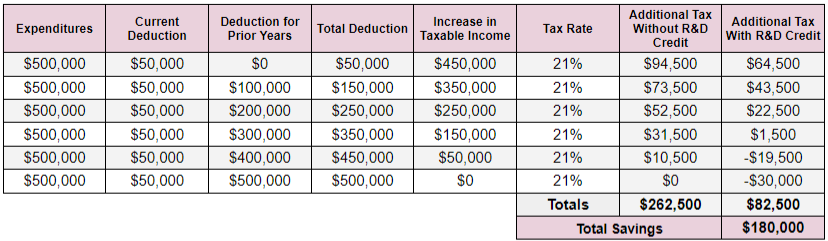
Table-1

Are you developing new technology for an existing application? Did you know your development work could be eligible for the R&D Tax Credit and you can receive up to 14% back on your expenses? Even if your development isn’t successful your work may still qualify for R&D credits (i.e. you don’t need to have a patent to qualify). To find out more, please contact a Swanson Reed R&D Specialist today or check out our free online eligibility test.

Who We Are:

Swanson Reed is one of the U.S.’ largest Specialist R&D tax advisory firms. We manage all facets of the R&D tax credit program, from claim preparation and audit compliance to claim disputes.

Swanson Reed regularly hosts free webinars and provides free IRS CE and CPE credits for CPAs. For more information please visit us at www.swansonreed.com/webinars or contact your usual Swanson Reed representative.

IRS Guidance on Amending Returns for R&D Tax Credit

bigstock Businesswoman presenting to co BW o

The IRS issued a Chief Counsel memo in fall 2021 outlining specific information now required when amending a tax return to include the R&D tax credit. This supplemental information will be used to aid the IRS in expediting their review process of amended returns.

This new requirement for supplemental information impacts any taxpayer planning to amend their tax return for an R&D tax credit after January 10, 2022. If the IRS finds the information provided deficient, the credit claim could be denied.

Previously, amended returns were treated similarly to timely filed returns, wherein taxpayers would only need to provide supplemental documentation upon request. 

The supplemental documentation is to be included in the amended tax return to be reviewed by an IRS agent upon submission. If the claim were to be found deficient, the return would be denied. The taxpayer would then have 45 days to perfect the claim and resubmit it to the IRS.

What is a Valid Tax Credit Claim?

In order to be a valid claim, as defined by the IRS, Taxpayers must:

  • Identify all the business components to which the Internal Revenue Code (IRC) Section 41 research credit claim relates for that year.
  • Identify all research activities performed for each business component.
  • Name the individuals who performed each research activity.
  • Describe the information each individual sought to discover.
  • Provide the total qualified employee wage expenses, total qualified supply expenses, and total qualified contract research expenses for the claim year. This may be done using Form 6765, Credit for Increasing Research Activities.

Additional Details and FAQs

  • Transition Period
      • The IRS extended the transition period to January 10, 2024. During the transition period, taxpayers who file an amended tax return for an R&D credit claim will be allowed 45 days to perfect their claim if the IRS finds the initial filing deficient.
      • After this transition period closes, credit claims that are denied can’t be fixed or appealed.
      • Taxpayers will not receive any refunds for the credits they attempted to amend.
  • What is “Perfecting a Claim for Refund?”
      • Perfecting a claim means taxpayers have the opportunity to provide missing information to process the R&D credit claim.
      • The IRS will notify taxpayers of a deficient claim and provide a maximum of 45 days to perfect the claim. The letter sent to the taxpayer will include the date by which the taxpayer must provide the updated claim.
  • Does supplementary documentation need to be submitted if a claim isn’t being amended for a refund?
      • No. If an R&D credit is submitted on an amended tax return that doesn’t result in a refund to the taxpayer, the supplementary documentation for the claim doesn’t need to be submitted with the amended tax return.
  • What’s the preferred method to provide missing information to the IRS?
      • The IRS noted that the best way to provide missing information for a deficient claim is by fax to a designated number. You can also send information by mail.
      • As of publication date, the IRS planned to have amended tax returns with R&D credit claims reviewed and processed within six months of receiving the amended tax return.
  • Pass through entities
      • If a claim for refund that includes the Research Credit is based on a Research Credit from a BBA partnership, the BBA partnership does not file an amended return.  Instead, the BBA partnership must file an administrative adjustment request (AAR) and attach the five items of information to that AAR.  As part of the AAR process, the BBA partnership will also submit Forms 8985 and 8986 to the IRS and send Forms 8986 to its partners.  The BBA partnership is not required to provide the five items of information again on the Forms 8985 and Forms 8986.  The BBA partners do not need to attach the five items of information to their original returns to which their Forms 8986 are attached. 
      • If a claim for refund that includes the Research Credit is based on a Research Credit from a non-BBA pass-through entity (such as a TEFRA partnership, S corporation, or other non-TEFRA/non-BBA partnership), the non-BBA pass-through entity may include the five items of information with its amended return. Partners or shareholders are required to include the five items of information with their amended tax return claiming the Research Credit.  Partners or shareholders should receive the five items of information from the partnership or S corporation in which they are a partner or shareholder, for example, in the form of an amended Schedule K-1 (and any statements attached thereto).
  • What if you e-file an amended return?
      • Taxpayers who e-file their amended return claiming a refund involving the R&D tax credit are still required to provide the five items of information with their e-filed amended tax return.
  • Statistical Sampling
    • Revenue Procedure 2011-42 provides guidance to taxpayers on using statistical sampling.  
    • If taxpayers utilize a statistical sample to compute their Research Credit, the documentation for all units in the sample must contain the first four items of information and must be provided with the claim for refund.  
    • Taxpayers utilizing a statistical sample to compute their Research Credit are still required to provide the total qualified employee wage expenses, total qualified supply expenses, and total qualified contract research expenses, as computed pursuant to Rev. Proc. 2011-42, for the claim year with the claim for refund.

Additional questions have been answered in an FAQ released by the IRS.

Are you developing new technology for an existing application? Did you know your development work could be eligible for the R&D Tax Credit and you can receive up to 14% back on your expenses? Even if your development isn’t successful your work may still qualify for R&D credits (i.e. you don’t need to have a patent to qualify). To find out more, please contact a Swanson Reed R&D Specialist today or check out our free online eligibility test.

Who We Are:

Swanson Reed is one of the U.S.’ largest Specialist R&D tax advisory firms. We manage all facets of the R&D tax credit program, from claim preparation and audit compliance to claim disputes.

Swanson Reed regularly hosts free webinars and provides free IRS CE and CPE credits for CPAs. For more information please visit us at www.swansonreed.com/webinars or contact your usual Swanson Reed representative.

Review of R&D Funding by Sector

engineer-4915787_1920

Research and Development funding throughout the United States has historically come from 5 distinct sectors. These include the federal government, state governments, businesses, academia, and nonprofit organizations. The composition of funding from these sectors has changed over the years as R&D has shifted from a primarily federal activity to a commonplace component of individual businesses. To see a detailed breakdown of R&D funding compositions and performance in 2019, see the Congressional Research Service report.

The federal and business sectors dominated the funding, accounting for more than 90% of R&D funding since 1955. In 1964, federal funding reached its peak, accounting for 88.8% of R&D expenditures on its own. From this point on, business funding began to rise and overtake federal funding as the business sector experienced a boom in innovation and self-funded R&D endeavors. By 2019, the business sector accounted for 70.7% of the U.S. R&D expenditures on its own.

Character of R&D

There are 3 unique types of R&D. Total estimated U.S. R&D expenditures in 2019 (the most recent year for which data are available) were $656.0 billion. Of this amount, $107.8 billion (16.4%) was for basic research, $124.8 billion (19.0%) was for applied research, and $423.4 billion (64.5%) was for development.

Basic Research: experimental or theoretical work which aims to acquire new knowledge of the underlying foundations of phenomena. These often have no particular application or use in view.

Applied Research: Original investigations undertaken to acquire new knowledge and with a specific and practical objective.

Development: Systematic work which draws on knowledge gained from research and practical experience. This ultimately produces new knowledge directed to producing new or improved  products or processes.

Federally Funded R&D

Federal R&D funding grew from $3.5 billion in 1955 to $138.9 billion in 2019 (in current dollars). This growth was not consistent over the years, as the nation saw a drop in funding between 2011-2014 with an $8.6 billion decline in funding. Similar drops were seen between 1987 and 1994. In more recent years, there has been an effort to increase this funding, getting innovation back on track and supporting the investment into R&D. 

Federal funding accounts for the largest share of basic research. The federal government performs some of the research it funds, but also funds research performed by business, universities and colleges, and other organizations.

Business Funded R&D

This sector has seen growth in R&D funding nearly every year since 1955, growing from $2.2 billion to $463.7 billion in 2019. The rate of growth has slowed down in recent years, reaching the beginning of a plateau. This continuous increase is a direct result of the benefits of investing in R&D. When a company commits $1 to their own R&D practices they often see a hefty return on investment.

The business sector accounts for 55% of applied research and 85.5% of development. This is largely due to the greater ROI on these research types, allowing businesses to advance their own objectives and expand their stake in the industry.

Are you conducting research and development activities? Did you know your development work could be eligible for the R&D Tax Credit and you can receive up to 14% back on your expenses? Even if your development isn’t successful your work may still qualify for R&D credits (i.e. you don’t need to have a patent to qualify). To find out more, please contact a Swanson Reed R&D Specialist today or check out our free online eligibility test.

Who We Are:

Swanson Reed is one of the U.S.’ largest Specialist R&D tax advisory firms. We manage all facets of the R&D tax credit program, from claim preparation and audit compliance to claim disputes.

Swanson Reed regularly hosts free webinars and provides free IRS CE and CPE credits for CPAs. For more information please visit us at www.swansonreed.com/webinars or contact your usual Swanson Reed representative. Click here for more information about our technical expertise.

Federal Budget for 2022 Fiscal Year Increases R&D Funding

Mississippi Patent of the Month - August 2021

“Where we choose to invest speaks to what we value as a Nation.” – President Biden

The budget for the 2022 fiscal year has unique challenges as the office strives to confront the pandemic and rescue the economy from its effects. Part of this economic effect is seen in the nation falling behind its biggest competitors in research and development. With this in mind, the new budget once again renews its commitment to R&D.

The budget proposes historic increases in funding for foundational R&D across a range of scientific agencies including:

  • National Science Foundation
  • National Aeronautics and Space Administration
  • Department of Energy
  • National Institute of Standards and Technology

The budget includes plans to invest in R&D, revitalize manufacturing and small businesses, and focus on technologies of the future. The budget outlines investment plans for 2022-2031 in these areas:

  • Fund research infrastructure, including Historically Black Colleges and Universities
  • Increase R&D for existing programs
  • Transform the NSF by adding a technology doctorate
  • Increase climate-focused research
  • Increase demonstration funding at energy programs
  • Launch Advanced Research Projects Agency-Climate
  • Create STEM centers of Excellence
  • Fund STEM education and training

In Fiscal Year 2021, federal spending on R&D was around $157 billion. The president’s Fiscal Year 2022 budget would increase that number to $171 billion. 

While these commitments can help the nation achieve innovation, the commitment also spreads to any business conducting their own R&D efforts. To support small business innovation, the budget incorporates plans to create a national network of small business incubators and innovation hubs, connecting businesses together to drive innovation. This budget commits to funding and supporting innovation across the nation in a 9% increase, creating hundreds of thousands of quality jobs. 

How do these commitments stack up against historical R&D funding?

Federal funding for R&D has grown from $3.5 billion in 1955 to $138.9 billion in 2019 (in current American dollars). This shows a compound annual growth rate of 5.9%. A dip in federal funding between 2011 and 2014. To rebound from this, a 2.1%, 4.1%, and 5.3% increase in funding over the course of 2017-2019 respectively. The 2022 budget supports this continued increase in R&D funding through the federal R&D tax credit and innovation grants.

Are you conducting research and development activities? Did you know your development work could be eligible for the R&D Tax Credit and you can receive up to 14% back on your expenses? Even if your development isn’t successful your work may still qualify for R&D credits (i.e. you don’t need to have a patent to qualify). To find out more, please contact a Swanson Reed R&D Specialist today or check out our free online eligibility test.

Who We Are:

Swanson Reed is one of the U.S.’ largest Specialist R&D tax advisory firms. We manage all facets of the R&D tax credit program, from claim preparation and audit compliance to claim disputes.

Swanson Reed regularly hosts free webinars and provides free IRS CE and CPE credits for CPAs. For more information please visit us at www.swansonreed.com/webinars or contact your usual Swanson Reed representative.

TechConnect West Virginia Receives $125K Grant

startup-594091_1920

TechConnect West Virginia has been awarded a third Federal and State Technology Partnership Program (FAST) grant from the US Small Business Administration. This $125, 000 grant will help West Virginia R&D-focused small businesses apply for and win federal Small Business Innovation Research (SBIR) and Small Business Technology Transfer (STTR) grants. The first award was received in 2019, showing rapid success over the past few years.

TechConnect’s FAST grant, called Bridging the Ecosystem in Science & Technology in West Virginia Program (BEST in WV), is raising awareness of the benefits of applying for the SBIR/STTR programs while offering additional financial and technical assistance to help companies and researchers do so. They intend to use hands-on education for entre[reneurs and small business owners on this application process and utilize online bootcamps to highlight best practices. 

The multi-billion-dollar SBIR and STTR programs were developed to help small businesses engage in R&D with strong potential for technology commercialization. They are highly competitive as they help to offset the costs associated with R&D and ensure businesses have the financial resources to achieve their goals.

Are you developing new software for an existing application? Did you know your development work could be eligible for the R&D Tax Credit and you can receive up to 14% back on your expenses? Even if your development isn’t successful your work may still qualify for R&D credits (i.e. you don’t need to have a patent to qualify). To find out more, please contact a Swanson Reed R&D Specialist today or check out our free online eligibility test.

Who We Are:

Swanson Reed is one of the U.S.’ largest Specialist R&D tax advisory firms. We manage all facets of the R&D tax credit program, from claim preparation and audit compliance to claim disputes.

Swanson Reed regularly hosts free webinars and provides free IRS CE and CPE credits for CPAs. For more information please visit us at www.swansonreed.com/webinars or contact your usual Swanson Reed representative.

Tonix Pharmaceuticals to Open R&D Center in Maryland

protective-suit-5716753_1920

Tonix Pharmaceuticals, a pharmaceutical company focused on developing repurposed drugs for central nervous system (CNS) conditions, has announced their plans to acquire an R&D facility in Frederick, Maryland.

The 48,000 sqft R&D facility will expand their vaccine and treatment development capabilities, with initial focus on COVID-19. They have currently started development of three treatment options, adn are looking to speed up the development process. An additional vaccine in development would protect against smallpox and monkeypox.

As the Delta variant leads to a rising case count in both the US and the UK, development of additional or new vaccines and treatments is paramount. But COVID-19 isn’t the only concern in the states. The re-emergence of monkeypox has been noted with cases in the US, Israel, Africa, and the UK. Tonix Pharmaceuticals aims to use their R&D facility to create a rapid and effective vaccine pipeline with efficacious results to get ahead of potential spreading diseases. 

“The Fredrick facility will be a major expansion of our R&D capabilities,” Tonix CEO Dr. Seth Lederman said in a statement. “We believe this facility will ensure adequate resources and capacity to support and grow our pipeline of vaccines and antiviral therapeutics. In addition, we view control of in-house facilities as a strategic capability to ensure the speed and efficiency with which we can develop vaccines and antiviral products in the future against known, emerging or novel pathogens.”

Are you developing new software for an existing application? Did you know your development work could be eligible for the R&D Tax Credit and you can receive up to 14% back on your expenses? Even if your development isn’t successful your work may still qualify for R&D credits (i.e. you don’t need to have a patent to qualify). To find out more, please contact a Swanson Reed R&D Specialist today or check out our free online eligibility test.

Who We Are:

Swanson Reed is one of the U.S.’ largest Specialist R&D tax advisory firms. We manage all facets of the R&D tax credit program, from claim preparation and audit compliance to claim disputes.

Swanson Reed regularly hosts free webinars and provides free IRS CE and CPE credits for CPAs. For more information please visit us at www.swansonreed.com/webinars or contact your usual Swanson Reed representative.

Connecticut R&D Tax Credit Updated in State Budget Legislation

Idaho Patent of the Month - June 2021

On June 23rd, Governor Lamont signed Connecticut’s state budget legislation into law. While the budget did not change anything for income or sales tax rates, it did include a change to the Connecticut State Research and Development Tax Credit.

There will be an increase in the R&D credit corporations may claim against their annual Connecticut tax liability over the next two years. This increase will bring the cap on this credit from 50.01% to 60% of their annual tax liability for the 2022 tax year and 70% for the 2023 tax year and onward. 

However, the carryforward period for unused credits will be reduced. This period will now be capped to 15-year carryforward rather than the unlimited “period’ that was used before. This change will come into effect starting with R&D credits earned in the 2021 tax year.

Are you developing new software for an existing application? Did you know your development work could be eligible for the R&D Tax Credit and you can receive up to 14% back on your expenses? Even if your development isn’t successful your work may still qualify for R&D credits (i.e. you don’t need to have a patent to qualify). To find out more, please contact a Swanson Reed R&D Specialist today or check out our free online eligibility test.

Who We Are:

Swanson Reed is one of the U.S.’ largest Specialist R&D tax advisory firms. We manage all facets of the R&D tax credit program, from claim preparation and audit compliance to claim disputes.

Swanson Reed regularly hosts free webinars and provides free IRS CE and CPE credits for CPAs. For more information please visit us at www.swansonreed.com/webinars or contact your usual Swanson Reed representative.

The Speed of R&D is Uncountable

Parvizi Surgical Innovations Announces Investment and Collaboration with Efferent Health

Research and development is often limited by the speed at which the experts can process data. The alumni from MIT know all too well that many scientists and researchers rely heavily on Excel spreadsheets and lab notebooks to manage and analyze their data. This rapidly becomes unsustainable as the experiment grows in size. 

Uncountable intends to speed up R&D with their digital workbook. This startup was founded and created by MIT alumni. Their software helps scientists pull more info from their data – and from others’ data. The platform makes it possible for scientists to access data from anywhere, merge various data with customizable parameters, and share the findings with others. This gives a deeper insight and prevents scientists from trialing the same experiments that are known failures over and over again. Instead, they can focus on the avenues of research that still hold promise.

Carbon, a 3-D printing company, has adopted Uncountable’s platform as they work to develop novel resins. 

“Uncountable helps us understand whether we’re exploring enough, what else we might try, and whether there are other considerations,” says Carbon scientist Marie Herring ’11. “We get to that point faster, and it speeds up the whole R&D process.”

Carbon is one of several 3-D printing companies Uncountable works with. As the founders have realized scientists face similar problems across industries, the company has expanded to work with teams developing energy storage devices and plant-based foods as well as biotech startups and research hospitals. Another customer, Nohbo, is making dissolvable toiletries that could eliminate millions of tons of plastic waste created by hotels each year.

“To get to these greener, more sustainable products, there’s no magic wand,” Hollingsworth says. “The future isn’t discovered; it’s invented by these hard-working scientists we work with on a day-to-day basis. Getting to help all these partners, not just in one field but every field, has been really amazing.”

Are you developing new software for an existing application? Did you know your development work could be eligible for the R&D Tax Credit and you can receive up to 14% back on your expenses? Even if your development isn’t successful your work may still qualify for R&D credits (i.e. you don’t need to have a patent to qualify). To find out more, please contact a Swanson Reed R&D Specialist today or check out our free online eligibility test.

Who We Are:

Swanson Reed is one of the U.S.’ largest Specialist R&D tax advisory firms. We manage all facets of the R&D tax credit program, from claim preparation and audit compliance to claim disputes.

Swanson Reed regularly hosts free webinars and provides free IRS CE and CPE credits for CPAs. For more information please visit us at www.swansonreed.com/webinars or contact your usual Swanson Reed representative.

Pony.ai Receives Driverless Permit from California DMV

Oregon Patent of the Month - June 2021

Pony.ai is an autonomous vehicle technology company with headquarters in California and China. This startup launched with plans to create a driverless Robotaxi service California. They have made major progress, even initiating testing driverless vehicles on public roads in California ahead of their schedule. 

“The technology is moving from experience-level to application,” says James Peng, CEO at Pony.ai. “The first half of the game is to build stable and mature products and accumulate experience. The second half is to move from R&D to mass production and scale, in addition to achieving commercially viable products.”

The company has just received a driverless permit from California DMV – a huge milestone that will allow engineers to perform driverless testing without a human driver behind the wheel on real public roads within California. With this advancement, Pony.AI hopes to accelerate their commercial growth across all their operation sites. Even better, they now intend to officially launch their driverless Robotaxi service to the public in California starting 2022.

Pony.ai currently offers ride-hailing in its autonomous vehicles in five markets: Irvine and Fremont in California; as well as Beijing, Shanghai, and Guangzhou in China. The company plans to install its technology in hundreds of vehicles next year, rising to tens of thousands in 2024-2025.

Are you developing new software for an existing application? Did you know your development work could be eligible for the R&D Tax Credit and you can receive up to 14% back on your expenses? Even if your development isn’t successful your work may still qualify for R&D credits (i.e. you don’t need to have a patent to qualify). To find out more, please contact a Swanson Reed R&D Specialist today or check out our free online eligibility test.

Who We Are:

Swanson Reed is one of the U.S.’ largest Specialist R&D tax advisory firms. We manage all facets of the R&D tax credit program, from claim preparation and audit compliance to claim disputes.

Swanson Reed regularly hosts free webinars and provides free IRS CE and CPE credits for CPAs. For more information please visit us at www.swansonreed.com/webinars or contact your usual Swanson Reed representative.

Maryland Startup Announces Next-Gen Quantum Computer

quantum-computer

Maryland-based quantum computing startup, IonQ, has announced its next-gen quantum computer. The device has a lower error rate than any other on the market due to the unique way it was built.

What is a Quantum Computer?

Simply put, a quantum computer is a machine that uses a quantum system to perform calculations that regular computers can’t. Classical computers (including smartphones and laptops) put information into binary “bits” – 0s and 1s. In a quantum computer, the basic unit of memory is a quantum bit (qubit). Qubits are made using physical systems, such as the spin of an electron or the orientation of a photon. These systems can be in many different arrangements all at once – quantum superposition. Qubits can also be inextricably linked  together – quantum entanglement. The result is that a series of qubits can represent different things simultaneously.

For example, eight bits is enough for a traditional computer to represent any number between 0 and 255. But, eight qubits is enough for a quantum computer to represent every number between 0 and 255 at the same time. A few hundred entangled qubits would be enough to represent more numbers than there are atoms in the universe.

Applications

Quantum computers have an edge of traditional computers because of this ability to link and represent information simultaneously. That makes them extremely useful for things like artificial intelligence (AI), and cybersecurity and encryption.

However, because developers are working with new, intricate technology, the systems are not always stable. Quantum computers are highly sensitive: heat, electromagnetic fields (EMFs) and collisions with air molecules can cause a qubit to lose its quantum properties. This process, known as quantum decoherence, causes the system to crash, and it happens more quickly the more particles that are involved. 

At present, classic computers outperform quantum computers, but that may change within the next decade. And, even then, they’re not likely to replace classical computers, but be used as a different tool; emails and spreadsheets will stay with computers we know now, and more advanced data work will be done on quantum computers.

IonQ’s Next Generation Computer

Quantum computer makers typically use ‘synthetic’ quantum systems for their quantum bits (qubits). For example, developers may use loops of supercooled superconducting wire,  intentional imperfections in crystalline silicon, or other designs carefully coaxed to behave as quantum systems.Some companies (like IBM and Google) are experimenting with superconducting qubits to develop their quantum computers. Others (like D-wave) utilize annealer technology, which involves cooling qubits during an algorithm’s execution to change their value passively. 

IonQ’s method is different. The company uses a naturally occurring quantum system: individual atoms. It uses a “flexible” Ion Trap Technology approach. This involves turning atoms into ions, and then using EMFs to deploy and trap the ions on silicon chips. It can then load any number of ions into a linear chain, meaning it can possibly use a 100+ qubit system without having to create new hardware. 

However, errors are extremely common with quantum computers, because of decoherence and/or quantum noise (interference from EMFs, lasers, etc). If this happens, the computing from the qubits is interrupted. Some quantum computer makers believe that more qubits will mean better working technology, so they add as many as possible and use separate systems to deal with errors. IonQ, on the other hand, is trying to develop qubits that are less error prone. And this could entail reducing the number of qubits in the system. For instance, quantum computers by IBM and Google have about 50 qubits; IonQ’s system has only 32. And yet it also has a lower error rate to give the system 99.9 percent fidelity. In fact, IBM has devised a calculation for quantum volume, and IonQ’s system calculates at over four million, the highest known number. 

IonQ says the computers should be commercially available soon.

Are you developing new software, products or inventions? Did you know your R&D experiments could be eligible for the R&D Tax Credit and you can receive up to 14% back on your expenses? To find out more, please contact a Swanson Reed R&D Specialist today or check out our free online eligibility test.

Who We Are:

Swanson Reed is one of the U.S.’s largest Specialist R&D tax advisory firms, offering tax credibility assessments, claim preparation, and advisory services. We manage all facets of the R&D tax credit program, from claim preparation and audit compliance to claim disputes.

Swanson Reed regularly hosts free webinars and provides free IRS CE and CPE credits for CPAs and CFPs. For more information please visit us at www.swansonreed.com/webinars or contact your usual Swanson Reed representative.