Boost Your Competitive Advantage Through R&D

business 561388 960 720

Businesses that develop a research and development (R&D) strategy are more likely to grow and succeed.

Why is this? In performing R&D, companies must internally review their processes and technologies in order to identify issues. With these weaknesses targeted, both the products and services offered can be improved upon.

Innovation enables productivity and customer satisfaction to increase thereby strengthening the company’s competitive advantage.


Developing a Strategy

Each strategy is unique, depending on the drive and size of the company. For a small business it is beneficial to focus on perfecting the chain of production or delivery of service in order to enhance customer experience gaining trust and mutually beneficial relationships.

A larger company would also benefit from this but typically once a business is well established R&D turns toward introducing new products and services to expand further into the market.


Supporting Your Growing Business

While R&D is extremely necessary to increase competitive advantage, it is often times very costly. For a small business this can be challenging especially when your business is not yet profitable. The good news is that the R&D Tax Credit recognises this.

Research and development does not need to happen in a test tube to be eligible for return.

If  you would like to discuss the R&D Tax Incentive further, please do not hesitate to contact one of Swanson Reed’s offices today.

Issues Facing Multinationals After Apple’s Tax Headlines

CaptureTAX

Apple in Ireland

This week Apple has taken a blow from the European Commission as the EU demands Apple pay their withstanding taxes to Ireland to the tune of about 14.5 billion US dollars. While Apple would be the one with a large bill, the focus lies heavily on the Irish government for what the EU defines as selective treatment or creating a special benefit for an individual or company. However, Ireland refuses to claim the taxes. Why?

By accepting the $14.5 billion Ireland will put at risk its reputation for being a cheap and stable market in which to perform business. As of 2014, Ireland had $350 billion or 311 billion euros of foreign direct investment which was 165% of GDP. Despite what is sure to be a costly fight with the European Commission, Ireland can not afford to lose these large investors. This, in effect, will damage Ireland’s relationship with the many multinationals functioning there such as Facebook and Google who have their European headquarters in the country.

Apple & the Big Brother

Apple CEO, Tim Cook, has issued a clear letter addressing Europe’s Apple community stating that the opinion issued by the European Commission has no factual basis as Apple pays the taxes it owes. The company continued to say that as nearly all of Apple’s R&D (research and development) is performed in California the vast majority of their profits are taxed within the US. This year Apple is lined up to spend about $10 billion on R&D increasing their research spending by about 30% from 2015. The letter concluded by drawing attention to proactive rather than retroactive lawmaking and by committing to further investment in Ireland and the European market.

Why has the US government supported Apple in this fight? For some time there has been conversation regarding the repatriation of profits being made abroad. While bringing the era of parking money offshore to an end would be beneficial for the US, allowing Apple to pay the sum would potentially add to the federal deficit. Additionally, Washington has stated its concern regarding the European Commission encroaching on US Government Jurisdiction. However it seems that not only the US is getting involved.

Bigger Fish to Fry

This is only the beginning of much more to come – governments worldwide have been struggling with how to tax the intangible multinationals and now the conversation has been opened. The question is; will these multinationals be forced to pay for their previous agreements or will rulings move from the current period forward?

If you would like to discuss the R&D Tax Incentive further, please do not hesitate to contact one of Swanson Reed’s offices today.

R&D Recreating Business

Emails

Competitive Differentiation

We are all beyond aware of the rapidity of innovation today. In less than twenty years we have seen the technological dreams of Sci-Fi favorites come to life. Just this July we watched as the launch of Pokemon GO transformed the business sphere overnight, creating new methods of engaging consumers. As we accelerate our technological capabilities the challenge we face is to balance that technological innovation within human spheres such as workplaces, learning environments and business.

In a review of R&D transformation in relation to digitalization, SAP Vice President – Thomas Ohnemus, wrote that, “only five percent of companies say they’ve mastered digital transformation to the point of competitive differentiation.” In this quickly evolving market, competitive differentiation can be achieved through rapid response to the demand for innovation. This is where R&D must constantly be one step ahead of the game.

Shifting Business Structure 

While this race of market prediction is typically seen in the electronic industry, Ohnemus draws attention to the frequency in which companies are shifting from offering products to offering services. In this way companies must rethink the way they perform business; selling a service often requires continued customer relations, troubleshooting and preventative care to keep the service running smoothly.   

Innovating to Create Innovation

As the industry itself transforms, so must the workplace and the expectations surrounding furthered education within companies. Google has been one of the greatest workplace innovators – as the source of much of the world’s information Google employees are encouraged to take full advantage of the resource. Furthering education on topics of interest as well as using the company’s wide range of technological innovations to improve company culture and communication. This can be extended from personal interests to company training as education methods become faster and more accessible harnessing the strengths of millennials.


A famous example of this is Google’s 20 percent projects. Google allowed creativity to blossom and subsequently produce major projects such as Gmail and Google News by allotting for 20 percent of working hours to be dedicated to furthering personal projects and interests. While the 20 percent project time is rumored to have lost momentum it is true that, “any company can benefit from learning how to better attract and manage innovators, foster engagement and ultimately lead to success.”
Thomas Ohnemus suggests that nowhere are these innovative techniques more important than in R&D.


If you would like to discuss the R&D Tax Incentive further, please do not hesitate to contact one of Swanson Reed’s offices today.

How R&D Can Transform the Oil & Gas Industry

From operating our vehicles to warming our homes, oil and gas is one the most commonly used and important commodities in the world. In 2014, oil provided approximately 38% of the world’s energy needs and is directly responsible for about 2.5% of world GDP. Indeed, oil and gas is a leading component of the world’s energy mix, a trend that will no doubt endure for many years to come.

However, in an increasingly technologically-driven world, the oil and gas industry is changing in two fundamental ways. Firstly, with majority of the world’s ‘easy oil’ already exhausted, the importance of utilizing sophisticated technologies to find and produce tomorrow’s hydrocarbons is becoming increasingly imperative. Secondly, high profile disasters such as Shell’s Brent Spar Incident in 1995 or the recent Deepwater Horizon accident (Perrons, 2014), has resulted in a significant shift in the expectations of the oil and gas industry in regards to safety, environmental stewardship and human welfare. Thus, in the face of these challenges, technology and innovation will play a pivotal role in the success or failure of the future of oil and gas firms.

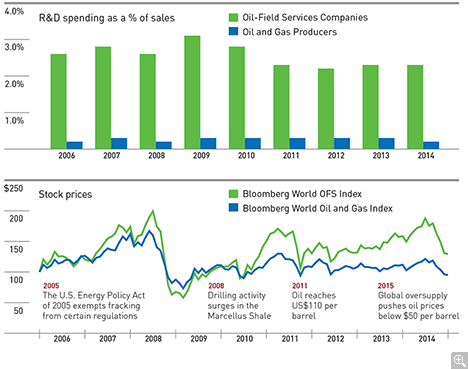
Generating the question, how can oil and gas companies succeed in an industry where supply is limited and expectations are high? One way is through investing in research and development (R&D) to drive innovation and create new and improved technologies. Certainly, one would expect that the economic rewards in an industry that is perceptibly more technology-driven would go to the firms that create most of the innovations – and, indeed, that seems to be happening.  Several international oil companies (IOCs) and national oil companies (NOCs) have increased their spending on R&D dramatically over the past years. In particular, oil-field service companies have greatly increased their investment in innovation which has correlated with higher stock prices, as seen below.
15201_ex1s
Source: Doshi, 2015.

Without a doubt, investing in R&D to create new and improved technologies is vital in enabling the industry to meet global energy demand. Moreover, with traditional forms of energy becoming harder to find, investing in new technologies will be critical in meeting the needs of an increasingly urbanised population and to combat environmental challenges in the decades ahead.

In addition, several companies may already be partaking in R&D activities and may not be aware of how the federal and state governments seek to support them by encouraging innovation through the Research and Development Tax Credit. Oil and gas companies are eligible for this incentive, which presently values at almost 10 billion dollars, for work activities that are often already being conducted. Many of these activities may not occur in traditional laboratories or are not usually thought of as ‘research’. Nonetheless, these undertakings entail time and money that may be defined as qualified research expenditures resulting in substantial tax benefits. Both large and small companies in the oil and gas industry are able to get the incentive – contact Swanson Reed’s R&D tax specialists today to see if you’re eligible.

 

References:
Perrons, Robert K. (2014) How innovation and R&D happen in the upstream oil & gas industry : insights from a global survey. Journal of Petroleum Science and Engineering124, pp. 301-312.
“Surviving the Worst: It’s Time for Oil Services to Address Shortcomings and Find Strategic Solutions,” by Viren Doshi, John Corrigan, Shawn Maxson, and Adrian del Maestro, Strategy& white paper, Feb. 2015, strategyand.pwc.com/OFS; Bloomberg; University of Michigan Center for Local, State, and Urban Policy.